
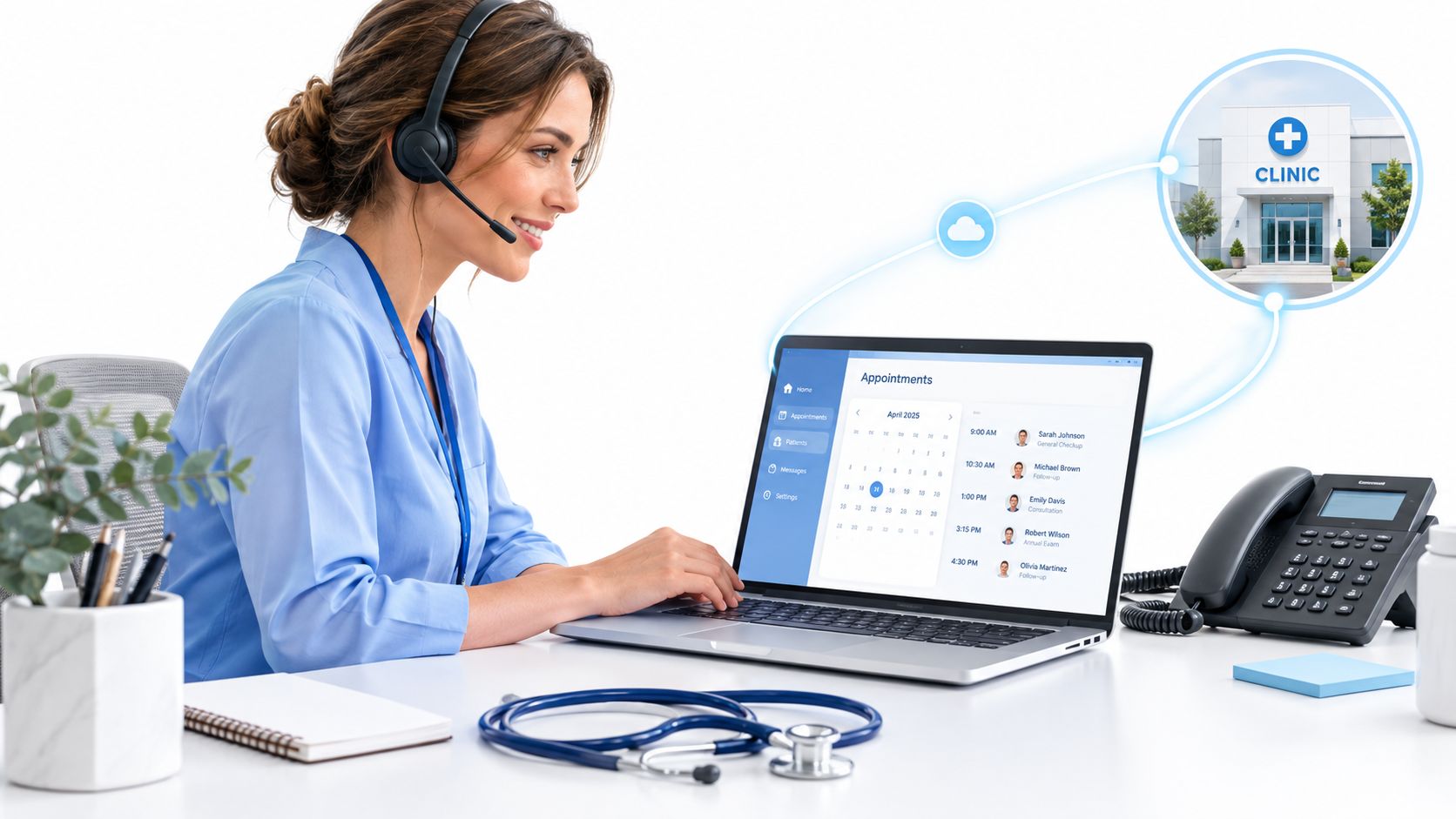
Yes, a remote medical receptionist can handle high-volume clinic calls when the practice uses formal call-center staffing logic rather than treating the role as ad-hoc administrative help. With about 88% of healthcare appointments scheduled by phone, staffing decisions must account for call timing, handle time, service targets, and escalation rules, not just the total number of calls.
The usual problem appears before the first provider finishes a visit. The phone rings while a patient waits at check-in, a nurse needs a message routed, an authorization is still pending, and the front-desk employee is expected to do all of it without letting the schedule fall apart. A remote receptionist can absorb that pressure, but only when the person has secure system access, clear boundaries, and enough coverage during the hours patients call.
This guide explains what the role includes, how it fits into phone and EMR workflows, when human staffing makes more sense than AI or a hybrid model, and how to vet LATAM-based support for a U.S. practice. It also addresses privacy, prior authorization coordination, bilingual communication, specialty differences, and the operational checks that separate a reliable remote team member from another inbox to manage.
Why U.S. Medical Practices Need Remote Front-Desk Coverage
A primary care office can lose control of its morning quickly. One patient calls to reschedule, another needs a new-patient appointment, a third wants to know whether a referral was received, and an established patient leaves a voicemail because nobody answers. Meanwhile, the in-office receptionist is checking in patients and collecting forms. The work isn't necessarily difficult, but it arrives concurrently, and interruptions create errors.
Healthcare has already moved much of this access work into centralized telephone operations. A 2022 NIH-indexed study of primary-care telephone access management found that most medical centers relied on centralized call centers for scheduling and nurse triage, while the organization and responsibility of those centers varied widely. The study is available through the Healthcare Contact Center Survey Report. A remote medical receptionist is therefore not an unusual add-on. The role is a smaller, distributed version of an established access-management model.

Phone demand still determines access
A 2024 healthcare scheduling analysis reported that about 88% of healthcare appointments were scheduled by phone, compared with 2.4% booked online. It also reported a 4.4-minute average hold time in U.S. healthcare call centers and a 16% abandonment rate, meaning nearly one in six callers disconnected before reaching a scheduler. The analysis is summarized in healthcare scheduling data from CCDCare.
The same source estimated that 30% to 40% of incoming outpatient clinic calls were appointment-related. That makes front-desk coverage an access issue, not merely a convenience. If the receptionist misses a call during a surge, the result may be a voicemail backlog, a delayed booking, an empty cancellation slot, or a patient who calls another practice.
Practical rule: Measure demand by hour and call type before you decide whether you need a person, an AI overflow layer, or both.
Remote coverage works best when the practice defines the problem precisely. A solo behavioral-health provider may need a bilingual person during clinic hours to answer calls and protect therapy time. A multi-site primary-care group may need queue coverage, centralized scheduling, recall outreach, and message routing. Those are different staffing designs, even if both use the title remote medical receptionist.
What a Remote Medical Receptionist Actually Does
A remote medical receptionist handles patient-facing administrative work from outside the clinic, using the practice's phone platform, scheduling software, EMR, and approved communication tools. The core role includes answering calls, booking and rescheduling appointments, confirming visits, managing cancellations, recording messages, and routing requests to the appropriate team member.
The scope can expand into virtual medical assistant work. That may include recall lists, new-patient intake, insurance verification, referral coordination, form follow-up, and prior-authorization paperwork. The person can gather records, submit documentation, track status, and escalate delays, but clinical judgment remains with licensed staff. A receptionist shouldn't diagnose, interpret symptoms, decide medical necessity, prescribe, or independently triage a clinical complaint.
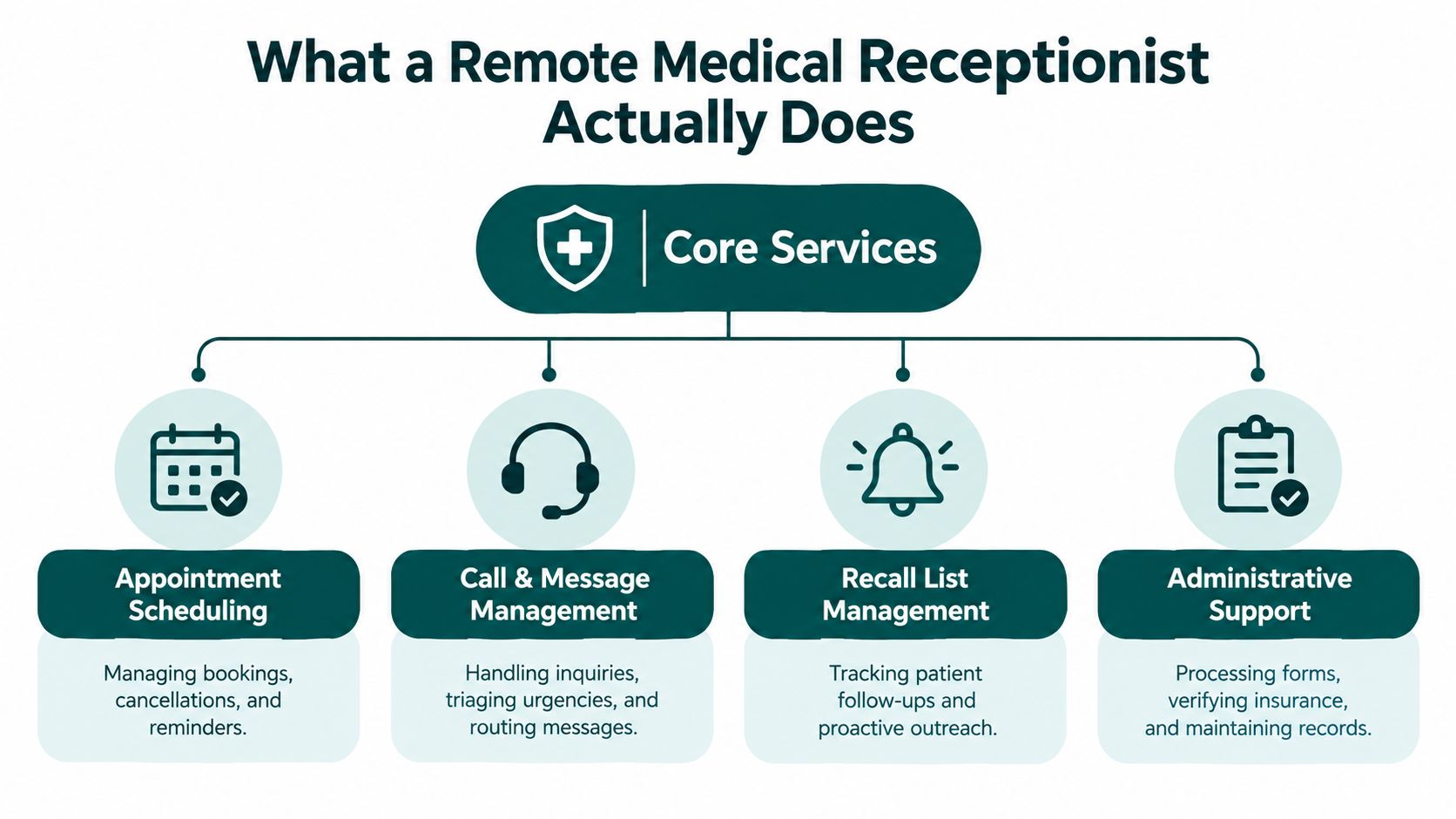
The daily responsibility map
| Function | Typical remote responsibility | Escalation boundary |
|---|---|---|
| Appointment scheduling | Book, cancel, reschedule, confirm, and fill openings from an approved waitlist | Clinical suitability and appointment urgency stay with the practice |
| Call and message management | Answer inquiries, document messages, and route them according to written rules | Symptoms, emergencies, and medical advice go to licensed personnel |
| Recall management | Contact patients about approved follow-ups, recalls, and unconfirmed visits | The clinical team defines who requires follow-up and when |
| Administrative support | Process forms, verify insurance, organize records, and support referrals | The receptionist doesn't interpret documents or make coverage guarantees |
| Authorization coordination | Gather documentation, submit requests, monitor payer status, and escalate | Medical necessity decisions and clinical peer discussions remain with providers |
The role also helps with the operational work that tends to disappear during busy sessions. A receptionist can maintain a cancellation list, contact patients who haven't confirmed, prepare registration forms, and route portal messages into a defined queue. A separate insurance verification specialist or prior-authorization specialist may be a better fit when those tasks consume substantial time.
For a clearer view of how reception, scheduling, intake, billing, and coordination roles differ, review the medical virtual assistant role categories. Practices hiring bilingual English and Spanish support can also compare expectations with bilingual customer service jobs on Virtustant Jobs, particularly for phone etiquette, written communication, and language proficiency.
Remote doesn't mean detached
An in-office receptionist can greet patients and manage physical check-in. A remote employee can't hand someone a clipboard or observe a waiting-room interaction, but can protect the in-office team from phone and inbox interruptions. That distinction matters for dental, optometry, veterinary, and multi-location practices, where physical presence may still be necessary for check-in while remote staff manage calls, recalls, insurance questions, and schedule changes.
The strongest arrangement assigns ownership rather than vague availability. The receptionist should know which appointment types they can book, which messages need same-day routing, which forms require staff review, and what to do when a provider's schedule changes. Without those rules, remote coverage moves confusion from the front desk into a digital queue.
Integrating Remote Staff with Your Phone and EMR Systems
A remote receptionist can answer calls reliably and still create operational problems if the phone queue, EMR permissions, or message rules are unclear. A capable worker needs dependable tools, defined ownership, and written procedures. Without them, missed transfers, duplicate notes, and incorrect appointments quickly become a staffing headache.
Document the workflow before granting access. Trace each call from identification through appointment selection, documentation, escalation, and closure. Create separate instructions for new patients, established patients, cancellations, refill requests, referrals, billing questions, and potentially urgent messages. For details on how insurance verification fits into intake workflows, see our insurance verification services.
Build the technical connection in stages
Define the system of record. Decide whether the EMR, practice-management platform, phone system, or task queue holds the authoritative status for each activity. Recording the same update in several places makes omissions more likely.
Create individual accounts. Give each staff member a named login with only the permissions required for the role. Shared passwords and broad administrative access make accountability and access reviews harder.
Configure the phone queue. Set call groups, business-hour routing, voicemail rules, transfer destinations, hold messages, and fallback coverage. Document when the receptionist should keep a caller on the line, take a message, or escalate immediately.
Test EMR actions in a controlled environment. Verify appointment booking, cancellation, rescheduling, message entry, document upload, and task assignment. Confirm that audit logs identify the user who completed each action.
Write the escalation script. Include identity verification, emergency language, provider messages, interpreter requests, and the limits of administrative support. The script should guide the receptionist without inviting clinical advice.
HIPAA does not require a particular software brand or staffing location. A practice that gives a remote worker access to protected health information does need appropriate contractual and operational safeguards. Depending on the arrangement, these may include a Business Associate Agreement, role-based access, confidentiality commitments, secure transmission, workforce training, and documented incident procedures. Confirm specific obligations with qualified compliance counsel.
A phone intake layer can support the workflow, but it cannot correct unclear routing rules. If you are evaluating a voice lead capture system, test how it records, routes, and secures information against your HIPAA program and patient communication policy. Review transfer behavior, message ownership, and failure handling before connecting it to live calls.
LATAM coverage requires deliberate scheduling
LATAM-based staff can align with U.S. clinic hours, which often matters more than broad promises of round-the-clock availability. Primary care offices may need support during a Monday morning surge, a lunch-hour backlog, or a late-afternoon scheduling push. Therapy practices may need coverage while providers are in sessions. An English-Spanish bilingual receptionist can reduce handoffs for clinics serving multilingual communities.
Set the schedule around actual call patterns and provider availability. Define who supervises the worker, how schedule changes are communicated, and where every message is documented. Use a dedicated account, approved devices, secure password management, and a private workspace. Integration is complete only when the clinic can review access, assign responsibility, and trace each patient communication to a clear next action.
Human Remote Staffing vs. AI and Hybrid Solutions
Human, AI, and hybrid models solve different operational problems. A human remote receptionist provides judgment, empathy, flexible conversation, and direct accountability. AI can absorb repetitive requests and provide after-hours coverage. A hybrid model combines automated intake or overflow with a person who handles exceptions, escalations, and patient interactions that need context.
The choice should begin with two weeks of call logs, including volume by hour, average handle time, abandonment, transfer reasons, appointment requests, and message categories. Guidance on medical call-center management and Erlang C staffing emphasizes that coverage depends on call volume, average handle time, and target service level. A commonly cited operational benchmark is 80% of calls answered within 30 seconds, while typical handle time is 3 to 5 minutes, but those figures should be treated as planning references rather than universal requirements.
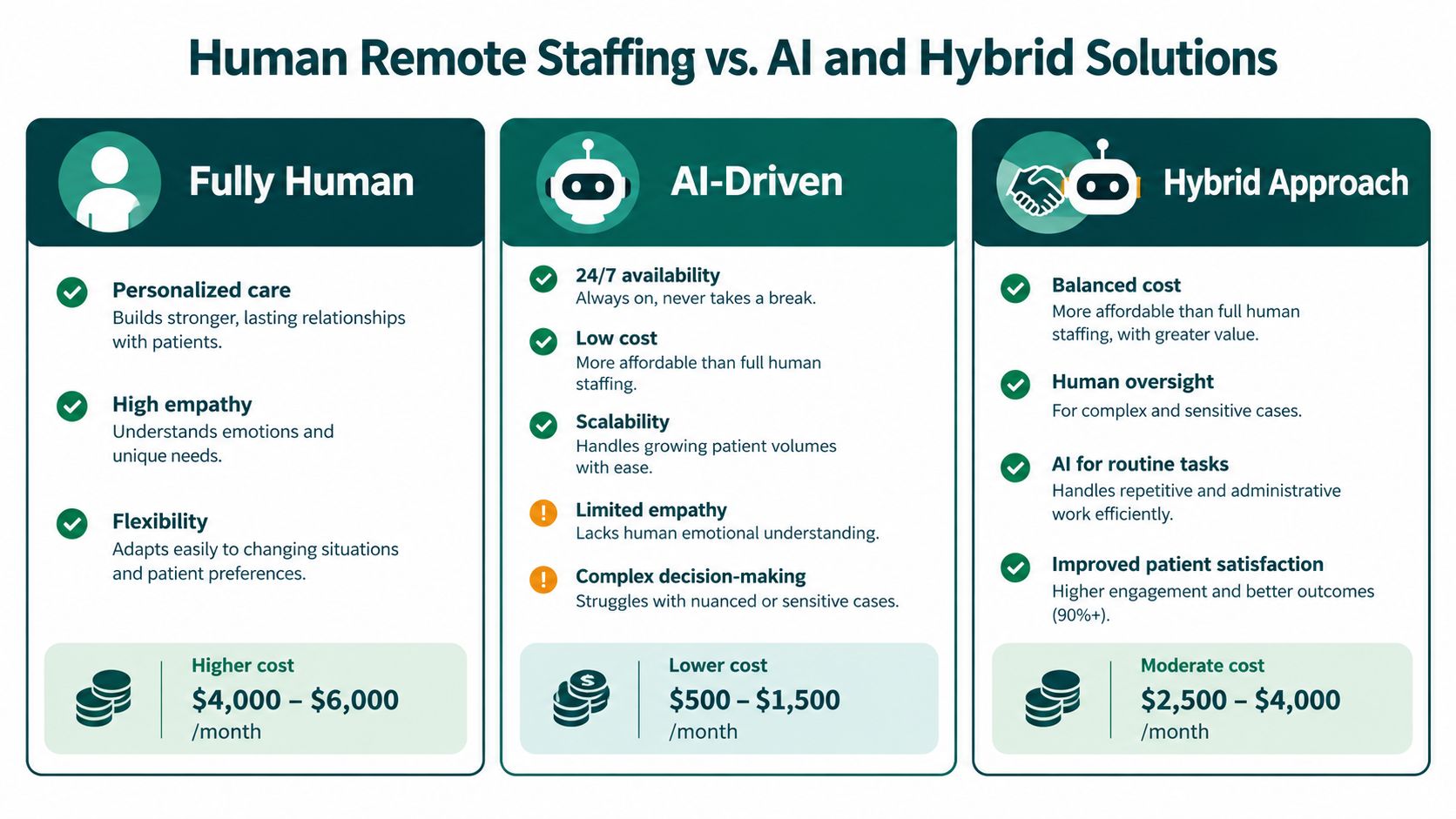
Match the model to the call pattern
| Model | Works well for | Weak point | Practical fit |
|---|---|---|---|
| Fully human | Live scheduling, bilingual conversations, complex patient questions, recalls, and message routing | Requires staffing coverage and supervision | Strong choice when patient interaction needs judgment |
| AI-driven | Simple requests, basic information, overflow, and after-hours intake | Can struggle with ambiguity, distress, exceptions, and nuanced scheduling | Useful when requests are predictable and escalation is reliable |
| Hybrid | Automated first contact with human handling of exceptions and priority calls | Requires careful handoff design and integration | Appropriate when demand fluctuates or after-hours intake matters |
Implementation speed is another trade-off. Guidance cited by the virtual medical receptionist overview from OHMD states that human remote services typically go live in 1 to 2 weeks, while AI or hybrid deployments may take 2 to 4 weeks, depending on EMR integration and scheduling complexity. A faster launch isn't automatically better, but a practice with immediate daytime coverage needs may reasonably start with a trained human and add automation later.
AI is most useful when the practice has a narrow, repeatable request set. It may collect a callback request, provide approved location information, or capture an appointment inquiry after hours. It becomes riskier when patients describe symptoms, ask whether a visit is medically necessary, or need a schedule exception. Practices exploring AI for after-hours support should define those boundaries before activation.
Use a simple decision test
Choose primarily human coverage when:
- The call requires context. Patients frequently explain complex scheduling constraints, referral questions, or sensitive concerns.
- The population needs language support. English-Spanish communication is central to access and trust.
- The schedule changes often. Human staff can handle cancellations, waitlists, provider changes, and exceptions more naturally.
- The practice needs daytime continuity. A remote receptionist working U.S. clinic hours may solve the underlying problem more directly than a 24/7 promise.
Consider AI or hybrid support when:
- Requests are repetitive. The practice receives many basic calls with predictable answers.
- After-hours capture matters. Patients need a way to leave structured information outside office hours.
- The queue spikes briefly. Automation can collect routine requests while human staff handle live callers.
- The handoff is explicit. Every automated path has a documented destination, response time, and owner.
Don't judge the model by availability alone. Judge it by completed bookings, accurate messages, timely escalation, and whether staff can tell what happened to each patient request.
How to Hire and Vet Remote Medical Talent
Hiring a remote medical receptionist should resemble hiring an in-office employee with additional controls for distance, system access, and communication. A polished phone voice isn't enough. The person must follow scheduling rules, document accurately, respect clinical boundaries, and stay calm when several demands arrive at once.
Start with a role scorecard. Separate reception from specialized work instead of combining every administrative function into one vague job description. A receptionist may manage calls and appointments, while an insurance verification specialist checks eligibility, a prior-authorization specialist tracks payer requests, and a billing assistant works denials and follow-up.
Evaluate the person in the work itself
Use a practical screening sequence:
Review relevant experience. Look for prior U.S. medical practice, billing, patient coordination, or call-center work that matches your specialty and systems.
Test the core skills. Give a simulated scheduling task, a message-routing exercise, an EMR navigation scenario, and a written documentation sample. Assess accuracy before speed.
Test language and phone judgment. A bilingual role requires more than conversational Spanish. Test the ability to explain administrative steps clearly in English and Spanish without improvising clinical advice.
Verify identity and background. Complete appropriate background checks and confirm work history according to your hiring arrangement and applicable requirements.
Train before access. HIPAA and privacy training should precede live PHI access. Add your own rules for identity verification, minimum necessary access, screen privacy, device use, and incident reporting.
Run a supervised launch. Start with a defined call queue or appointment type. Review recordings where legally and operationally appropriate, message accuracy, scheduling errors, and escalation decisions.
Medical Virtual Assistants is one staffing option for U.S. practices seeking pre-vetted LATAM healthcare talent. Its placement model includes role scoping, a human-curated shortlist, candidate interviews, in-country employment and payroll support, confidentiality measures, HIPAA training, and Business Associate Agreement execution. The company places roles such as remote receptionists, patient intake coordinators, insurance verification specialists, billing assistants, records specialists, and prior-authorization support. Practices should still perform their own operational and compliance review before granting access.
Set performance expectations after hiring
A remote employee needs a manager, not just credentials. Assign one internal owner for schedule-rule updates, escalation questions, quality review, and access changes. Define what gets reviewed daily during the first stage, what gets audited weekly afterward, and which errors require immediate retraining.
Track operational measures that reflect the role's actual purpose:
- Answer and abandonment patterns: Identify the hours when callers wait or disconnect.
- Booking accuracy: Check appointment type, duration, provider, location, and patient instructions.
- Message completeness: Confirm that the reason for contact, callback details, and routing destination are clear.
- Escalation discipline: Review whether clinical or urgent matters reached licensed staff promptly.
- Recall execution: Check whether approved follow-up lists are worked consistently rather than sporadically.
- Authorization tracking: Confirm that submissions, payer responses, deadlines, and escalations are documented.
Prior authorization deserves its own workflow. The American Medical Association's physician survey found that 93% of physicians said prior-authorization delays care, and 29% said those delays led to a serious adverse event for a patient in their care. Another AMA report states that prior authorization consumes around 13 hours of physician and staff time per week, while 40% of practices have staff whose sole job is handling those requirements. Those figures support assigning administrative tracking to trained staff, but they don't authorize a remote coordinator to make clinical decisions.
For impacted Medicare Advantage, Medicaid CHIP, and Marketplace plans, CMS says that from January 1, 2026, expedited prior-authorization decisions must be sent within 72 hours, and standard decisions within 7 calendar days. Practices can use those limits as tracking and escalation targets, while recognizing that payer, plan, request type, and applicable rules still matter. An AMA survey summary also reported that 64% of physicians waited at least one business day, and 30% waited three business days or longer, for prior-authorization decisions, as reported by Healthcare Dive.
Use the talent FAQ for medical virtual assistant hiring to clarify questions about placement, systems, supervision, and role scope before signing an agreement. The right hire should reduce queue pressure without creating a second layer of uncertainty.
The Takeaway
A remote medical receptionist can handle meaningful call volume, but the practice must staff the role around hourly demand, handle time, service targets, and escalation needs. The work extends beyond answering phones to scheduling, recalls, message routing, intake, insurance verification, and administrative coordination. Clinical judgment stays with licensed staff.
For a U.S. practice using LATAM-based support, align coverage with U.S. clinic hours, use individual secure accounts, document permissions, confirm the Business Associate Agreement structure, and test the phone and EMR workflow before launch. Start with a narrow role, measure the queue and booking quality, then expand only when the process is stable. A human, AI, or hybrid model can work, but the decision should follow the call pattern rather than a generic promise of 24/7 availability.
Medical Virtual Assistants connects U.S. medical practices with pre-vetted LATAM professionals for reception, scheduling, patient intake, insurance verification, billing, records, and prior-authorization support. Review the available staffing options at Medical Virtual Assistants and request a role match based on your specialty, systems, language needs, and clinic hours.