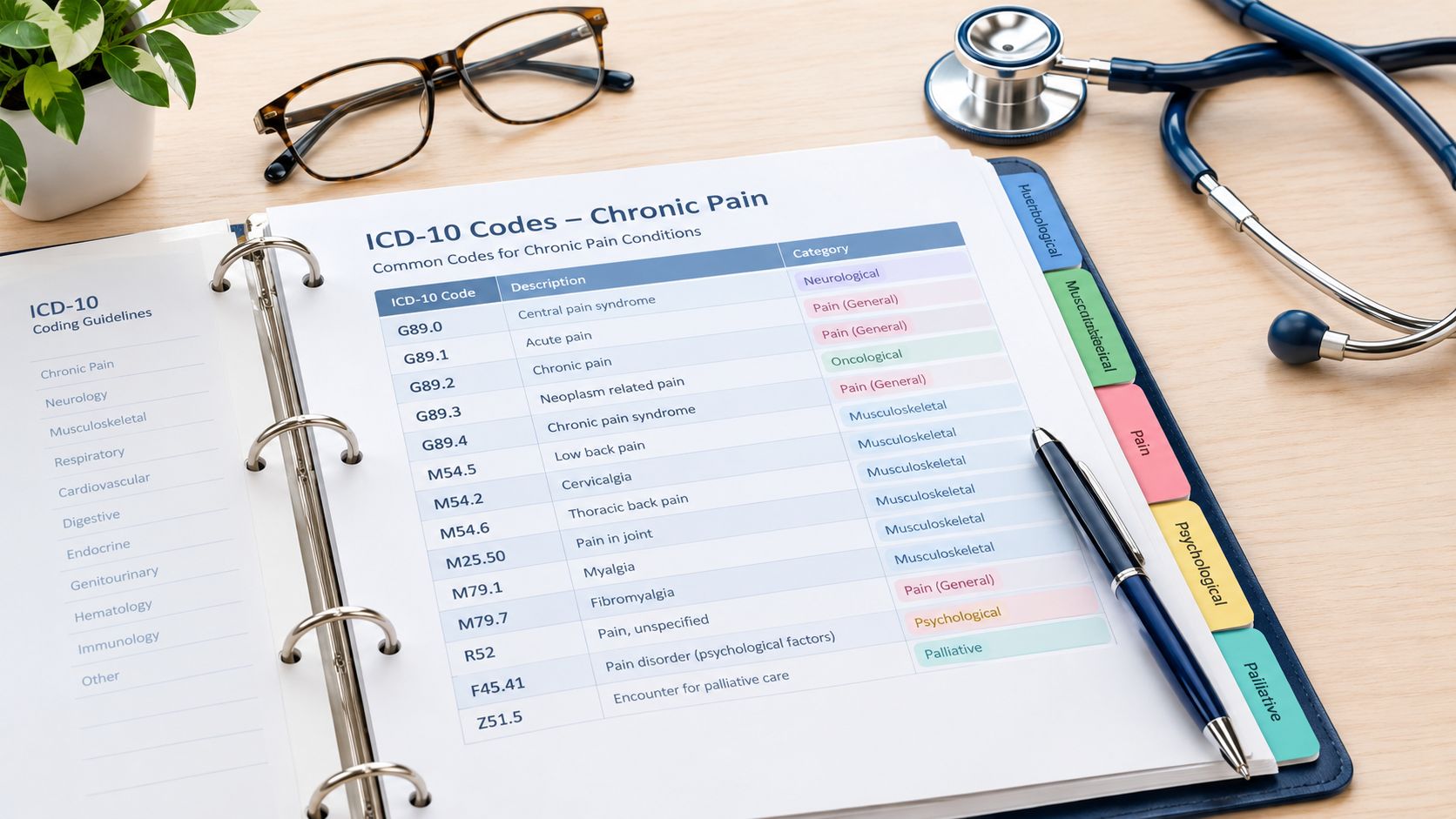
Chronic pain ICD 10 coding centers on G89.2, and CMS guidance does not set a fixed time threshold for when pain becomes chronic. The right code depends on what the provider documents about etiology, pain type, and whether the encounter is for the pain itself or for the underlying condition.
That's the part that trips up a lot of practices. The note says “chronic pain,” the diagnosis list looks close enough, and then the claim comes back because the code choice didn't match the documentation trail. When that happens, you're not just fixing reimbursement, you're cleaning up a record that has to stand up to audit, continuity of care, and payer review.
For practice managers, coders, and billing teams, chronic pain coding works best as a quick-lookup decision process, not a guess. The G89 family gives you the pain characterization, while the underlying diagnosis preserves the cause when it's known. In the sections below, you'll get a practical reference for the chronic pain codes in the G89 family, how they relate to site-specific pain codes, and what documentation makes each choice defensible in day-to-day billing.
Introduction to Chronic Pain ICD 10 Coding for Medical Practices
A common front-office and billing problem starts with a chart that says “follow-up for chronic pain,” but not much else. The provider knows the pain is ongoing, the patient has a history behind it, and the visit clearly is not about a one-day flare. What matters next is whether the note supports G89.2, a more specific chronic pain code, or the code for the underlying condition.
CMS guidance is clear on the core rule. There is no fixed time frame that automatically defines chronic pain, and provider documentation controls the code choice. That is why the CMS ICD-10-CM Official Guidelines matter here, while the annual update process is reflected in the FY 2025 ICD-10-CM guidelines. Chronicity is not guessed from the calendar. It has to be supported by the note, the diagnosis, and the treatment context.
Practical rule: if the chart does not explain the pain well enough for someone else to understand the cause and intent of treatment, the claim is usually fragile.
For practice managers and coding leads, this section works as a quick-reference starting point. Review the documentation first, then decide whether the pain should be captured with the G89 family or with the site-specific diagnosis that explains the complaint. In busy offices, a documented medical billing services workflow can catch missing pain linkage before submission, which helps keep claims audit-ready and reduces avoidable denials.
How the ICD 10 System Organizes Pain Codes
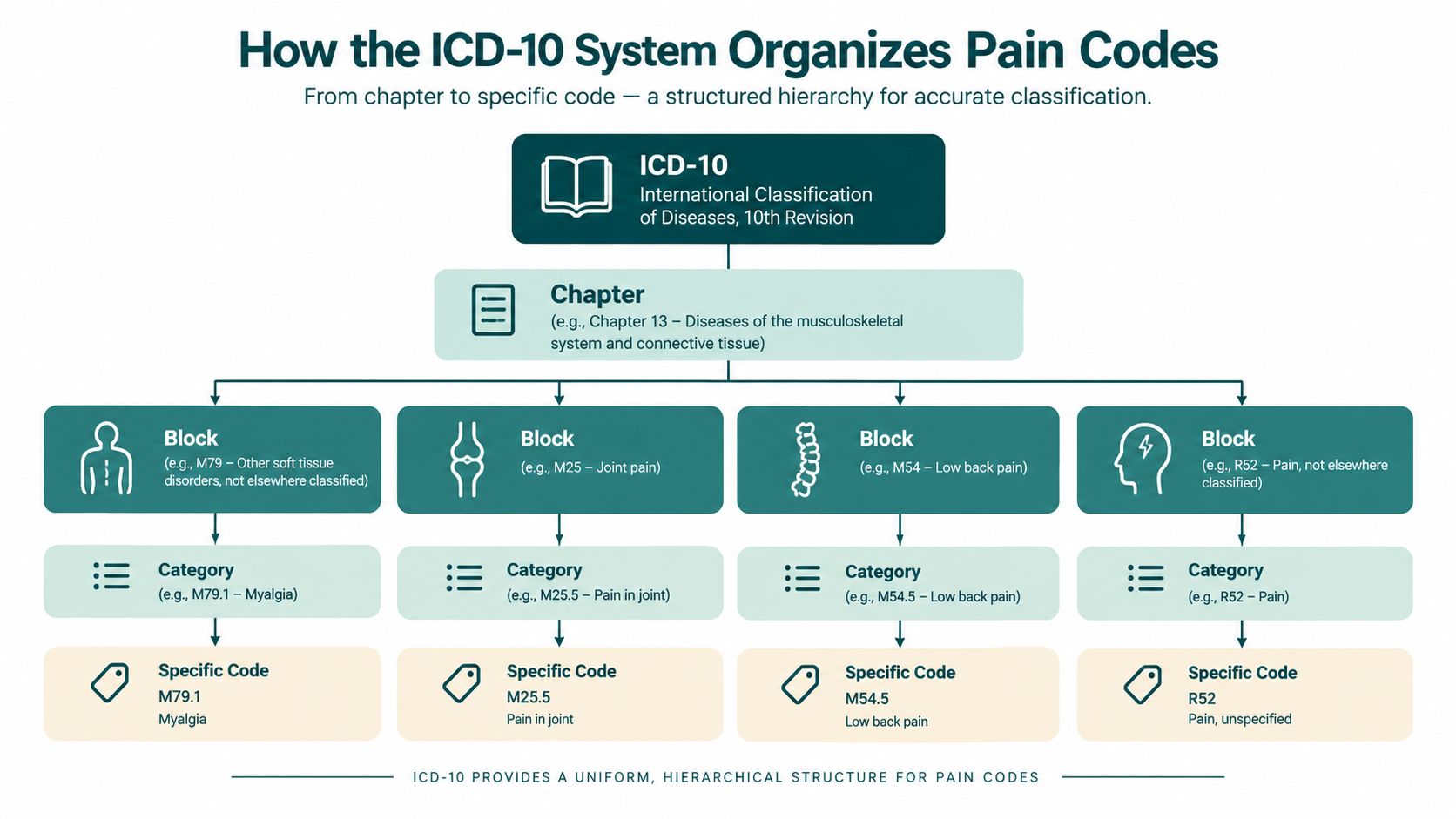
A clean pain claim starts with the chart, not the code book. ICD-10-CM organizes pain by function, so one code may identify the pain pattern, another may identify the site, and a third may identify the condition driving the visit. For chronic pain workups, that structure matters because the pain code often belongs beside the diagnosis code, not in place of it. A diagram illustrating the hierarchical structure of the ICD-10 system for classifying pain codes.
G89 is the pain family in Chapter 6. It is used when the record needs to show that pain itself is part of the clinical picture, especially when the provider documents a chronic, postprocedural, or syndrome-based pain state. Site-specific codes in other chapters still matter, because they tell you where the pain is, such as the back, a joint, or a broader musculoskeletal region. They do not always tell you whether the pain is chronic or how it relates to treatment.
General pain codes and characterization codes
For coding teams, G89 acts as a characterization layer. A note may document lumbar stenosis, neuropathy, or a post-surgical pain state, and G89 clarifies that pain is part of the encounter description. The disease code explains the underlying condition. The pain code explains the symptom pattern that the provider is treating.
That distinction matters in audits and claim review. If the chart gives enough detail to tie the pain to an etiology, the code set should reflect that relationship. If the chart is vague, code only what the documentation supports and avoid forcing a chronic label that the note does not justify.
Chronic, acute, postprocedural, and syndrome-based pain
These categories are separate for a reason. Chronic pain, acute pain, postprocedural pain, and chronic pain syndrome do different jobs in the record, and payer review depends on the difference. A provider who documents postprocedural pain, trauma-related pain, neoplasm-related pain, or chronic pain syndrome has already given the coder the direction needed for the code choice.
The practical test is simple. Acute pain describes a current pain state that is not documented as longstanding. Postprocedural codes connect pain to a procedure. Chronic pain codes fit persistent pain when the provider states it that way. Chronic pain syndrome is broader than a symptom label, so it should be coded only when the record supports that syndrome-level diagnosis.
The coder's job is to translate the provider's documented meaning into the correct code set, then make sure the rest of the record supports it.
Complete Reference to Chronic Pain ICD 10 Codes in the G89 Family
Keep the G89 entries in view while reading the note. Once the provider states the pain type or the cause, the code choice usually becomes much clearer. If the chart supports a specific etiology, code to that level instead of stopping at a broad chronic pain label. The CMS FY 2026 ICD-10-CM coding guidelines support that approach when the documentation names the source, such as trauma, post-thoracotomy pain, other postprocedural pain, neoplasm-related pain, or chronic pain syndrome.
The code family and what each one signals
G89.21 is for chronic pain due to trauma. Use it when the provider ties persistent pain to an injury history, such as a prior fracture, accident, or other traumatic event. A clean note may say “chronic pain secondary to old motor vehicle accident,” which gives the coder enough direction to avoid a generic pain code.
G89.22 is for chronic post-thoracotomy pain. The code is narrow by design. If a thoracic surgery note documents ongoing pain after thoracotomy, the code should reflect that exact context rather than slipping into a broader chronic pain entry.
G89.28 covers other chronic postprocedural pain. Use it when the chart clearly connects pain to a procedure but does not fit the more specific thoracotomy category. A post-op note that documents persistent pain after surgery, with the procedure named, is the kind of record this code was built for.
G89.29 is other chronic pain. It works as the fallback when pain is clearly chronic but the cause is not documented with enough specificity for a more targeted code. It should not become the default just because it is convenient. If the etiology is in the note, code the etiology-supported option instead.
G89.3 is neoplasm-related pain. Oncology documentation should support this code when pain is related to malignancy or the treatment context. The key question is whether the provider has linked the pain to the neoplasm. If they have, the code should mirror that linkage.
G89.4 is chronic pain syndrome. This is more than “pain that has lasted a long time.” The term implies a syndrome-based condition, often with broader functional or psychosocial features, so the chart needs to support that level of specificity. Routine chronic pain should not be pushed into chronic pain syndrome without clear provider documentation.
Quick reference table
| ICD-10 Code | Descriptor | When to Use | Example Documentation |
|---|---|---|---|
| G89.21 | Chronic pain due to trauma | Pain clearly linked to prior trauma | “Chronic left shoulder pain after prior fall.” |
| G89.22 | Chronic post-thoracotomy pain | Persistent pain after thoracotomy | “Ongoing pain following thoracotomy.” |
| G89.28 | Other chronic postprocedural pain | Chronic pain after a documented procedure | “Persistent pain after lumbar surgery.” |
| G89.29 | Other chronic pain | Chronic pain without a more specific documented cause | “Chronic pain, cause not otherwise specified.” |
| G89.3 | Neoplasm-related pain | Pain tied to cancer or malignancy context | “Pain related to metastatic disease.” |
| G89.4 | Chronic pain syndrome | Provider documents a syndrome-level pain condition | “Chronic pain syndrome with functional limitation.” |
What to avoid in routine chart review
Do not use G89.29 just because it feels safe. If the provider wrote trauma, surgery, cancer, or another defined source, the chart should point you to a more precise code. Do not assign chronic pain syndrome unless the documentation really supports a syndrome-level diagnosis. And do not leave the record vague if a better diagnosis is already sitting in the encounter note.
Chronic Pain Versus Site Specific and Acute Pain Coding
The fastest way to miscode a pain encounter is to treat every pain complaint the same way. A patient can have back pain, joint pain, or generalized pain and still need different coding depending on whether the pain is acute, chronic, postprocedural, or linked to another diagnosis. The code choice changes because the documentation changes, not because the symptom name sounds similar.
When a site-specific code is enough
If the provider documents a pain location and does not describe the pain as chronic or tied to a broader pain syndrome, a site-specific code may be enough. That's often the case in straightforward musculoskeletal visits where the diagnosis is the joint, region, or spine condition itself. In those charts, adding a chronic pain code without support can muddy the claim instead of helping it.
A coder should ask a simple question. Is the encounter about the pain symptom, or about the disease causing the pain? If the answer is the disease, the disease code usually deserves primary attention. If the answer is the pain state itself, the G89 family may carry more weight.
When chronic pain coding belongs in the chart
Chronic pain coding belongs when the provider documents persistent pain as a clinical issue that needs active management. That could appear in primary care, orthopedics, pain management, oncology, or post-op follow-up. The point is not specialty. The point is whether the note supports the chronic pain designation and connects it to a documented context.
A chart that says “chronic low back pain due to degenerative disc disease” is different from a chart that says “back pain.” The first gives the coder a pathway. The second may only support a symptom or site code, depending on the rest of the record.
How acute and chronic entries differ in real workflow
Acute pain codes and chronic pain codes do not belong in the same bucket. CMS keeps those distinctions because the clinical meaning is different and sequencing can change claim handling. If the provider is treating an acute flare, the acute code family may fit better. If the patient is being followed for longstanding pain, the chronic code family is usually more accurate.
The mistake I see most often is not technical. It's a documentation mismatch, where the note reads one way and the code choice tells a different story.
A simple comparison you can use at review time
- If the note names a body part only, confirm whether the body-part code alone is enough.
- If the note names a chronic condition, look for the underlying diagnosis first.
- If the note names a chronic pain state, check whether the G89 chronic code fits better than a symptom code.
- If the note names cancer or a procedure, look for the pain code that matches that cause.
- If the note is vague, ask for clarification before the claim goes out.
Sequencing Rules and Common Co Codes for Chronic Pain
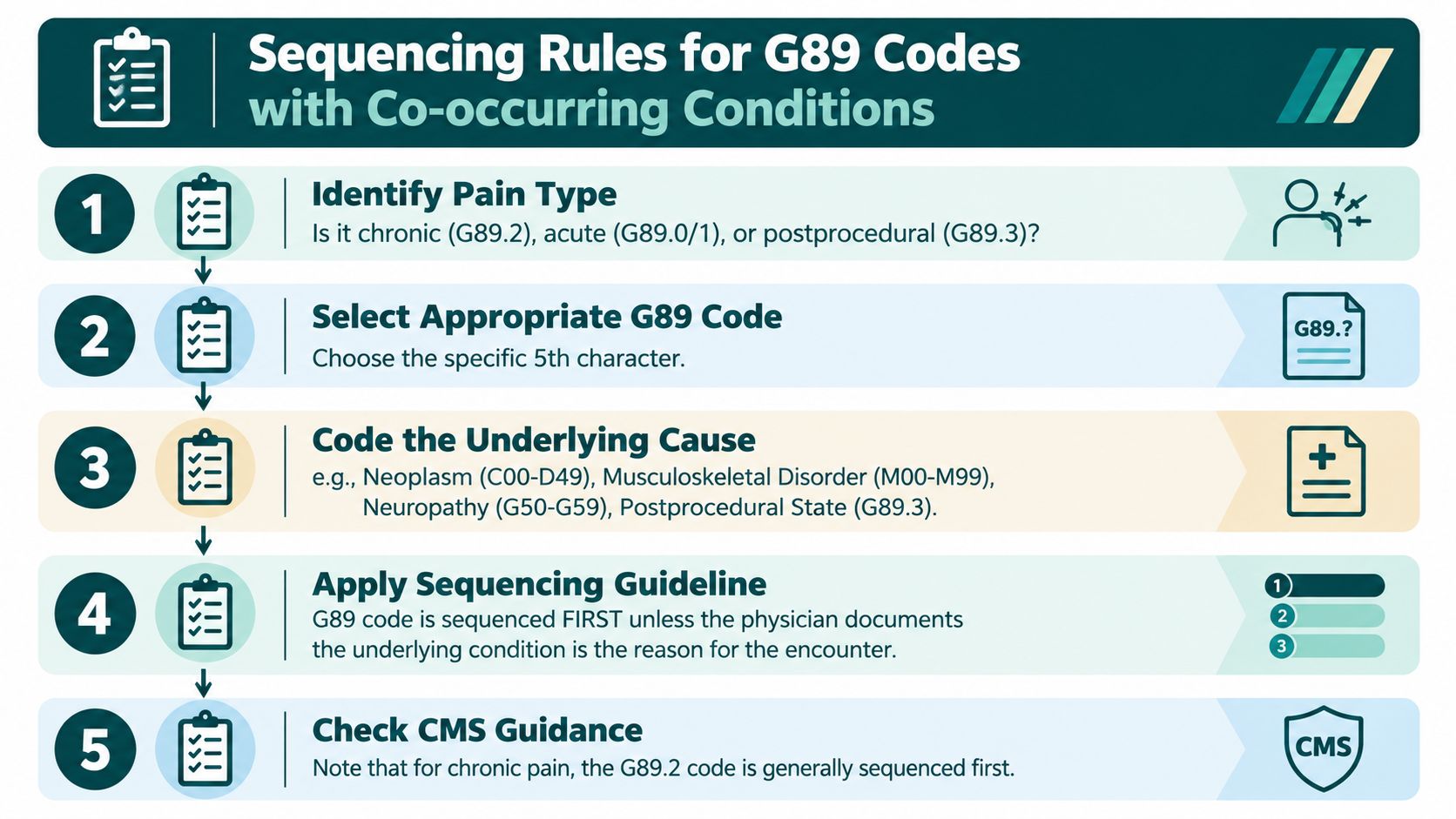
A chronic pain claim usually turns on sequencing, because the code order needs to match the reason for the encounter. When the cause is known, the pain code and the underlying diagnosis belong together. The pain code shows the pain state, and the primary disease code preserves the condition driving it. That is the order auditors expect to see.
How the underlying condition changes the claim
A provider can document chronic pain and still treat the underlying disease as the main reason for the visit. In that setting, the disease diagnosis may lead. If the visit is focused on pain management, the chronic pain code may be listed first when the note supports that choice. The deciding factor is the encounter focus, not routine.
The causal condition often comes from different specialties. Oncology notes may link pain to neoplasm. Orthopedic and primary care notes often connect pain to musculoskeletal disease. Neuropathy-related pain may point to nerve disorders. Postprocedural pain needs the procedure state clearly documented so the code choice is defensible.
Co-code patterns that help keep claims clean
- Neoplasm-related pain: pair G89.3 with the cancer diagnosis when the provider links the pain to malignancy.
- Trauma-related pain: pair G89.21 with the injury history or residual condition when documented.
- Postprocedural pain: pair G89.28 with the procedure or postprocedural state when the note supports it.
- Chronic pain syndrome: pair G89.4 only when the syndrome-level documentation is in the chart.
- Other chronic pain: use G89.29 when the pain is chronic but the etiology is still undocumented or nonspecific.
Billing teams should look for one clear causal chain. If the note supports it, the code set should reflect it. If it does not, the claim is harder to defend when a payer reviews medical necessity.
EMR prompts that prevent missing linkage
Templates can help without forcing providers to write more than needed. A strong chronic pain template asks for the cause, the pain location, how long the provider says it has been present, and whether pain is the reason for today's visit. It can also prompt the provider to state whether the pain is postprocedural, trauma-related, or cancer-related when that is clinically true.
For busy practices, structured scribing and billing review reduce back-and-forth after the encounter. A workflow that keeps the pain description, cause, and treatment plan in the same record makes coding easier to defend later. That is also where a HIPAA-compliant virtual assistant workflow guide can help practices that want remote support tied to documentation and billing.
Documentation Pointers That Support Accurate Chronic Pain Coding
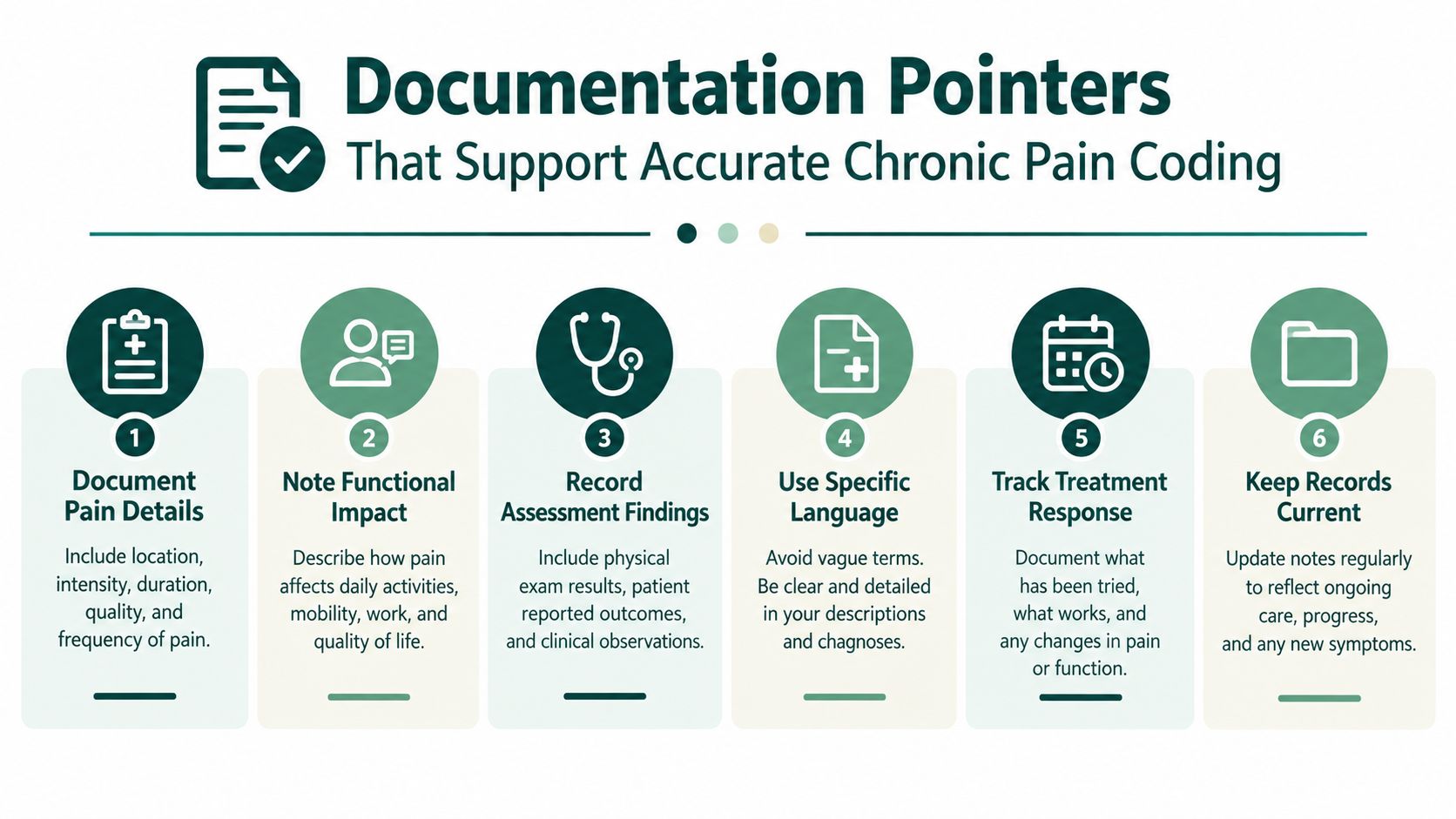
Auditors don't want creativity, they want a chart that says what the provider meant. For chronic pain, the note has to support the diagnosis, the reason for the visit, and the relationship between pain and the underlying condition when one is known. If the provider never documents that relationship, the coder shouldn't manufacture it.
What the note should contain
A defensible pain note usually includes the following:
- Etiology: the provider identifies the cause when known, such as trauma, procedure, neoplasm, or another underlying condition.
- Location: the note identifies where the pain is most prominent or how it presents clinically.
- Severity: the provider describes the level of pain in words or with a pain scale if that's part of the encounter.
- Duration: the chart reflects the provider's description of the pain as chronic, persistent, longstanding, or otherwise ongoing.
- Functional impact: the note describes how the pain affects movement, sleep, daily activity, or work.
- Treatment plan: the provider states what's being done, whether that's medication review, imaging, referral, therapy, or follow-up.
Those elements don't need to be wordy, but they do need to be present somewhere in the encounter. A short, clear note is usually stronger than a long note that never pins down the diagnosis. If the provider is treating multiple issues, the pain-related language should still be easy to find.
What coders can't infer
Coders can't decide that pain is chronic just because the patient has been seen before. They can't assume syndrome language just because the case is complex. They can't pull a cause out of thin air when the provider didn't document one. That boundary matters in audit work, because coding is translation, not interpretation beyond the record.
If the chart doesn't support the wording, the code doesn't support the claim.
How remote documentation support fits the workflow
Many practices use virtual medical scribes or administrative support to keep notes tighter on the same day the visit happens. That kind of support is useful when it helps capture the provider's words accurately, prompt missing pain details, and get the chart closed before memory fades. It can also help patient intake staff gather prior records so the current provider can verify whether the pain history is chronic and continuous.
The main benefit is not speed for its own sake. It's consistency. A clean note reduces coding questions, shortens billing follow-up, and gives the payer a better record if the claim is reviewed. For practices exploring remote help, the key is to keep the assistant role within documentation and administrative boundaries, not clinical decision-making.
Common Coding Errors Denials and How to Prevent Them
Most chronic pain denials don't come from obscure coding theory. They come from avoidable workflow mistakes. The claim either uses a vague code when the chart supported something more specific, or it sequences the diagnosis in a way that doesn't match the encounter focus. Sometimes the problem is older guidance still sitting in a template after the documentation standard has already moved on.
The errors that show up most often
- Using an unspecified pain code when the note gives a specific cause. If the provider documented trauma, postprocedural pain, or neoplasm-related pain, the chart should usually reflect that specificity.
- Missing the link between chronic pain and the underlying condition. The note may mention both, but the claim doesn't show how they relate.
- Sequencing the codes backwards. The primary diagnosis doesn't always belong to the pain code, especially when the visit is centered on the underlying disease.
- Using chronic pain syndrome without support. That label can attract scrutiny if the record only shows ordinary chronic pain.
- Relying on an outdated template. Pain language that once passed review may no longer match current documentation habits.
A pre-billing checkpoint helps here. Billing assistants and insurance verification staff can compare the assessment, the linked diagnoses, and the plan before claim submission. That review is especially useful when multiple pain sources appear in one note or when the visit blends disease management with symptom control.
A practical claim review workflow
- Check the provider's exact wording. Don't rely on the problem list alone.
- Verify the etiology. If one is documented, make sure the diagnosis reflects it.
- Confirm sequencing. Ask whether the encounter is for pain management or for the underlying condition.
- Look for syndrome language. Only use it when the record supports it.
- Match the claim to the note. If the narrative and the diagnosis list disagree, fix it before submission.
Daily denial work matters because chronic pain claims often reappear in the same patterns. If your team resolves the documentation issue early, you're less likely to let the account drift into avoidable follow-up. For practices that also need support with utilization review and payer submissions, a prior authorization and insurance follow-up workflow can help keep pain-related claims moving without losing the documentation thread.
The Takeaway
Chronic pain ICD 10 coding works best as a documentation-led decision, not a memory test. G89.2 is the chronic pain family to watch, but the right code still depends on what the provider documented, trauma, a procedure, cancer, a syndrome, or no clear cause. CMS guidance keeps those distinctions in play, and code-set updates continue to reinforce them.
For practice managers and billing leads, the next step is a cleaner note-to-claim workflow. Update templates so they prompt for cause, duration, location, severity, and treatment plan. Train providers to state the pain relationship clearly. Then have billing or remote support review the linkage before the claim goes out.
A pre-billing check also helps when chronic pain overlaps with disease management or symptom control in the same visit. That review catches mismatched diagnoses early, before the chart turns into a denial.
If your team wants help keeping notes, billing, and follow-up cleaner, Medical Virtual Assistants can support U.S. practices with pre-vetted remote staff who understand clinic workflows. Their services can include documentation support, billing assistance, and prior authorization help, which can keep chronic pain charting more audit-ready without adding in-house overhead.