

You've got a Medicaid request sitting in the void, the front desk is staring at a fax queue like it owes them money, and someone in the building is asking whether the MRI is approved yet. Meanwhile, the patient is still waiting, the doctor is still asking, and your staff is still toggling between portal tabs, phone calls, and sticky notes like it's 2009. That's medicaid prior authorization in real life, not as a neat policy concept, but as a daily little chaos machine.
The annoying part is that the problem usually isn't one thing. It's not just “the payer is slow.” It's rules that change by state, plan, and service category, plus clocks that pause, requests that come back for more documentation, and denials that don't always make much sense to the people living inside them. The fix isn't more heroics. It's a better operating system.
Introduction Why Medicaid Prior Authorization Feels So Unpredictable
A clinic can do everything “right” and still get stuck. The order is valid, the diagnosis makes sense, the patient is eligible, and the request is still pending because the payer wants one more note, one more attachment, or one more piece of proof that somebody already faxed twice. That's why medicaid prior authorization feels less like a checklist and more like a maze with different floor plans in every state.
Here's the part people miss. Medicaid prior authorization isn't one universal rulebook. It's a mix of state policy, managed care plan rules, and service-specific requirements that can shift under your feet depending on what you're asking for and who's paying for it. GAO found that Medicaid managed care plans' prior authorization policies aren't consistently standardized across services, and that state oversight can be limited, especially for children's EPSDT services, which is exactly the sort of thing that turns “simple auth” into a three-day scavenger hunt GAO report.
Practical rule: if you treat every Medicaid request like it follows the same playbook, the payer will happily teach you otherwise.
There's a better way to think about it. Treat the process like a state-and-plan-specific operating system with clocks, extensions, and payer behavior variance baked in. That mindset changes everything. You stop guessing. You start checking rules first, collecting the right proof before submission, and building a track-and-escalate rhythm that doesn't chew up your staff.
The other big shift is visibility. Medicaid prior authorization is getting dragged out of the fax era and into something closer to a machine-readable workflow. The 2024 CMS interoperability rule requires a standards-based HL7 FHIR Prior Authorization API for Medicaid managed care plans and state Medicaid agencies, and CMS says decisions must move within 72 hours for expedited requests and 7 calendar days for standard requests beginning in 2026 CMS final rule fact sheet. That doesn't make the work painless. It just makes it measurable, which is a huge upgrade if you've ever tried to chase a missing status update by phone.
How Medicaid Prior Authorization Works
An MRI order lands on the desk, and the clock starts. In Medicaid, that order might be reviewed by a state Medicaid agency, a managed care organization, or a fee-for-service program, depending on how that state has set up the service. Same request, different operator. That is why one clinic gets a quick yes and another gets stuck in paperwork limbo.
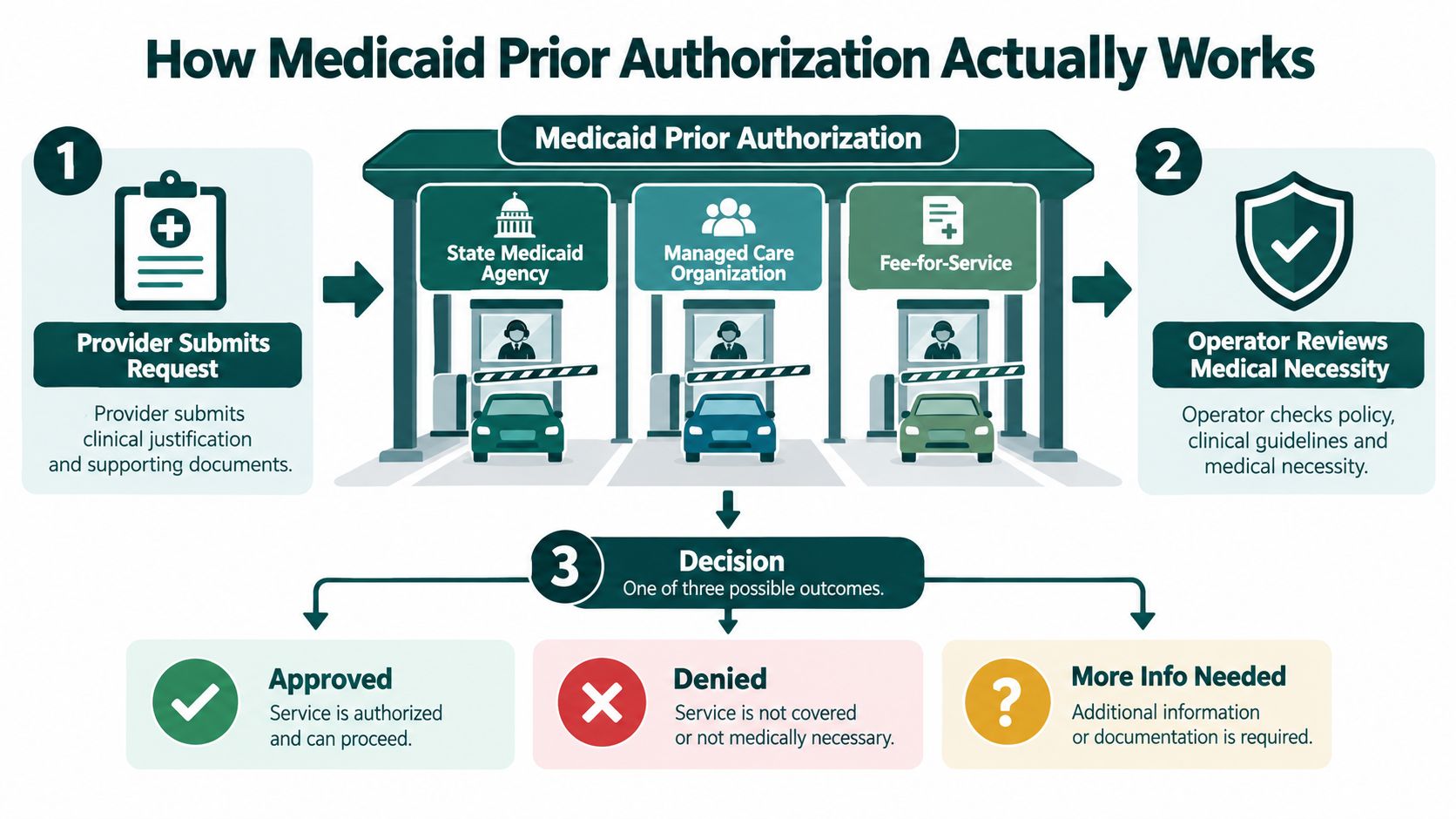
The workflow itself is plain enough. A provider submits the request, the payer checks medical necessity and whether the request fits policy, then the payer sends back approved, denied, or needs more information. The trap is usually not the clinical case. It is the packet. A strong reason with a missing attachment still sits untouched.
The Three Basic Request Types
Standard requests are the routine ones. They still need clean documentation, the right code or service description, and a submission that does not force the reviewer to hunt for basics. CMS says impacted payers must decide standard requests within 7 calendar days beginning January 1, 2026, and can extend that by up to 14 days when more information is needed CMS press release.
Expedited requests are for urgent situations. CMS sets a 72-hour benchmark for those decisions beginning in 2026 CMS final rule fact sheet. Fast on paper, slower in real life if the request goes in half-built.
Urgent does not mean exempt from cleanup. If the payer has to search for missing details, the request can still stall.
Approvals are not always clean wins. You may get a partial denial, which means part of the request passed and part did not. That is not a yes. It is a split decision that leaves the team deciding whether to appeal, resubmit, or revise the order.
The point is to manage the chain, not just the end result. Intake, submission, review, decision, appeal. If your team knows where the request sits, who owns the next move, and when the clock expires, you are already ahead of the usual Medicaid mess.
Why Requirements Change by State Plan and Service Category
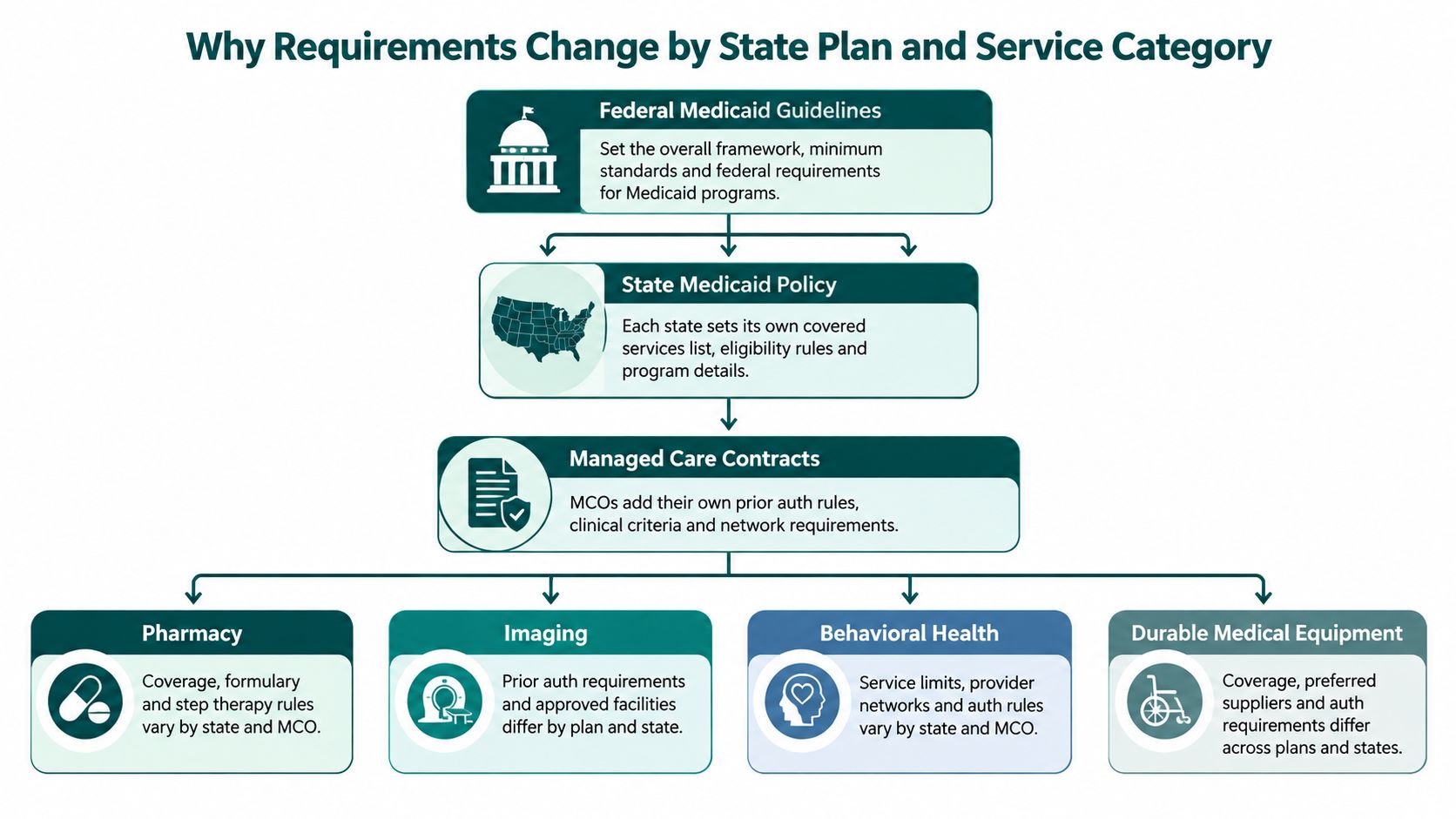
A Medicaid auth request can sail through one plan and stall in another because the rules change at several layers at once. Federal Medicaid rules set the outer frame, state policy decides what gets covered and how closely it is watched, managed care contracts add their own prior auth rules, and each service category brings its own quirks. One checklist will not survive that kind of setup.
The oversight gap is real. Reviewers found that some plans used prior authorization for services without clear state direction, and oversight was uneven, especially for children's EPSDT services. A generic template cannot solve that. You need payer-specific logic, and sometimes state-specific logic too, or the request sits in limbo while staff guess which rulebook is in charge.
Where Variation Bites Hardest
Imaging, procedures, behavioral health, pharmacy, and durable medical equipment tend to get the most scrutiny because they are easier to delay, question, or deny. The proof points are not identical across states or plans, so the same chart note may work in one place and fail in another. The practical move is to check the state Medicaid manual and the plan's prior auth policy before anyone submits. That is not glamorous work, but neither is reworking the same request three times.
Operator's note: if your staff cannot identify the governing rulebook in under a minute, your process is too loose.
Denial behavior changes too, and the patterns are not subtle. In a U.S. HHS Office of Inspector General review, Medicaid managed care plans submitted more than 17 million prior authorization requests and denied or partially denied over 2.2 million, for an overall denial rate of 12.5%, or about 1 in 8 requests. Among the 115 managed care organizations examined, 12 had denial rates above 25% OIG review summary. That is payer behavior with real operational consequences.
Build the process like a rules engine, not a guessing game. Match the payer, the service category, and the state before the request leaves your desk, and the waiting room gets a little less expensive.
What Usually Needs Authorization and What Payers Want to See
Some requests practically announce themselves. Imaging. Specialty drugs. Durable medical equipment. Procedures with expensive downstream risk. Behavioral health services in certain setups. None of those categories are mysterious, but each one tends to demand a different proof pattern, and that's where practices get tripped up.
Here's the trick. Don't collect documents because “they might want it.” Collect them because the service category almost always needs them. If you're asking for imaging, the payer usually wants to see why conservative care wasn't enough. If you're asking for a specialty drug, the payer often wants diagnosis specificity, prior therapy history, and supporting clinical detail. If you're asking for durable medical equipment, the request usually needs clear functional justification and the chart note to match.
Common Medicaid Services and Typical Documentation Triggers
| Service Category | Typical Documentation Triggers | Common Pitfall to Avoid |
|---|---|---|
| Imaging | Recent exam findings, conservative treatment history, symptom progression, clinical rationale | Sending the order without enough history to justify why the scan is needed now |
| Procedures | Diagnosis specificity, failed conservative management, specialist notes | Vague coding that doesn't line up with the clinical story |
| Durable Medical Equipment | Functional limitation, diagnosis support, chart notes showing medical necessity | Treating the DME request like a generic supply order |
| Specialty Drugs | Prior therapy history, labs, diagnosis detail, protocol match | Missing one document and forcing the payer to ask for a second round |
| Behavioral Health | Diagnosis, treatment plan, level-of-care rationale, progress notes | Submitting a thin packet that doesn't show why this setting or service is needed |
The cleanest submissions start before the form is filled out. If intake staff can spot the service category early, they can gather the right packet before the clock starts ticking. That's the difference between a request that glides and a request that boomerangs.
One practical move helps a lot here. Create a one-page cheat sheet by service type for your team, then keep it tied to the payer rules your clinic sees. If you want a broader admin workflow for this kind of front-end tasking, the process used for insurance prior authorization handling is a useful model for organizing the work without turning your staff into full-time packet archaeologists.
Documentation That Gets to Yes on the First Submission
Clean documentation isn't about volume. It's about matching the payer's logic so the reviewer can say yes without playing twenty questions. If your submission packet feels scattered, the payer will make you pay for the mess in time.
The goal is to make the request look inevitable. Eligibility checked, benefits confirmed, codes linked correctly, clinical history attached, and the medical necessity story written in plain English. That's the boring version of excellence, and boring wins a lot in prior auth.
Build the Packet Like a Reviewer Will Read It Fast
Start with eligibility and benefits verification. If the patient's coverage, product, or service category isn't confirmed before submission, you're gambling with staff time. Then make sure the CPT/HCPCS and ICD linkage matches the service and diagnosis. A beautiful note won't save a mismatched code pair.
Next, attach the evidence that tells the story. That usually means prior conservative care, relevant notes, labs, imaging, and any specialist documentation that supports the request. Keep the clinical rationale short, specific, and aligned to the payer's own criteria language where possible. You're not writing a novel. You're writing a clean yes.
Make the Workflow Hard to Mess Up
Practical rule: if your team has to remember five places to look for one auth packet, you've already built too much friction.
A strong submission workflow usually includes:
- Eligibility First: Confirm active Medicaid coverage and benefits before you touch the form.
- Code Matching: Make sure procedure codes and diagnosis codes tell the same story.
- Chart Support: Pull the exact notes, labs, or images that prove necessity.
- Document Naming: Use file names that a human reviewer can follow without squinting.
- Signature Check: Confirm the right clinician signed the right form before sending anything out.
EMR templates help, but only if they reduce hunting. If they create more fields than your staff can keep straight, they're just fancy clutter. I'd rather have a simple, repeatable packet than a “smart” template that makes everybody click through six screens and three sighs.
A useful side effect of cleaner documentation is fewer extension requests. That matters because a request that gets paused for missing records is still a request that's not helping the patient. Keep the packet tight, and resubmission becomes the exception instead of the business model.
Tracking Escalation and Beating the Clock Without Burning Out Staff
The biggest issue usually arises after submission. A packet goes out, then it sits in limbo because nobody owns the next move. That is how Medicaid prior authorization turns into a pile of open tabs and tired people.
The clock is only half the story. Medicaid managed care plans have long used different review windows, and the newer federal framework, noted earlier, tightens the standard timeline while still leaving room for an extension when more documentation is needed KFF summary. So a request can look manageable on paper and still drag in real life. That is why you need an operating rhythm, not optimism.
Run a Visible Status Queue
Every request needs a plain status that the whole team can read without decoding it. Submitted. Pending review. Additional info requested. Resubmitted. Approved. Denied. Appealed. Anything fancier just hides the problem.
Ownership matters too. One person should own the next action, even if another person gathers the records. If the plan is “someone will call back,” you do not have a plan. You have a shrug.
Track the request the way a good dispatcher tracks a busy route, one clear handoff at a time. Put the next move in the queue before the current step goes stale. That keeps the work from living in one staffer's inbox, which is where good intentions go to die.
The newer CMS interoperability rule makes this even more operational, because prior auth data has to be exposed in ways that are easier to audit and move between systems, as noted earlier in the rule discussion. That matters because status chasing should not depend on who is most patient on hold.
If the request lives only in one person's inbox, it does not really exist.
For clinics that want fewer phone loops, build three things into the workflow from the start, a follow-up cadence, escalation triggers, and appeal-ready documentation. A team that already knows what will be appealed before the denial lands does not scramble nearly as much. For staffing design around this kind of front-office coverage, the logic is similar to a virtual medical receptionist role, except here the payoff is fewer dead requests and less administrative scavenger hunting.
The best teams do not chase every auth in a panic. They track the clock, assign the next move, and escalate before the request ages out.
Putting It All Together and Choosing How to Staff It
The clinics that handle Medicaid prior authorization well usually do three things consistently. They know the payer rules before they submit. They send clean packets the first time. They run a disciplined track-and-escalate rhythm instead of trusting optimism and voicemail. That combination beats frantic multitasking every time.
Visibility is about to get a lot better, whether people are ready or not. CMS requires Medicaid managed care plans to publicly report prior authorization metrics, including approvals, denials, appeals, and turnaround times, with reporting beginning in 2026 and submissions due by March 31 MACPAC summary. CMS's metrics framework also requires reporting the percentage approved and the percentage denied in the calendar year, which turns auth from a hidden headache into a measurable performance problem CMS metrics overview.
Decide Whether to Train, Specialize, or Outsource
Small practices can absolutely upskill front-desk or billing staff to handle basic auth work, especially when volume is modest and the service mix is predictable. The catch is consistency. If the same person is also answering phones, verifying insurance, and calming down patients, prior auth becomes the task that gets pushed into the cracks.
Larger clinics or busier specialty groups usually need a dedicated specialist. That's not luxury. That's triage. Once requests start varying by state, plan, and service category, the work needs somebody who lives in the details and doesn't have to relearn the game every Monday.
If you're comparing staffing models, the math is usually less about headcount and more about owning the workflow end to end. A dedicated operator inside the EMR and phone system can keep requests moving, especially when the rules keep changing and the payer behavior isn't even across the board. If you're evaluating that option, this overview of what a medical virtual assistant does is a sensible place to start thinking through the work.
The goal isn't to become a prior auth fan club. It's to stop care from stalling because no one owns the boring middle. Build the rules, tighten the packet, track the clock, and make the process visible. That's how you turn Medicaid prior authorization from a daily nuisance into a managed operation.
If you want a team that can keep prior authorizations moving without turning your staff into full-time fax wranglers, Medical Virtual Assistants can help. They place experienced remote support inside your clinic workflow so requests get submitted, tracked, and escalated before they rot in the queue. Visit Medical Virtual Assistants and see how a steadier operating model can take some of the Medicaid auth chaos off your plate.