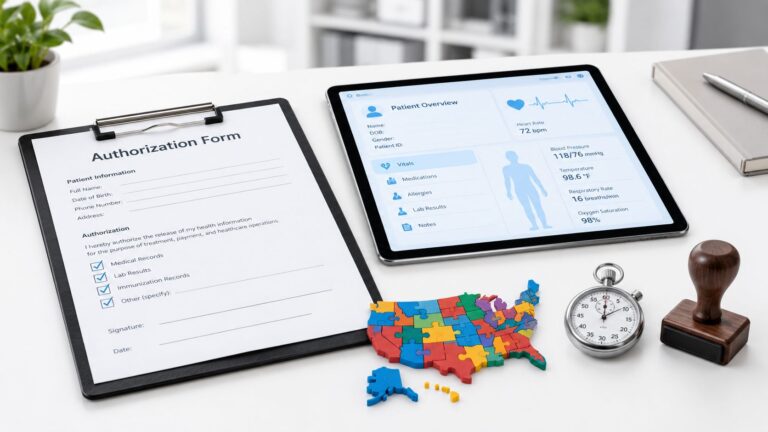

A medical records clerk maintains the accuracy, completeness, and controlled access of patient records across paper and EMR systems so care, billing, and compliance can keep moving. In the United States, this is a defined healthcare support role with 185,690 jobs, a mean annual wage of $53,690, and a median hourly wage of $23.45 according to the Bureau of Labor Statistics occupation profile for medical records specialists.
If you're managing a practice and wondering why schedules are full but the day still feels jammed, records workflow is often part of the answer. A provider can't start cleanly if referral notes aren't attached, billing can't defend a claim if documentation is missing, and staff can't respond to a patient request if nobody knows where the chart lives. That's where the records clerk matters. The role sits in the middle of chart integrity, release-of-information, and daily handoffs between the front desk, clinical team, and revenue cycle.
For practice owners and managers, the confusion usually comes from the title. Some teams hear "clerk" and think filing. In a modern practice, the job is much broader. It often includes scanning and indexing into the EMR, checking chart completeness, tracking record location, processing record requests, and making sure access stays controlled.
Introduction What a Medical Records Clerk Actually Does
A new manager usually notices this role when something goes wrong. The provider opens the next day's chart and the outside consult isn't there. Billing asks for a missing operative note. A patient requests records and the team isn't sure whether the authorization is complete. These aren't isolated annoyances. They're workflow bottlenecks.
A medical records clerk keeps that bottleneck from forming. In plain terms, this person manages the record so the right information is in the right chart, under the right patient, available to the right authorized person, at the right time. That sounds simple until you see how many handoffs sit underneath it.
In many practices, the clerk functions as a quiet throughput control point. They help pull together incoming documents, route them into the correct encounter, verify that chart elements are complete before storage or release, and retrieve records when clinicians, billing staff, or patients need them. When this work is done well, providers are more prepared, billing has cleaner support, and release-of-information requests don't turn into fire drills.
Practical rule: If your team regularly says "we can't find it," "it wasn't scanned," or "billing needs one more document," you don't have a filing problem. You have a records workflow problem.
What follows is the practical view most practice managers need. You'll see what the role means in a modern EMR environment, what the clerk does day to day, which skills matter most, how this role differs from adjacent jobs, and how it changes across specialties and practice sizes.
Understanding the Medical Records Clerk Role in Modern Practices
A modern practice can receive the same patient's information through four doors in one week: a portal message, a faxed consult note, a hospital discharge packet, and a signed request to send records out. If those items are filed late, attached to the wrong encounter, or released without the right review, the problem does not stay inside the chart. It slows visits, creates billing rework, and raises disclosure risk.
From paper storage to health information control
The role grew from paper chart storage, but the work now centers on controlling how information enters, lives in, and leaves the record. In practical terms, that means document capture, correct indexing, retrieval, and access control inside the EMR and any remaining paper workflow.
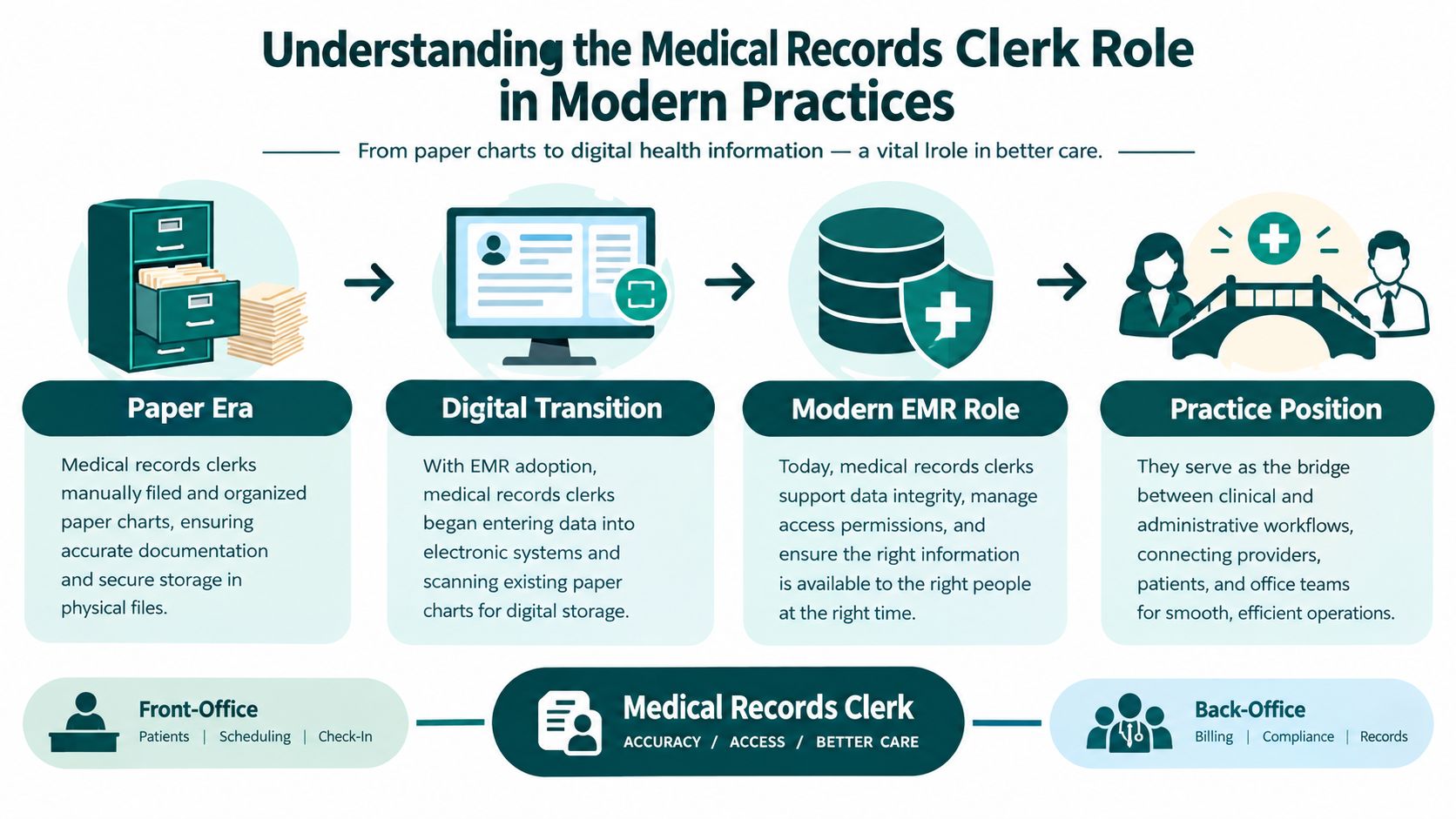
That shift matters because very few clinics are fully digital in a clean, orderly way. A family medicine office may still receive specialist notes by fax. An orthopedic group may scan outside imaging reports while also importing operative documentation electronically. A behavioral health practice may have stricter release rules layered onto routine chart handling. The clerk keeps those mixed inputs tied to the correct patient, date, and purpose.
Where the role sits in the practice
In operations terms, the medical records clerk often sits at a three-way junction:
- Clinical side: providers need complete charts, prior notes, labs, and referral material available before or during care.
- Administrative side: billing, audits, referrals, and patient service depend on fast, accurate retrieval.
- Compliance side: access, amendment requests, and disclosures have to be reviewed, limited, and documented correctly.
One records clerk job description used in behavioral health reflects that broader scope. It includes converting source documents into the EMR accurately, attaching incoming clinical data to the correct patient or encounter, and checking completeness before storage or release in the medical records clerk role description.
This is why the role should not be defined as filing support alone. The clerk is often the practice's throughput control point for chart integrity and release-of-information. If intake sends in a document, billing needs supporting records, or a patient asks for a copy of the chart, that request usually passes through the same control point.
When a chart is incomplete, the delay spreads into the visit, the claim, and the disclosure log.
Why the role changes by setting
The title stays the same, but the job can look very different from one practice to another. In a small primary care office, one person may handle scanning, indexing, record requests, and chart cleanup alongside front-desk support. In a larger multispecialty group, the clerk may work in a centralized records team with tighter task separation and higher daily volume.
Specialty also changes the risk points. Cardiology may depend on timely outside testing and hospital records. Surgery may depend on operative notes and pathology being attached to the right encounter. Behavioral health may place more attention on release review and disclosure tracking. As noted earlier in the BLS profile, pay varies widely across this occupation, which fits the fact that some employers use the role for basic document handling while others expect more complex health information work.
For a practice manager, the useful question is not "Do we need someone to file records?" It is "Who owns chart integrity and release control when information is coming in, being used, and going out all day?" In many practices, that owner is the medical records clerk.
Daily Duties and Core Responsibilities Explained
The workflow starts before the provider sees the patient
A medical records clerk usually works across the full record lifecycle, not one isolated task. In operational settings, duties may include pulling next-day charts, updating schedules for cancellations and no-shows, mailing and processing medical releases, and copying record elements needed by billing when claims lack support, as reflected in this clinic medical records clerk specification.
That means the day often starts with preparation, not filing. In a primary care clinic, the clerk may check tomorrow's schedule, confirm that outside lab reports have been attached, and make sure referral documents are visible in the EMR before the first patient arrives. In a specialty office, that prep may focus more on operative reports, imaging, or consult notes that support medical necessity.
What the clerk does during the record lifecycle
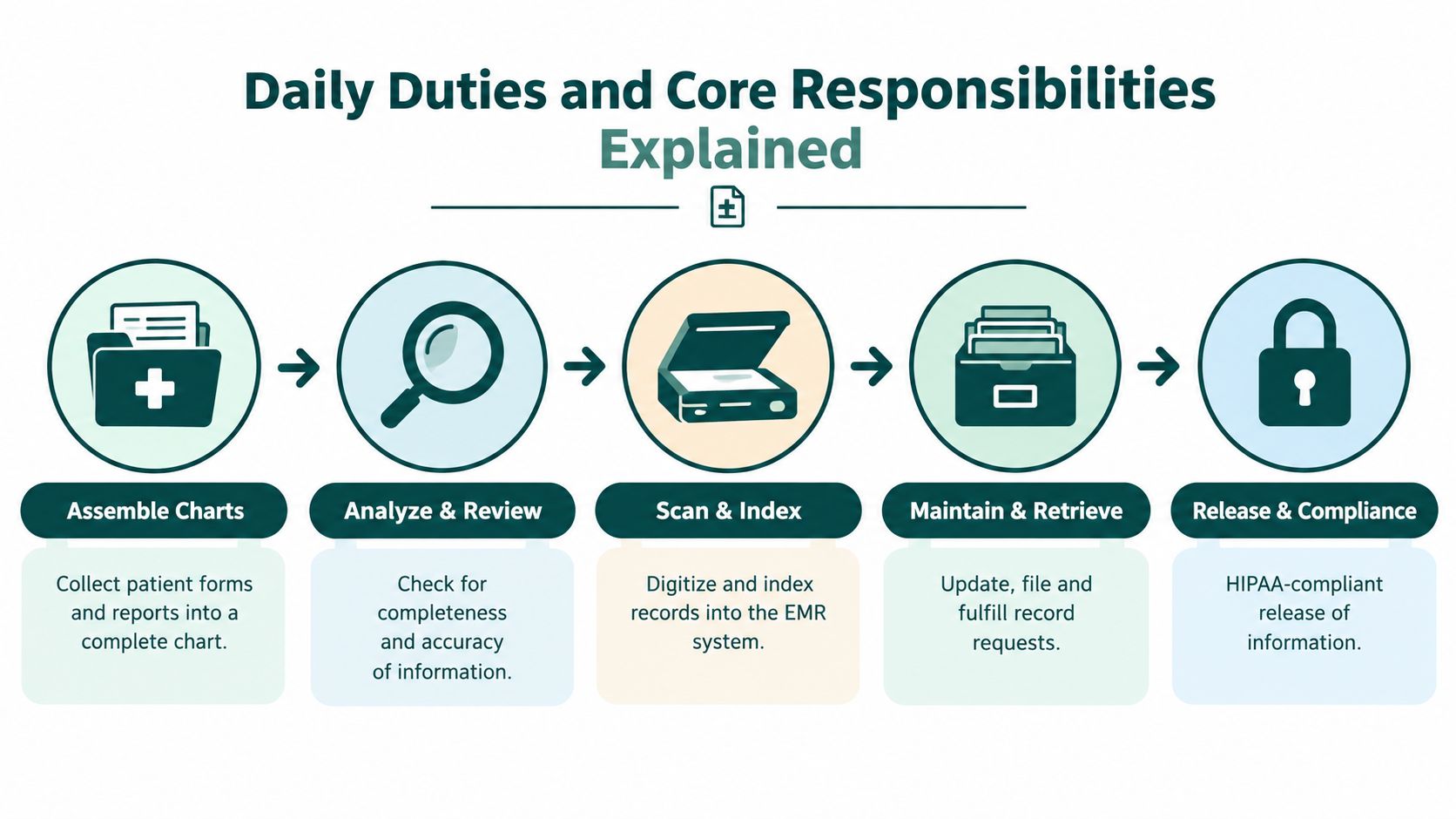
A practical breakdown looks like this:
- Assemble and review charts: collect documents from intake forms, faxes, portals, and prior visits, then check whether essential elements are present.
- Scan and index documents: upload paper or faxed items into the EMR and attach them to the correct patient and encounter.
- Check completeness and accuracy: confirm dates, patient identifiers, document type, and whether the record belongs in the chart at all.
- Maintain storage and retention flow: file, archive, or queue records according to the practice's process.
- Retrieve records quickly: respond to clinician requests, referral needs, billing support, and authorized external requests.
A county job specification describes the role more directly: medical records clerks commonly assemble, analyze, file, code, index, and cross-index records, check them for completeness and accuracy, and maintain controlled access to the chart set in ways that support audits, referrals, and patient requests in the medical records clerk job specification.
Why small errors create bigger operational problems
Records work is unforgiving because minor mistakes propagate. If a discharge summary is scanned under the wrong patient, the immediate issue looks clerical. The downstream effect may be much larger. A provider may miss context at follow-up, billing may not have support for a claim, or staff may release the wrong material in response to a request.
That's why records teams often become a hidden support layer for medical billing services. Billing can only defend documentation that the practice can retrieve. If your claim team keeps asking for chart support, the root cause may sit in scanning, indexing, or chart closure rather than in billing itself.
Operational cue: When denial work repeatedly starts with "please resend records" or "documentation not found," review records intake and indexing before you assume the billing team is the problem.
Release of information is part of the job, not an extra
Many managers separate filing from release-of-information, but in smaller practices they often live together. That includes validating authorization forms, locating the requested material, documenting the release, and making sure only the appropriate content leaves the practice.
A records clerk in a busy office might spend one hour scanning inbound documents, another pulling records for a provider, and another processing patient or third-party requests. In a high-volume specialty clinic, those requests may also include insurer support, legal requests routed through protocol, or chart copies needed for transfers of care. The common thread is controlled, traceable handling.
Essential Skills Compliance Knowledge and Tools
A strong records clerk works like the front desk for the chart itself. Every document that enters or leaves the record needs the right destination, the right timing, and the right controls. In a small primary care office, one person may handle scanning, chart pulls, and release requests in the same afternoon. In a larger specialty group, those tasks may be split across teams, but the clerk still sits at a key throughput point for chart integrity and release-of-information.
Accuracy skills that catch errors before they spread
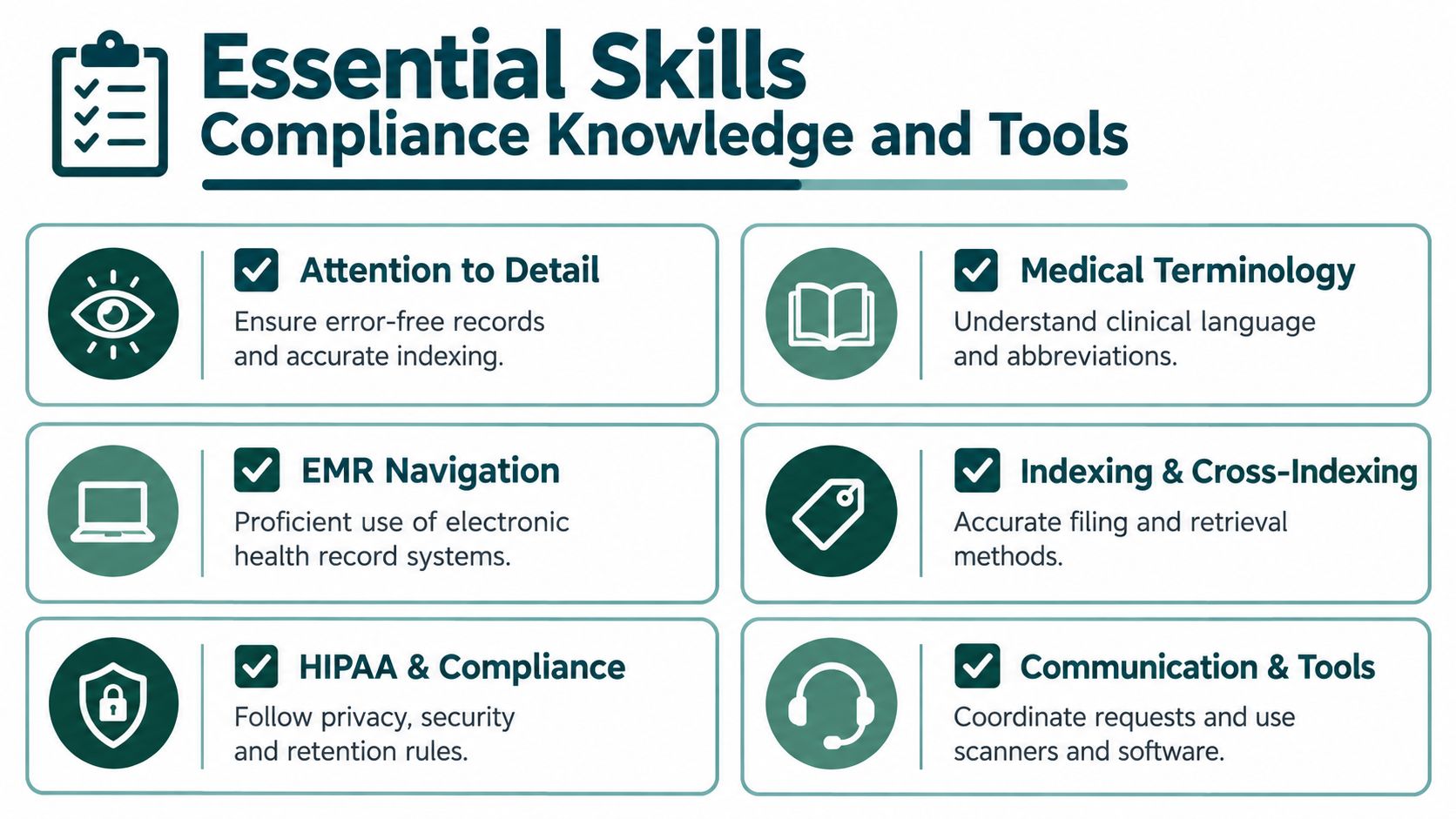
Accuracy here means more than careful typing. It means noticing that John A. Smith and Jonathan Smith share a birth year but not a medical record number. It means catching that a referral note was scanned under the wrong date of service. It means seeing that a lab result belongs to the cardiology follow-up, not the annual physical.
That kind of accuracy protects flow. Once a document is misfiled, the provider may miss it, the biller may not find support, and the release team may send the wrong pages. One indexing mistake can create work for three departments.
EMR skill matters for the same reason. A clerk needs to know where incoming records belong, how the practice names and tags documents, and how to retrieve material from current visits, older encounters, and archived charts. The exact system may be Athenahealth, eClinicalWorks, NextGen, Kareo, Dentrix, or a specialty platform. The practical question is always the same. Can this person place and retrieve the right document without slowing the rest of the office down?
Compliance knowledge shapes daily decisions
Privacy rules matter here because records staff handle protected health information all day. The HHS explanation of the HIPAA minimum necessary standard puts that into operational terms. Staff should access, use, and disclose only the information needed for the task, and routine requests should follow standard protocols.
For a manager, that usually turns into three workflow choices:
- Access design: Set EMR permissions around records duties instead of giving broad chart access by default.
- Release workflow: Use standard forms, identity checks, and routing rules for common request types.
- Documentation practice: Keep a clear record of what was released, to whom, and under what authorization or purpose.
Timing matters too. Under 45 CFR 164.524, a practice must act on a patient's request for their own records no later than 30 calendar days after receiving it. In practice, that means the clerk's work queue cannot depend on memory or casual follow-up. Requests need dates, owners, status tracking, and a review step before anything goes out.
Specialty changes the pressure points. In behavioral health, sensitivity around disclosure often makes validation and segmentation more important. In surgery or orthopedics, imaging reports, operative notes, and outside records can make chart assembly slower and retrieval more complex. In dental or small family medicine offices, the same person may be both the intake checkpoint and the release checkpoint, so process discipline matters even more.
Tools and safeguards that reduce rework
The usual toolkit includes scanners, fax queues, document naming rules, chart completion checklists, release logs, access logs, and secure transmission methods. These are not just office tools. They are controls that keep the record findable and defensible.
Remote support adds another layer. Managers need clear workstation rules, role-based permissions, secure file transfer, and a handoff process for exceptions. For the IT side of those decisions, Technovation LLC's guide for medical practices gives a useful overview of the infrastructure behind secure administrative work.
Some practices keep all records work on site. Others use remote support for scanning queues, indexing, chart prep, and records requests, with oversight built into the workflow. If you're evaluating that model, this guide to HIPAA-aligned virtual assistant workflows covers permissions, handoffs, and documentation controls for remote records support.
How a Medical Records Clerk Differs From Related Roles
Managers often hire the wrong role because the titles overlap. The cleaner question isn't "what's the official title?" It's "what problem needs an owner?" If your issue is record completeness, retrieval, and release, a medical records clerk is often the right anchor. If your issue is coding depth, denial management, or real-time note creation, another role may fit better.
Where confusion usually happens
A medical records clerk is typically responsible for the record's organization, controlled access, and availability. A medical biller is focused on claims, payer follow-up, and reimbursement support. A scribe documents visits in real time. A broader health information or records specialist may absorb some clerk duties but usually carries a wider or more technical scope.
That overlap is why practices sometimes combine tasks into one job. Smaller offices do this often. The risk is that the person ends up strong in one lane and weak in another. Someone who handles charges well may still struggle with release validation. Someone who scans accurately may not be the right person to manage payer denials all day.
Medical Records Clerk vs Related Roles
| Role | Primary Focus | Typical Tasks | When to Choose |
|---|---|---|---|
| Medical records clerk | Chart integrity and controlled access | Scanning, indexing, chart review, retrieval, release-of-information workflow, record tracking | Choose this role when your practice loses time to missing documents, chart prep gaps, or records requests |
| Medical records specialist or health information role | Broader health information management | More advanced review, indexing oversight, sometimes coding support, audit or reporting support | Choose this when record handling is more complex and the practice needs broader health information coverage |
| Medical biller | Revenue cycle execution | Charge entry, claim submission, denial follow-up, payment posting support, claim documentation requests | Choose this when the core problem is collections, claims, or payer rework |
| Medical scribe | Real-time visit documentation | Drafting notes during encounters, updating visit documentation for provider review | Choose this when providers need help closing notes during or immediately after visits |
| General medical virtual assistant | Mixed administrative support | Scheduling, phones, intake, reminders, basic records coordination depending on scope | Choose this when workload is spread across several admin functions rather than concentrated in records |
A broader explanation of mixed remote administrative roles appears in this guide to what a medical virtual assistant does and how practices hire one. For many practices, that model works best when the records function is clearly defined rather than left as a catch-all task.
A simple hiring lens
Use this decision test:
- If providers wait on documents, start with records coverage.
- If claims wait on documentation follow-up, you may need both records and billing support.
- If notes stay open, a scribe solves a different problem.
- If one admin person handles everything, define records ownership anyway so requests don't disappear into the front desk queue.
The point isn't title purity. It's operational ownership.
Real World Applications Across Specialties and Practice Sizes
Primary care and internal medicine
In primary care, the records clerk often feels like an extension of care coordination. The office receives outside consults, hospital discharge paperwork, imaging reports, school forms, and patient-submitted documents. If those items aren't indexed cleanly, the provider spends visit time hunting for context.
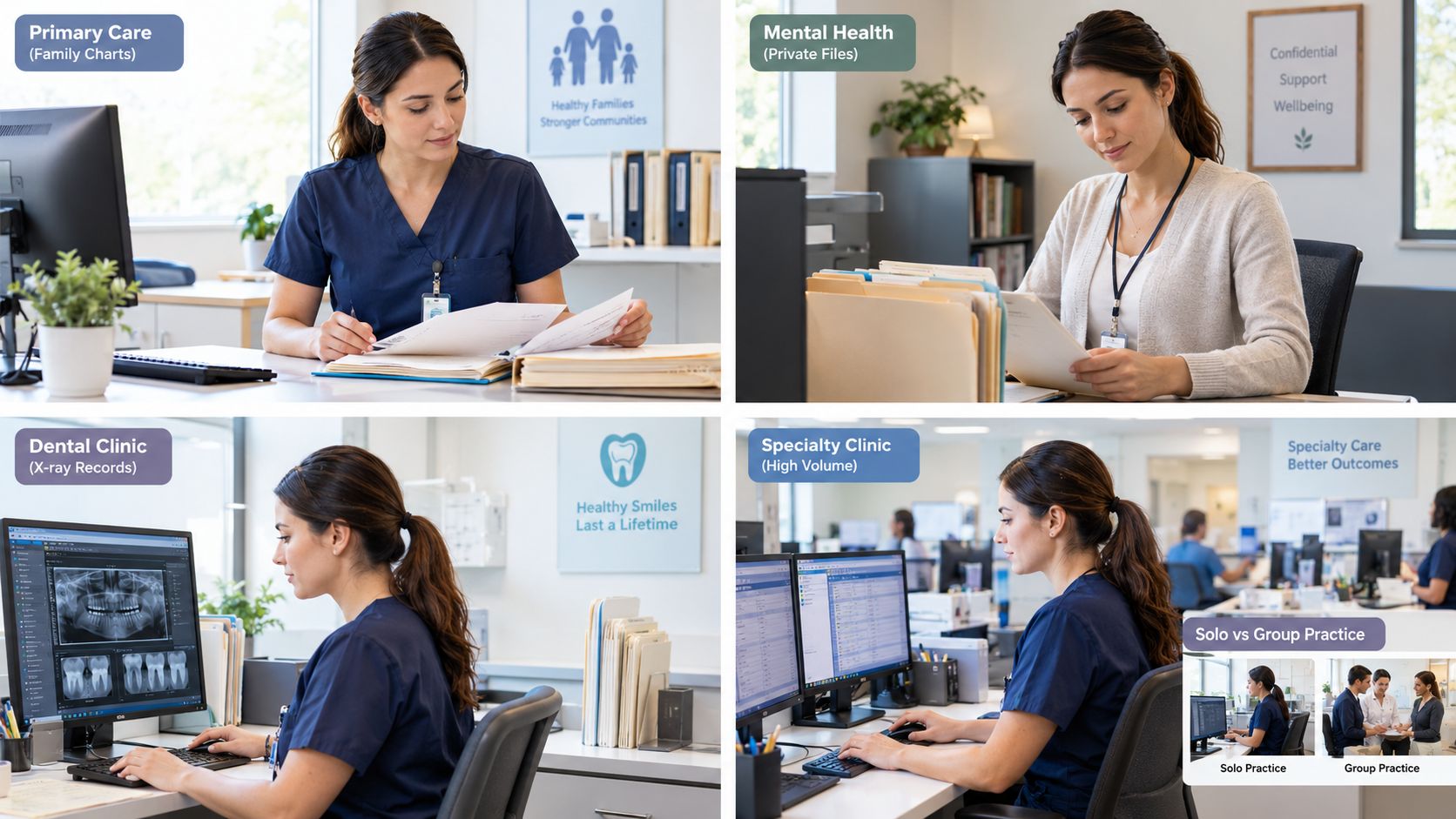
A practical primary care workflow often includes next-day chart prep, attaching referral notes to upcoming visits, and making sure records requests for continuity of care don't stall. In a solo office, the same person may also help at the front desk. In a larger group, records work usually benefits from tighter role boundaries because inbound document volume grows quickly.
Mental health and therapy practices
Mental health clinics usually have fewer external clinical artifacts than multispecialty medical groups, but privacy handling tends to feel more sensitive. Release-of-information requests may need especially careful review against the practice's own policies and legal guidance. Staff also need clear internal rules about who can retrieve and send what.
For remote support in this setting, access discipline matters more than broad flexibility. A smaller permission set, a defined release queue, and documented approval steps usually work better than letting everyone improvise. The clerk's value here is consistency. They reduce the chance that one urgent request gets handled in a way that doesn't match the rest of the practice.
Dental and specialty clinics
Dental, orthodontic, surgical, and other high-volume specialty settings often generate frequent imaging, referrals, and insurer-support paperwork. The clerk may spend less time on broad chart assembly and more time on tightly timed retrieval. A surgeon needs the prior imaging in place before consult. Billing needs the operative note when a claim is questioned. A referral partner needs specific records, not the whole chart.
Some specialty practices also still maintain hybrid paper and digital processes for consent forms, outside discs, or signed packets. That makes document control more physical. It can also raise disposal questions when equipment and storage media are retired. For practices reviewing that side of operations, Fulton County hospital e-waste management is a practical resource on handling obsolete electronic equipment in healthcare environments.
In specialty clinics, speed matters, but precision matters more. Sending the wrong subset of records creates more work than sending them a day late.
Solo practice versus multi-site groups
The role changes sharply with scale.
In a solo practice, the clerk may wear several hats. They might process records requests in the morning, scan intake forms at lunch, and retrieve old charts for billing in the afternoon. That can work if the volume is manageable and the owner defines a clear release process.
In a multi-site group, centralization becomes more useful. One person or team can own document naming rules, records request logging, retrieval standards, and chart prep for all sites. The more locations you add, the more dangerous informal habits become. One office labels scans one way, another uses a different document type, and retrieval quality falls fast.
A remote medical records specialist can help in either model when the handoffs are explicit. Coverage tends to work best when the practice specifies clinic hours, exact EMR tasks, approval points for releases, and which queue belongs to records versus front desk, referrals, billing, or prior authorization.
The Takeaway
If you're asking what is medical records clerk, the practical answer is this: it's the person or function that protects chart integrity and timely access so your practice can deliver care, support claims, and handle records requests without confusion. The role is much closer to information control than to old-fashioned filing.
That distinction matters when you're staffing. A practice with missing attachments, delayed chart prep, unclear release handling, or repeated document hunts doesn't just need "admin help." It needs someone to own records workflow from intake through retrieval and release. In smaller offices, that may be one cross-trained person. In larger or multi-site settings, it usually deserves a defined lane.
For next steps, review where your records process breaks. Look at incoming document attachment, chart prep before visits, release-of-information validation, and billing handoffs when support is missing. Once ownership is clear, you can decide whether that coverage belongs in-house, remote, or in a blended model built around your hours, EMR, and supervision structure.
If your practice needs that ownership but doesn't want to force records work into an already overloaded front desk role, Medical Virtual Assistants provides pre-vetted remote healthcare staff who can support EMR document handling, records requests, and related administrative workflows during U.S. clinic hours. It's a practical option for practices that want defined records coverage with clear handoffs to providers, billing, and patient service teams.