
ER scribes have no federal licensure requirement, so the bar is a high school diploma or equivalent, 40–70 WPM typing, English fluency, medical terminology comfort, and HIPAA training before touching PHI, with the note always attested by the treating clinician. In practice, the safest ER scribe requirements go beyond hiring filters and include EMR competency, defined role boundaries, controlled remote access, and auditable clinician review.
A practice manager usually encounters this question after a familiar problem appears: clinicians are moving from bed to bed, the waiting room is full, and unfinished charts are accumulating after the shift. The right scribe can document the encounter as it happens, but the wrong person, vendor arrangement, or access process can introduce omissions, privacy exposure, and confusion about who is responsible for the final note.
This guide focuses on the requirements that matter in an actual U.S. emergency department. It covers the work an ER scribe performs, the qualifications that recur in job postings, the technical skills that separate a workable hire from a dependable one, and the compliance mechanics behind HIPAA, BAAs, and note attestation. It also compares in-person, remote, and AI-assisted models, then provides a hiring and onboarding framework you can adapt to your ED.
What an ER Scribe Actually Does in a Modern ED
An ER scribe documents the clinical encounter in the electronic medical record while the physician, physician assistant, or nurse practitioner evaluates patients and makes treatment decisions. The scribe may enter the history and physical, provider-dictated assessment and plan, procedure details, consultations, diagnostic results, and disposition instructions directly into the EMR.
The role is live and workflow-oriented. A scribe tracks which patient is waiting for reassessment, which laboratory or imaging result has returned, and which chart still needs a disposition. That tracking helps the provider maintain continuity across multiple beds instead of reconstructing the encounter from memory at the end of the shift.
What the scribe can and cannot do
The boundary is straightforward, even when the environment is not. The scribe records what the clinician dictates, observes within the assigned documentation process, or directs the scribe to enter. The scribe does not triage patients, assess symptoms independently, prescribe medication, place clinical orders, select diagnoses, or make treatment decisions.
A unit clerk may manage calls, transport requests, registration details, or department paperwork. A medical assistant typically supports rooming, intake, clinical measurements, and other duties defined by the practice and applicable rules. A transcriptionist converts dictated material into text, often after the encounter. The ER scribe's distinctive function is real-time charting combined with chart tracking during active care.
Practical rule: If a candidate talks about “helping decide” what a patient needs, stop the interview and clarify the scope of the role.
Why live charting changes the ED workflow
Emergency documentation is rarely linear. A provider might begin an HPI, pause to evaluate another patient, review an EKG, return for a reassessment, speak with a consultant, and then discharge or admit the patient. The scribe must preserve the sequence without turning incomplete information into a finished clinical statement.
That requires attention to throughput as well as prose. A well-run scribe process can help providers keep charts current while they move through the department, but it doesn't remove the clinician's responsibility to review the note. The value comes from reducing clerical friction without shifting clinical judgment to unlicensed staff.
Baseline Qualifications Most ER Scribe Postings Require
Most U.S. ER scribe postings start with a high school diploma or equivalent, because the role generally isn't governed by a federal licensure standard. Some employers request college coursework, a bachelor's degree, or prior healthcare exposure, but postsecondary education and certification are commonly preferences rather than universal requirements. University of Michigan's medical scribe posting, for example, specifies a diploma, accurate typing at 70 WPM, clinical or medical terminology experience, and business software knowledge.
Typing thresholds commonly fall between 40 and 70 WPM, depending on the employer and the setting. A large health system may list 40+ WPM, English fluency, computer use for several hours per day, and the ability to manage a demanding workflow. These thresholds aren't a substitute for accuracy. A fast typist who mishears medication names or drops negations is a risk, not an asset.
The filters that deserve a closer look
English fluency usually refers to clear written and verbal communication, not a requirement that the scribe speak only one language. In a busy ED, the scribe must understand provider dictation, document concise clinical language, and communicate a question without interrupting a critical interaction. A bilingual skill set can help with general communication, but it doesn't authorize the scribe to interpret clinical information unless the organization has a separate, properly defined process.
Medical terminology is another practical filter. Candidates don't need to arrive as clinicians, but they should understand common anatomy, abbreviations, diagnostics, and emergency medicine vocabulary well enough to recognize when a phrase needs clarification. Prior experience as an EMT, CNA, medical assistant, student observer, or healthcare administrator can shorten the learning curve, although it isn't always required.
| Requirement | Typical threshold | Why it matters in the ED |
|---|---|---|
| Education | High school diploma or equivalent | Establishes the usual entry point for a role without universal federal licensure |
| Typing | 40–70 WPM, depending on employer | Supports real-time entry while the provider continues the encounter |
| Communication | Clear English reading, writing, and speaking | Reduces ambiguity in dictated notes and handoffs |
| Medical terminology | Basic working familiarity, often preferred | Helps the scribe recognize anatomy, tests, medications, and abbreviations |
| Computer skills | Comfort with EMRs and business software | Allows navigation between charts, results, templates, and provider queues |
| Schedule | Availability for assigned ED coverage | Emergency departments need coverage across demanding shifts |
| Physical tolerance | Ability to remain active through the shift | In-person scribes may stand, move between beds, and work at shared stations |
A useful hiring principle is to evaluate demonstrated ability rather than treating a degree as proof of performance. The Synopsix hiring approach offers a helpful framework for skills-based evaluation, which fits scribe hiring because a timed charting simulation often tells you more than a polished résumé.
For a clear distinction between documentation work and adjacent clinical support, compare the responsibilities in this guide to medical assistant versus medical scribe roles. The distinction matters because an ER scribe shouldn't be hired into a job description that implicitly expects clinical tasks.
Technical and Clinical Skills That Make an ER Scribe Effective
The strongest candidates can move through an EMR without losing the encounter's clinical thread. They know how to open the correct chart, locate prior information, use approved templates or smart phrases, enter dictated material into the right fields, and move between the note and pending results without creating duplicate documentation.
Experience with Epic, Cerner, or Meditech is useful, but it shouldn't be treated as an absolute requirement when the candidate demonstrates sound documentation habits. Every organization configures its EMR differently. What transfers is the ability to learn navigation, follow a template, use keyboard shortcuts appropriately, and recognize when an entry belongs in the HPI, review of systems, physical examination, medical decision-making, or disposition.
The working skill set
An ER scribe may need to track several clinicians, patients, laboratory results, imaging reports, consultations, and reassessments at once. The task isn't just typing what someone says. The scribe must listen for the clinical sequence, identify missing context, and ask a concise clarification question at a safe moment.
Basic EKG and radiology terminology can be preferred skills, especially in emergency settings, but the scribe shouldn't independently interpret either. A candidate who says, “I know when to flag a phrase for clarification, but I don't turn a tracing or image into a clinical conclusion,” understands the boundary.
The soft skills are less visible on a résumé:
- Situational awareness: The scribe knows when not to interrupt a resuscitation, procedure, or sensitive discussion.
- Calm under pressure: The work continues when several charts change at once.
- Concise handoff: A shift-change report identifies open charts, pending results, and unresolved documentation tasks without adding interpretation.
- Attention to detail: Negations, laterality, dosage wording, and disposition status require careful handling.
- Coachability: The scribe accepts chart corrections without defending an inaccurate entry.
A practical test should include an abbreviated ED encounter, a sample provider dictation, and a few result updates. Score whether the candidate preserves meaning, follows the template, distinguishes pending from completed information, and finishes the note without inventing content. That simulation is more predictive than asking whether the person is “comfortable multitasking.”
HIPAA, BAA, and Note Attestation Compliance
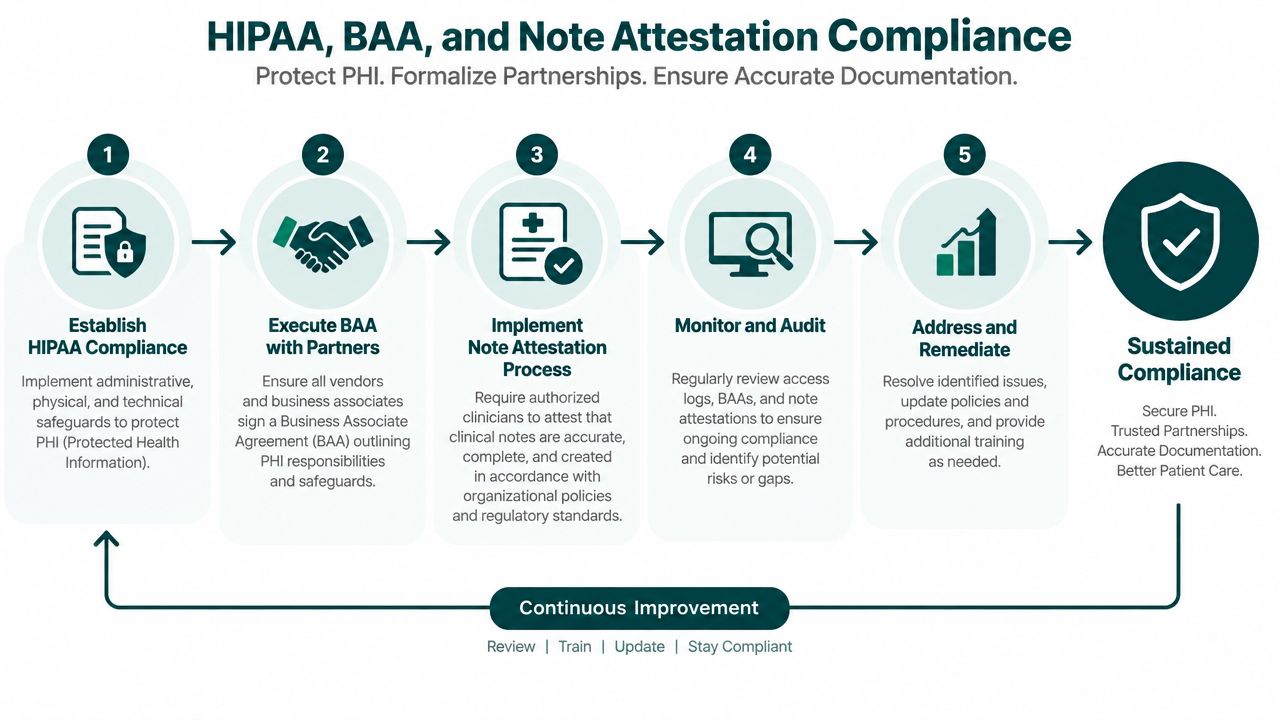
HIPAA compliance isn't a training certificate that makes a scribe safe by itself. It is a workflow involving access controls, permitted use of protected health information, supervision, documentation review, and contracts that match the staffing model.
Under HHS guidance on business associates, a covered entity may disclose PHI to a business associate only with satisfactory assurances, ordinarily documented in a signed Business Associate Agreement. The agreement must define permitted and required uses and disclosures and require safeguards against improper access or disclosure.
When the staffing model changes the contract
An in-person scribe hired as part of the practice or hospital workforce generally operates under the covered entity's workforce policies, confidentiality rules, access controls, and training program. A remote scribe service that accesses or receives PHI usually creates a business-associate relationship, so the practice should execute the BAA before the service receives access.
The exact arrangement depends on how the service works. A medical-insurance risk review of virtual scribes distinguishes between a service using proprietary software or receiving ePHI, where a BAA is needed, and an individual working only inside the organization's EHR without ePHI transmitted to the service provider, where the contracting structure may differ. Have qualified compliance counsel review the arrangement rather than relying on a vendor's label.
Who signs the note
The scribe drafts or enters the note. The treating physician, PA, or NP reviews the content, corrects errors, and attests or signs according to the organization's and payer's requirements. The clinician remains accountable for the accuracy of the professional service documentation.
ACEP notes that CMS doesn't require the scribe's signature, while some Medicare Administrative Contractors require the chart to identify the person acting as scribe for the clinician. That payer and regional variation means your policy should specify how the scribe is identified, how the provider attests, and which payer rules the billing team checks. ACEP's scribe guidance is useful background, but practices should confirm current requirements with their compliance and billing advisers.
Common ED failure points include:
- Shift handoffs: A departing scribe leaves pending documentation without a named owner.
- Visible screens: A monitor in a curtained bay exposes PHI to patients or visitors.
- Shared accounts: Staff use another person's credentials instead of an individual account.
- Overbroad access: A scribe opens charts unrelated to the assigned workflow.
- Unreviewed drafts: A clinician signs without checking copied-forward or misheard content.
A practice's remote staffing process should also address workstation privacy, secure authentication, access logging, device controls, incident escalation, and breach response. HIPAA rules and breach notification obligations can carry significant consequences, and the practice should obtain current guidance from its privacy officer or counsel rather than treating annual training as the entire control system.
In-Person, Remote, and AI-Assisted ER Scribe Models
The right model depends on how the ED communicates, how quickly providers need documentation, and whether the work requires physical presence. In-person scribes can hear and see the clinical workflow directly. Real-time remote scribes depend on a stable, secure audio or video connection and disciplined handoffs. AI-assisted tools can generate drafts, but they still require human review and clinical attestation.
A useful benchmark is same-day completion. One remote scribe vendor describes a workflow that delivers final notes within 1 hour and guarantees same-day completion, a concrete service-level reference for practices assessing whether remote coverage will reduce end-of-shift backlog. Scribe-X's remote workflow presents that benchmark as a vendor claim, so buyers should test it against their own acuity, connection quality, and review process.
Where each model fits
In-person coverage often fits high-acuity trauma, pediatric emergency care, or departments where providers rely on a scribe positioned beside the workstation or cart. The trade-off is less scheduling flexibility and a larger physical staffing footprint.
Remote coverage can work well for community EDs, overnight documentation, and services with reliable audio feeds and clear provider habits. It can fall short when multiple conversations overlap, the provider moves outside the capture area, or the connection drops during a critical part of the encounter.
AI-assisted documentation may fit lower-acuity fast-track encounters, follow-ups, and post-shift documentation cleanup. It is less suitable when the practice expects the system to recognize every nuance without review. The Commure overview of emergency scribes describes the expanding AI-assisted market and notes a U.S. market estimate of about $622 million in 2026, projected to reach $4.67 billion by 2035. Those figures indicate buyer interest, not proof that an AI workflow fits a particular ED.
| Dimension | In-person scribe | Real-time remote scribe | AI-assisted scribe |
|---|---|---|---|
| Latency | Immediate, if the scribe is present | Near real time when the feed is stable | Real time or shortly after the encounter, depending on the tool |
| Accuracy control | Scribe asks for clarification during the encounter | Depends on audio quality and communication discipline | Provider must review generated content carefully |
| BAA exposure | Usually workforce-based when employed by the covered entity | Service-provider access commonly requires a BAA | Vendor access to PHI commonly requires a BAA |
| Scheduling | Tied to physical coverage | More flexible across locations and shifts | Flexible, but depends on device and integration setup |
| Best fit | High-acuity, highly interactive environments | Stable remote workflows and overnight coverage | Lower-acuity or documentation-support workflows |
| Main limitation | Recruitment and physical coverage | Connection, privacy, and handoff failures | Hallucinated, omitted, or misattributed content if not reviewed |
Remote scribes don't independently practice medicine across state lines. The provider remains responsible for care, while the practice should confirm telehealth, privacy, employment, and organizational requirements that may apply to the communication method and locations involved. For broader remote staffing considerations, see this guide to medical virtual assistant tasks, costs, and hiring.
Onboarding, Training, and Supervision Expectations
A defensible onboarding process starts before the new scribe sees a chart. The practice should verify identity and employment details, complete required screening, provision an individual EMR account, and document privacy and security training before granting PHI access. The exact sequence varies by organization, but informal “learn while watching the board” onboarding is a poor fit for emergency documentation.
A staged onboarding path
Use a staged process that can expand or contract based on the candidate's experience:
- Pre-access screening: Verify the education requirement, test typing and medical terminology, complete background screening, and address any required drug screen or immunization verification for on-site access.
- Policy training: Complete HIPAA and HITECH awareness, security training, confidentiality expectations, code of conduct, and, for in-person staff, applicable OSHA bloodborne-pathogen awareness.
- EMR practice: Use a sandbox with sample ED encounters. Drill chart selection, templates, smart phrases, result tracking, handoffs, and note closure without exposing real PHI.
- Supervised shifts: Pair the new scribe with an experienced scribe or trainer, then assign charting alongside a designated clinician who can give immediate feedback.
- Controlled independence: Move to independent assignments only after the scribe meets the practice's accuracy, escalation, and completion standards.
A VA systematic review describes one scribe model using a 60-hour training program, 2 years of clerical experience, and software familiarity, with medical terminology and coding knowledge preferred. The review also found that scribed notes were often more thorough, comprehensible, and up to date, while benefits varied by encounter type and errors still occurred. The VA review of medical scribes supports structured training and review rather than assuming that speed alone produces quality.
Supervision and quality assurance
The clinician should know who is assigned to the chart, how to request a correction, and what happens when the scribe is uncertain. Supervisors should audit notes periodically, categorize errors, and feed those findings back into templates and training. Annual HIPAA refreshers and access reviews help keep the program current, but they don't replace day-to-day supervision.
A Practical Checklist for Hiring ER Scribes
A structured evaluation is more reliable than résumé screening because ER scribe performance depends on applied skills. Start with the basic filters, then test the candidate in a realistic documentation exercise before granting access to a live chart.
Screen for the minimum viable fit
Review the application for a high school diploma or equivalent, typing within the employer's 40–70 WPM range, EMR exposure, medical terminology coursework or experience, and shift availability that matches the ED. Epic, Cerner, or Meditech experience can reduce training time, but it shouldn't outweigh poor listening or weak documentation judgment.
A phone screen should test communication without turning into a casual conversation. Ask the candidate to explain what an ER scribe may not do, describe how they would handle an unclear medication name, and respond to a scenario in which two providers request documentation at once. Listen for calm prioritization and a willingness to escalate rather than improvise.
Use a paid charting simulation
Give the candidate a sample ED encounter with a short provider dictation, a result update, and a disposition change. Score the work against a defined rubric:
- Typing and timing: Can the candidate keep pace without sacrificing accuracy?
- Terminology: Are clinical terms, abbreviations, and negations captured correctly?
- EMR logic: Does the candidate place information in the right note fields?
- Scenario judgment: Does the candidate recognize uncertainty and ask for clarification?
- Scope awareness: Does the candidate avoid adding diagnoses, orders, or treatment decisions?
- Communication: Can the candidate deliver a concise handoff about incomplete work?
Red flags include discomfort with patient-facing environments, a vague understanding of HIPAA, inability to follow a documentation template, resistance to correction, or an expectation that the role includes independent clinical decisions. References should confirm performance in a fast-paced, detail-sensitive setting, not just attendance or general administrative reliability.
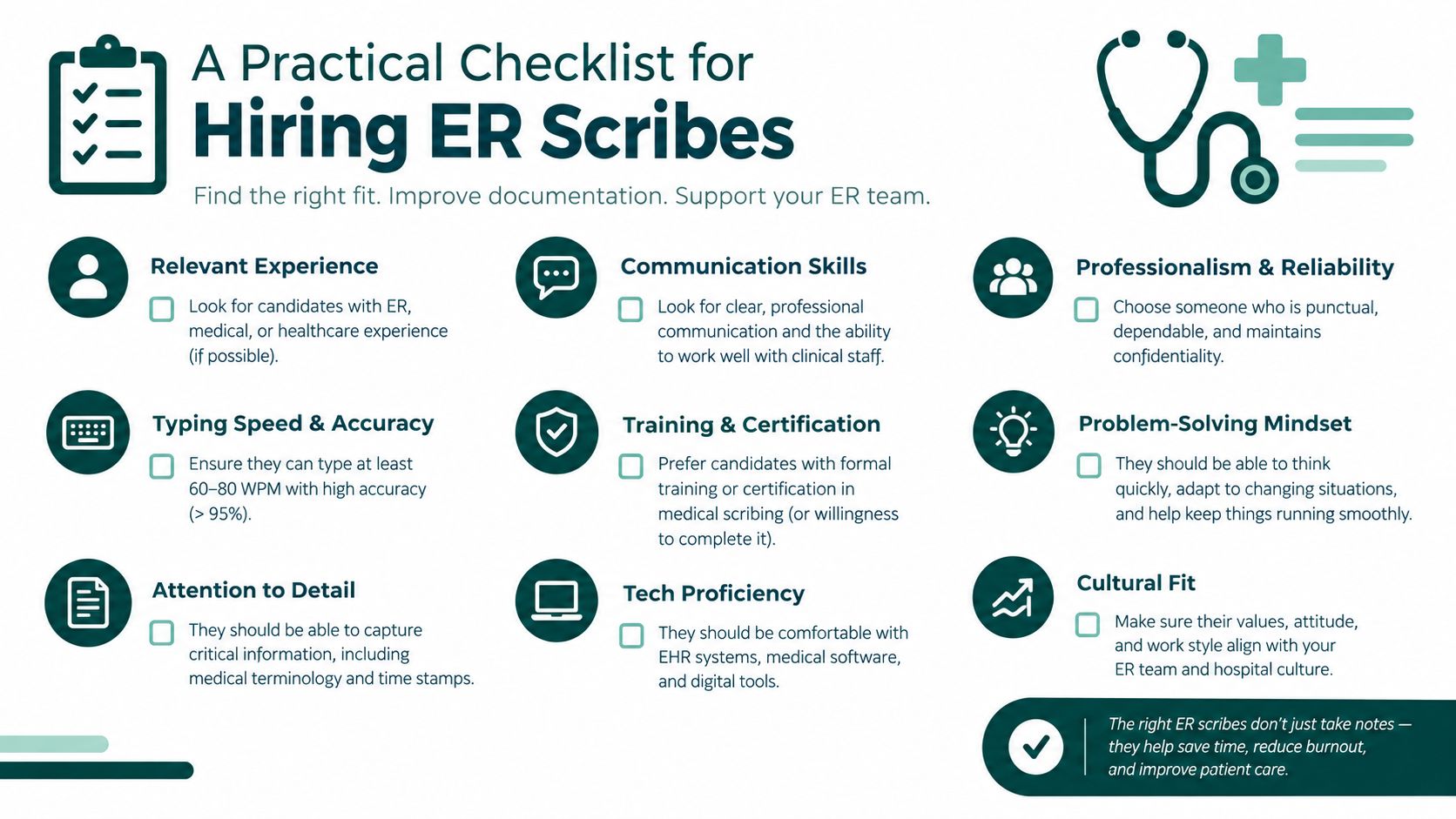
Weight typing, terminology, EMR comfort, and scenario performance evenly instead of letting a degree or confident interview style dominate the decision. If you're evaluating a remote candidate, add a connectivity test, a private-workspace confirmation, and a walkthrough of how the person will handle interruptions or a lost audio feed.
The core ER scribe requirements are simple to state but demanding to operate. Medical Virtual Assistants can help practices evaluate pre-vetted remote healthcare staff with U.S. practice experience, HIPAA training before start, EMR-focused skills testing, U.S.-hours coverage, and BAA support. Visit Medical Virtual Assistants to discuss a remote scribe profile that matches your ED workflow, specialty, software, and coverage needs.