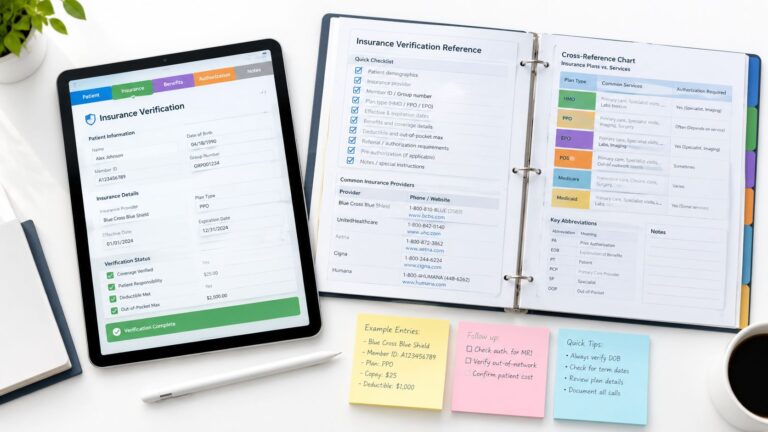

A provider stays late to finish charts while unanswered calls accumulate at the front desk. That situation is common, and it exposes why the medical assistant vs medical scribe decision can't be reduced to two job descriptions. A medical scribe primarily closes documentation gaps by recording the encounter in the EMR, while a medical assistant supports a much broader clinical-administrative workflow, including rooming, vital signs, scheduling, and procedure preparation.
The right choice depends on the bottleneck you need to remove first. If providers lose time to unfinished notes, a scribe is usually the more direct intervention. If patients wait, phones go unanswered, rooms turn slowly, or insurance work stalls, an assistant may produce wider operational relief. Hiring reliability also matters. The Bureau of Labor Statistics medical assistant outlook projects 12% employment growth from 2024 to 2034, about 109,700 openings per year, and 912,200 medical assistant jobs by 2034.
This guide compares duties, supervision, training, scope, documentation, billing impact, workflow fit, and staffing strategy. It also addresses hybrid roles and AI-assisted documentation, because many practices now need a dependable combination of coverage rather than a binary answer.
Introduction Why This Choice Matters Now
A provider finishes the last visit with several charts open, while the team still needs to room patients, answer calls, coordinate schedules, and keep procedures on time. Hiring a scribe may reduce unfinished documentation while leaving those operational tasks uncovered. Hiring a medical assistant may improve visit flow without removing enough of the provider's charting burden.
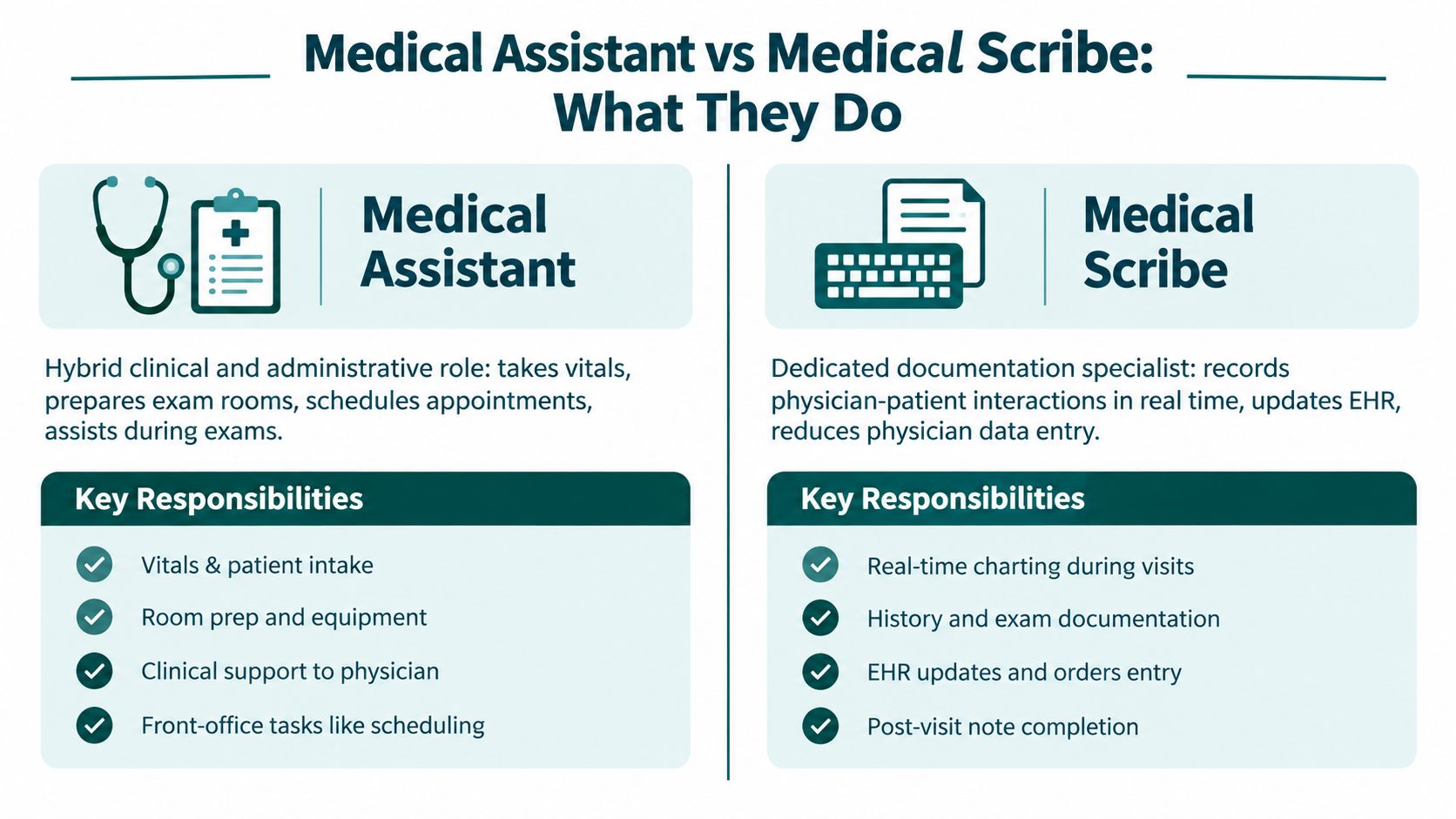
The distinction is practical. Scribes are documentation specialists, focused on real-time charting and note completion. Medical assistants are hybrid clinical-administrative staff, supporting patients, providers, rooms, schedules, and selected office processes under appropriate supervision.
The staffing decision should start with the bottleneck, then account for reliable hiring. A scribe fits a clinic where same-day note closure and after-hours charting constrain capacity. An assistant fits a practice that needs hands-on patient support and broader administrative coverage. Some clinics combine the roles, assigning documentation work to an assistant during selected visits. That model requires defined responsibilities, competency checks, and supervision.
Hiring availability can limit either plan. The 2025 State of the U.S. Health Care Workforce report reports 634,921 medical assistants nationally and estimates 112,300 annual openings over the decade. A May 2026 MGMA poll found 56% of practices said medical assistant hiring had worsened. Those conditions favor a workflow strategy rather than a fixed job-title choice. A hybrid assignment, or AI-assisted documentation paired with broader assistant coverage, may provide more dependable relief when a practice cannot staff a pure scribe or assistant model. Set task boundaries, verify competencies, and match the role to the work the clinic can consistently support.
What Each Role Actually Does in a Practice
The medical assistant supports the entire visit
A medical assistant works under physician or nurse supervision and combines patient-facing clinical support with administrative work. Depending on the practice and applicable state requirements, that can include preparing rooms, escorting patients, recording vital signs, updating histories, assisting with procedures, scheduling appointments, handling insurance-related tasks, and supporting documentation.
Consider a primary care visit. The assistant may review the schedule, prepare the exam room, bring the patient back, record vitals and medication information, alert the provider to the visit reason, assist with an examination, and arrange follow-up. In a specialty clinic, the assistant may prepare equipment, coordinate records, or support procedure setup. The role's value comes from moving several parts of the visit forward, not from one isolated task.
The AAMA position paper on medical assistant scope of practice notes that assistants can commonly perform both clinical and administrative work, including insurance claims and transcription of dictation. It also emphasizes that scope isn't uniformly defined across states, so a practice must validate delegation, supervision, and competency rather than assume that a task is permitted everywhere.
The medical scribe documents the encounter
A medical scribe follows the provider's encounter and enters information into the EMR in real time. The work can include recording the history, subjective and objective findings, physical examination details, laboratory results, diagnoses, treatment plans, prescriptions, follow-up instructions, and other provider-authenticated entries. The scribe supports documentation accuracy and workflow, but generally doesn't provide direct patient care.
A typical visit places the scribe beside the provider or in an approved remote workflow. The scribe listens, documents what the provider says and does, checks the note for completeness, and prepares it for provider review and signature. The provider remains responsible for reviewing and authenticating the clinical record.
Both roles handle protected health information, so access should be limited to assigned duties, documented through appropriate policies, and supported by training and agreements where required. A hybrid assistant/scribe role can work in some practices. The assistant may room the patient and prepare a procedure, then document during the encounter, but the practice must still separate clinical support from documentation responsibilities and define who may do what.
Operational rule: If a job description says “help with everything,” it isn't a workflow design. Write the task list, supervision rules, escalation path, and EMR permissions before recruiting.
Head to Head Comparison Across Key Criteria
The clearest way to compare the roles is to map them against the operational question you need answered. A practice that needs one person to absorb calls, room patients, and coordinate follow-up has a different requirement from a practice where the provider is clinically efficient but spends the evening finishing notes.
| Criteria | Medical Assistant | Medical Scribe |
|---|---|---|
| Primary responsibility | Clinical and administrative support across the patient visit | Real-time documentation and note workflow |
| Patient interaction | Direct and recurring, including intake and rooming | Limited, usually secondary to observing and documenting |
| EMR work | Updates histories, medications, schedules, and assigned clinical information | Captures provider findings, exam details, plans, and follow-up |
| Scope flexibility | Broader, but state and employer rules vary | Narrower and centered on documentation |
| Supervision needs | Clinical tasks require appropriate provider or nurse supervision | Provider review, authentication, and documentation oversight |
| Main provider-time effect | Reduces interruptions and helps visits move efficiently | Reduces in-visit and post-visit documentation time |
Primary responsibility and patient contact
The assistant interacts with the patient before, during, and after the provider encounter. That makes the role useful when intake is slow, exam rooms aren't turning over, or patients need help with scheduling and instructions.
The scribe's patient contact is usually limited. The scribe's attention remains on the provider's conversation and documentation requirements. That focus can be valuable in a complex visit where missing a physical examination finding or treatment instruction creates rework.
EMR work and scope flexibility
Both roles may work in the EMR, but they don't use it in the same way. An assistant may update demographic, medication, allergy, intake, scheduling, or other permitted information. A scribe records the provider's encounter content and prepares the note for review.
This distinction matters for access controls and accountability. The Medical Virtual Assistant role guide describes how administrative and documentation work can be separated by workflow, which is useful when a practice is deciding whether one person can safely cover multiple queues.
The provider-time test
A scribe earns its place by reducing documentation time. A medical assistant earns its place by reducing operational friction across the visit.
Measure the problem before choosing. Review unfinished notes, after-hours charting, rooming delays, call abandonment, referral work, eligibility queues, and follow-up gaps. If the dominant loss occurs inside the note, start with documentation support. If the loss occurs across the patient journey, start with the broader assistant role.
Training Certification and Scope of Practice Differences
Medical assistant preparation is broader
Medical assistant training typically covers anatomy, medical terminology, patient intake, vital signs, infection control, EMR use, administrative processes, and supervised clinical procedures. Certification may be preferred or required by an employer, but the exact expectations vary by position and jurisdiction.
The practice should hire against its actual workflow rather than a title alone. An assistant assigned to primary care rooming needs different demonstrated competencies from one supporting an oncology procedure clinic. Ask candidates to describe their experience with the specific EMR, intake process, equipment, referral workflow, and supervision model they will use.
Scope is the difficult part. State rules, employer policies, provider delegation, and demonstrated competency can all affect task allocation. A practice shouldn't assume that an assistant who performed a task elsewhere may perform it under the same conditions in another state or specialty.
Scribe preparation is narrower
Scribes usually need strong medical terminology, listening accuracy, typing or keyboard fluency, and familiarity with the practice's EMR. Their training is often employer-led and focused on templates, specialty vocabulary, provider preferences, note standards, and escalation rules.
The role expanded alongside EHR adoption because practices needed a way to reduce physician documentation burden and support same-day note closure. Current descriptions still emphasize visit documentation rather than direct care. A scribe should never independently diagnose, select treatment, or make clinical decisions because the person can use the chart.
Build competency checks into onboarding
A reliable onboarding process tests the work itself. Use supervised charting, sample encounter documentation, privacy scenarios, medication-list handling, and provider review before granting broader access. For assistants, add competency checks for each clinical or administrative task assigned by the practice.
The HIPAA guide for medical practices using virtual assistants is useful for separating legal obligations from recommended controls. HIPAA compliance isn't a badge or a generic certification. The practice remains responsible for its policies, access decisions, vendor agreements, training, monitoring, and state-specific requirements.
Specialty affects risk. A behavioral health group may prioritize precise documentation and privacy-sensitive communication. A procedural clinic may need an assistant who understands room preparation and patient flow. A multi-site organization should standardize core processes while allowing local rules and provider preferences to remain visible.
How Each Role Affects Documentation Billing and Revenue Cycle
Scribes move the documentation bottleneck
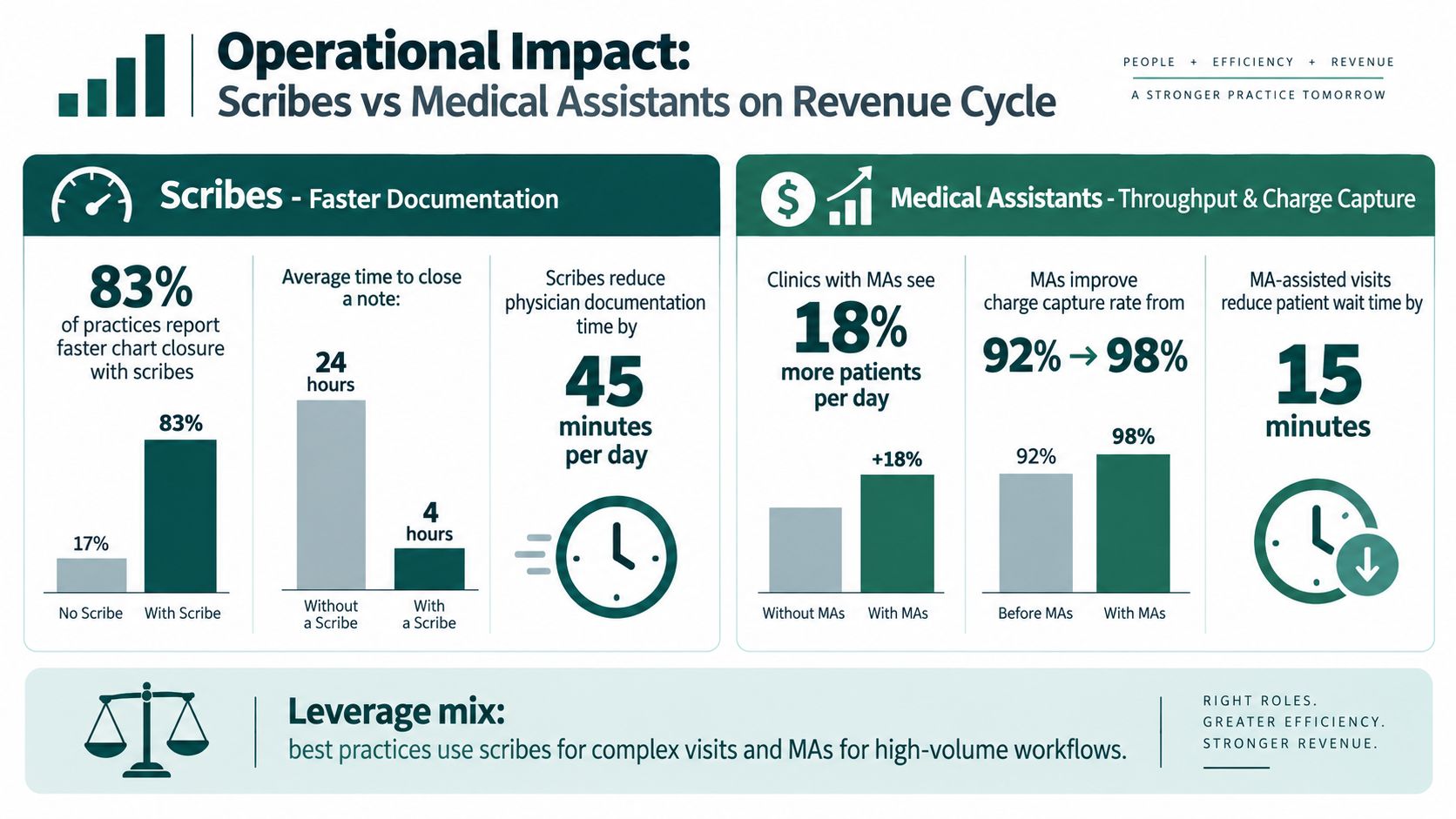
Scribing has a measurable effect on provider documentation time. In an outpatient study published through research on medical scribe efficiency, total physician documentation time fell from 7.6 ± 3.8 minutes per note without a scribe to 4.7 ± 2.9 minutes with a scribe. In-visit documentation time fell from 5.9 ± 3.1 minutes to 2.8 ± 2.2 minutes.
The same source reports that a pediatric primary care study found charting time per patient decreased by 3 minutes 28 seconds, while note finalization improved from 0.96 days to 0.26 days. Those figures don't guarantee the same outcome in your practice. They do show why a scribe is most relevant when providers lose time to charting, delayed note closure, or documentation completed after clinic hours.
A scribe doesn't replace provider review. The provider must still verify the note, orders, diagnoses, and treatment plan. Poorly trained scribes can create new work through inaccurate wording, missed details, or improper template use, so quality review should be part of the workflow from the beginning.
Assistants support front-end and visit throughput
Medical assistants affect revenue operations differently. They can help prepare patients, update information, coordinate follow-up, support insurance tasks, and reduce interruptions that cause rooming or scheduling delays. Depending on delegation and training, they may also support claims-related work, but the exact task boundary must be defined by the practice.
That contribution is indirect but broad. A clean intake supports accurate registration. Timely eligibility work can identify coverage issues before the visit. Reliable follow-up scheduling helps prevent unfinished administrative work from returning to the provider's queue. None of these activities should be described as a guaranteed revenue increase. Their value depends on execution, payer rules, staffing coverage, and the practice's existing process.
For managers reviewing the full cycle, this RCM guide for small practices provides useful context for connecting front-end work, claims processes, denials, and follow-up. If the main issue is billing execution rather than clinical rooming, a focused medical billing support service may fit better than either a general assistant or a scribe.
Match the hire to the queue
Audit the queue that consumes the most expensive time:
- Chart queue: Choose documentation support when providers spend substantial time completing notes.
- Rooming queue: Choose an assistant when patients wait for intake, vitals, or room preparation.
- Call queue: Choose an assistant or receptionist function when phones and scheduling are the constraint.
- Billing queue: Assign trained revenue-cycle staff when claims, denials, eligibility, or authorizations are stalled.
The mistake is hiring a scribe and expecting the person to solve front-desk overload, or hiring an assistant and expecting consistent real-time documentation without training and protected time.
Which Role Fits Your Practice by Specialty and Workflow
A role can look ideal on paper and still fail if the clinic cannot recruit, retain, and schedule that person consistently. With hiring scarcity persisting, prioritize the function you can staff reliably for the next year, then cover the other queue with virtual support, workflow changes, or AI-assisted tools. The practical question is which work must happen on site and which work can be completed safely elsewhere.

High-volume primary care
Primary care often has two competing pressure points. Providers may leave visits with unfinished notes, while staff manage calls, rooming, medication lists, referrals, and follow-up scheduling. If chart completion is delaying the next visit or extending the workday, a scribe may provide the more direct solution. If patients wait for intake, vitals, room readiness, or basic coordination, an assistant should take priority.
A hybrid arrangement can work when the assistant has protected documentation time and is not pulled into front-desk duties during the encounter. Without that boundary, one employee carries every queue and handles none of them consistently. Set coverage rules before hiring, including who handles interruptions and who owns unfinished work.
Specialty procedure clinics
Procedure-heavy practices generally need on-site clinical support first. Preparation, equipment, room turnover, patient instructions, and supervised clinical tasks affect whether the schedule stays on track. A scribe can help when providers produce detailed notes, but documentation support should not reduce attention to safe preparation or recovery procedures.
Define procedure-related duties in writing. The assistant's responsibilities must match provider supervision, state requirements, training, and clinic policy. Remote staff can handle records, authorizations, scheduling, and documentation preparation. They cannot perform hands-on clinical work from a distance.
Mental health groups
Behavioral health practices often face documentation pressure alongside portal messages, scheduling changes, forms, records requests, and continuity-of-care communication. A scribe can help the clinician remain focused during sessions. An administrative coordinator can manage appointment requests, forms, records, and follow-up messages.
Remote access requires role-based permissions, approved systems, written escalation rules, and a business associate agreement where applicable. Practices evaluating vendors can review cloud-based healthcare security solutions, then confirm their specific obligations with qualified compliance counsel.
Multi-site groups and AI-assisted workflows
A multi-site group may gain more from standardization than from adding the same role at every location. One site may need rooming coverage, another may need note completion, and a central team may handle scheduling, eligibility, authorizations, and records. A shared virtual function can cover selected administrative queues while local employees manage patient-facing work.
AI documentation tools offer another staffing option, but they do not replace clinical judgment, patient-facing support, or human review. A 2025 systematic review and 2026 multi-center research presentation describes reduced documentation burden and inbox workload, including 16 minutes saved in documentation time and 13 fewer minutes in the record per eight hours of patient care in a large 2026 study across five academic centers. Results varied by site. Define the queue first, select the tool for that queue, and assign a person to review its output.
The Takeaway
A medical scribe is usually the right first hire when providers lose time to real-time documentation, unfinished notes, and after-hours charting. A medical assistant is usually the better first hire when the practice needs rooming, vital signs, procedure preparation, scheduling, insurance support, and broader front-office coverage. The roles overlap in EMR use, but their operational purpose remains different.
Start with a short workflow audit. Identify where work waits, map each task to the correct role and supervision level, verify state-specific scope requirements, and define the quality checks before posting the job. If one hire can't cover the bottleneck, use a staged model, such as local clinical support paired with remote administrative coverage or a documentation tool with human review.
Medical Virtual Assistants connects U.S. practices with pre-vetted LATAM healthcare professionals for U.S.-hours coverage across reception, scheduling, documentation, billing, authorization, and patient coordination. If your staffing plan needs targeted support rather than another broad job description, visit Medical Virtual Assistants to review available role options.