

The ugly little truth about medical billing services is that they're usually judged when the practice is already bleeding cash. Full schedule, phones ringing, charts moving, and still the money shows up late, incomplete, or not at all. That's not a “billing problem.” That's a revenue problem wearing a headset and a polite smile.
KFF's 2024 insurer data says HealthCare.gov carriers received about 496 million claims, and roughly 85 million in-network claims were denied, which works out to an average 19% in-network denial rate and 37% out-of-network denial rate. In plain English, nearly 1 in 5 in-network claims needed follow-up, correction, appeal, or write-off, so billing isn't back-office paperwork, it's the part of the machine that decides whether work becomes cash (KFF denial data summary). If your team is busy but your cash is slow, you don't have a production problem. You have a claims-control problem.
That's why I'm blunt about this: the right billing support isn't about “sending claims.” It's about preventing avoidable denials, catching payer nonsense early, and getting paid before your AR turns into a museum exhibit. We'll get practical fast, because nobody needs another fluffy brochure about “streamlining workflows” while the overdue balances keep growing.
Introduction Why Your Billing Feels Broken Even When You Are Busy
A lot of practices live in this weird limbo where everyone looks slammed, yet collections still trail the work. The front desk is busy, the clinical team is backed up, and the billing inbox is full enough to qualify as a hazardous material site. Busy does not equal healthy.
The core issue is that billing is usually treated like a cleanup crew instead of what it is, the cash conversion engine. When claims slip, get denied, or age out, the practice doesn't just lose time, it loses power. A clean claim gets paid. A sloppy one gets stuck, and then somebody in your office gets to spend their afternoon chasing a payer who apparently enjoys making simple things weird.
The scale matters. KFF's 2024 insurer data showed wide variation, with in-network denial rates ranging from 3% to 36% across insurers and states, which is exactly why one-size-fits-all billing is a joke that keeps costing money (KFF denial data summary). Payer-specific workflows, documentation discipline, and follow-up rules aren't optional extras, they're how you keep cash moving.
So here's the promise. By the end, you'll know what medical billing services do, what they should cost, how to judge whether they're working, and when outsourcing beats suffering heroically in-house. If you've ever wondered whether your billing is merely annoying or broken, you're in the right place.
How Medical Billing Services Actually Work From Charge to Cash
Think of the revenue cycle like an airport baggage system. The bag leaves the plane, gets scanned, routed, checked, re-routed, and hopefully lands on the right carousel. When it works, nobody notices. When it breaks, everyone is standing around annoyed and asking who touched the bag.
From the visit to the claim
It starts with charge entry and coding review. Someone has to make sure the visit, procedure, diagnosis, modifiers, and payer rules line up before anything leaves the building. That's where good billing support earns its keep, because a claim that's coded badly is already half-denied.
Then comes claim scrubbing and submission. Scrubbing is just a fancy word for catching obvious mistakes before the payer does. Wrong member data, missing modifiers, mismatched diagnosis linkage, expired authorization, bad place-of-service, all the usual gremlins get filtered here. If your scrubber is weak, you're basically paying staff to mail problems.
Your insurance verification process matters earlier than many expect, because bad eligibility work turns into claim drama later. A solid verification workflow is worth studying at the front end, and this practical guide to insurance verification is a useful reference if your check-in process keeps tripping over the same insurance issues.
Practical rule: if the front-end data is weak, the back-end billing team spends its life cleaning up messes that should never have been created.
From payment posting to patient balance
Once the payer sends money or a denial, the next step is payment posting. That's not just bookkeeping. It's where contract variances, underpayments, and weird payer behavior show up if anyone is looking. After that comes denial management, appeal prep, payer follow-up, and finally patient statements.
The point is simple. Clean claims move quickly, denials move slowly, and unresolved claims age into cash flow pain. When billing services are doing their job, they're not just processing transactions. They're protecting the practice from avoidable leakage, one payer rule at a time.
The Denial Problem No One Warned You About
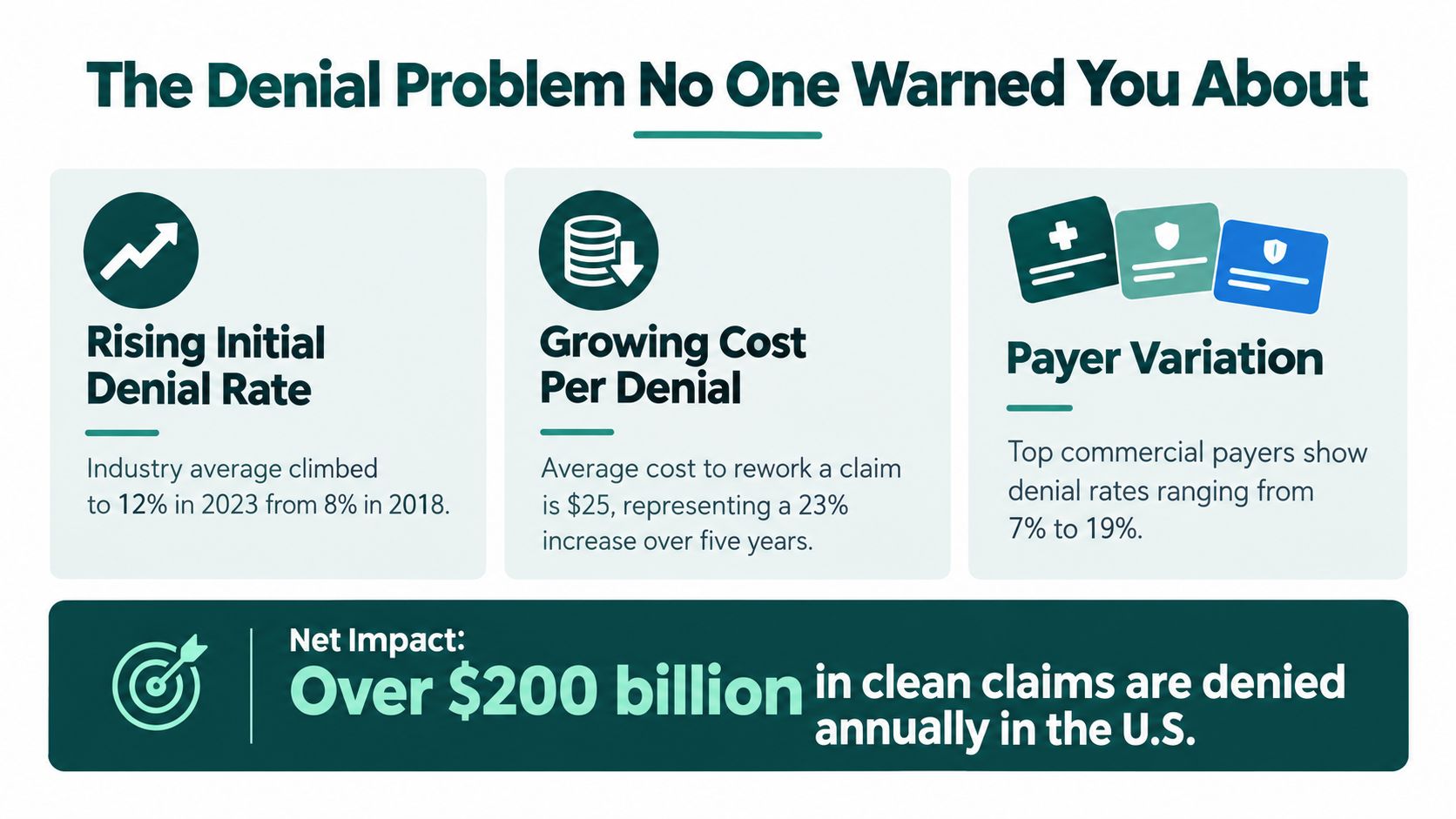
Denials aren't just more common. They're more expensive, more selective, and more irritating in all the wrong places. The old school view was that denials were mostly a volume problem. Not anymore. Now the smart money is on margin impact per denial, because a low-value denial that gets fixed in 20 minutes is not the same beast as a high-dollar denial tied to prior auth, medical necessity, or a payer that likes moving the goalposts for sport.
HFMA reported initial claim denials climbed to nearly 12% in 2024, up 2.4% year over year, while industry reporting tied to Optum put the all-payer denial rate at about 12% in 2023, up from 9% in 2016 (industry reporting on denial trends). That's not random noise. That's a slow grind toward more operational friction, more staff time, and more revenue at risk. The same reporting estimated about $262 billion in U.S. medical claims were initially denied out of roughly $3 trillion submitted annually, which is a giant pile of avoidable chaos if your workflow is sloppy.
Not all denials deserve equal attention
The common mistake is treating every denial like it deserves the same amount of oxygen. It doesn't. Medical necessity, prior authorization, and payer-specific policy mismatches tend to hit margin harder than routine data fixes because they consume more staff time and often sit closer to the payer's decision layer.
That's why the best billing teams don't just count denials. They sort them by payer, by category, and by expected recovery value. If a payer has a habit of denying the same service line, the answer is not more heroic follow-up. It's a better workflow, tighter documentation, and a smarter front-end gate.
The same logic applies to follow-up timing. Prior auth delays don't just irritate staff, they create claim aging and abandonment risk. The point isn't to “work harder.” It's to work the denials that move the margin needle.
Useful filter: if a denial category keeps showing up and the dollar value is real, fix the upstream workflow first. Chasing the same broken claim format again and again is billing theater.
If you want a decent mental model, use this: raw denial count tells you how noisy the room is. Payer-specific dollar exposure tells you where the fire is.
For a clean operational overview of prior authorization bottlenecks, the practical breakdown at insurance prior authorization is worth a look if your denials keep starting with “authorization not on file.”
Pricing Models for Medical Billing Services and What You Really Pay
Pricing is where a lot of practices get seduced by a pretty number and then discover the quote left out the annoying stuff. Cheap billing can be very expensive if it lets denials age, underpayments slip, and filing deadlines pass. The core question isn't “What's the lowest fee?” It's “What's the total cost of bad collections?”
| Medical Billing Pricing Models Compared | How It Works | Best For | Watch Out For |
|---|---|---|---|
| Percentage of collections | The vendor takes a cut of what gets collected | Practices that want aligned incentives and variable cost | Can quietly tax growth if the vendor's scope is vague |
| Flat fee per claim | You pay for each claim processed | High-volume, predictable claim flow | Can reward volume over quality if denial work isn't included |
| Flat monthly fee | One set monthly invoice for an agreed scope | Practices that want budget certainty | Scope creep, hidden add-ons, weak denial support |
| Hybrid or staffing-based model | A mix of service fee and dedicated support time | Practices needing coverage, control, and flexibility | Contract terms can get muddy fast if deliverables aren't explicit |
What good proposals actually include
A decent proposal should spell out claim submission, payment posting, denial follow-up, appeals, patient statements, timely filing support, and reporting. If those items are buried under vague language, you're not buying billing. You're buying surprises in monthly installments.
The best fit depends on practice size and claim complexity. A small office with one payer mix and simple workflows might prefer predictable monthly pricing. A busier multi-provider group often needs a model that keeps incentives aligned with collections, not just claim volume. If the vendor gets paid the same whether they fix denials or shrug at them, guess which behavior you'll get more of.
My rule: if a billing proposal doesn't clearly state who owns denial follow-up and timely filing tracking, keep your wallet in your pocket. Vague billing contracts are how practices end up mortgaging their patience and their margins.
Five KPIs That Tell You If Billing Is Working
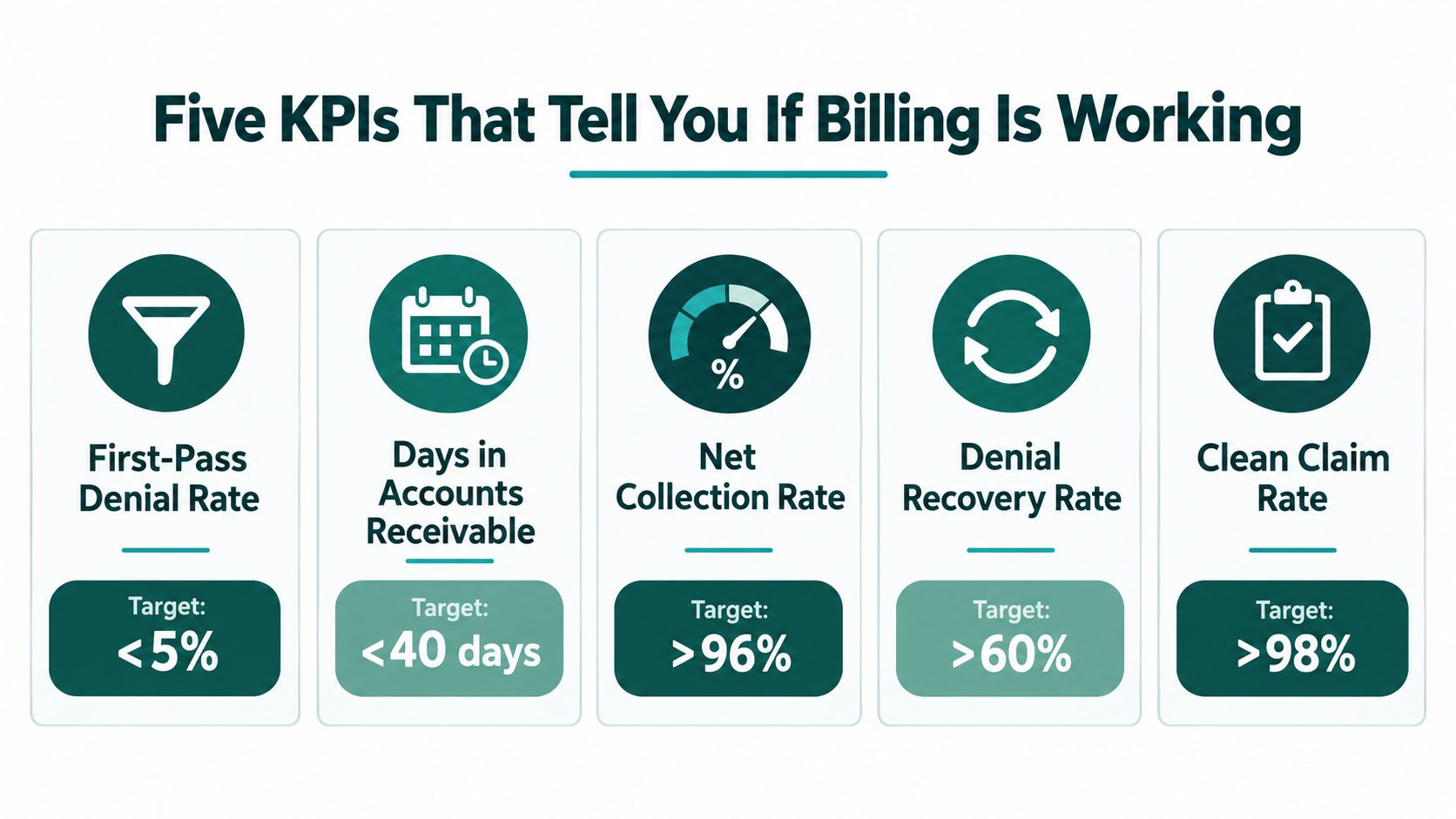
You don't need forty dashboards. You need five numbers that tell you whether cash is flowing or leaking. Everything else is decorative. Nice to look at, not useful in a fight.
The five that matter
First-pass denial rate tells you how many claims get kicked on the first go. A large U.S. physician-practice benchmark sits around 8% for first-submission denial rate, while broader reporting places initial denial rates around 11.8% to 12%, and private-payer initial denial rates near 15% (benchmark reporting). If you're consistently in the double digits, don't brag about follow-up heroics. Fix the front end.
Days in AR tells you how long your money is sitting in the waiting room. Net collection rate tells you how much of your allowable revenue makes it back. Denial recovery rate shows whether appeals are working or just producing more emails. Clean claim rate tells you whether your submission process is doing its job.
The smart move is to review these weekly, not monthly, in a short huddle. If first-pass denial rate is ugly, registration and coding need attention. If days in AR are bloated, follow-up cadence is too slow or payer queues are poorly managed. If clean claim rate is strong but net collections are weak, you've probably got underpayments or write-off leakage hiding in plain sight.
Claim filing deadlines also make speed essential. Payer limits often range from 90 days to one year from date of service, and can be as short as 15 to 30 days, so “we'll get to it next week” can turn into a write-off before anyone notices (AAFP on filing deadlines). That's why the best billing teams work like adults with a stopwatch, not philosophers with a backlog.
Quick operating rhythm: check the five KPIs every Monday, split denials by payer and reason, and assign follow-up the same day. If a metric is ugly on Friday and untouched by Wednesday, you don't have a dashboard. You have a museum exhibit.
Outsource vs In House How to Make the Right Call
People get weirdly sentimental about their office setup. “We've always done it in-house.” Great. And some practices have also always used fax machines, which doesn't make them wise. The right choice is not ideological. It's operational.
A business associate under HIPAA is any non-workforce person or entity performing functions or services for a covered entity that involve access to PHI, and HIPAA requires a written business associate contract with specific safeguards and obligations (HHS business associate guidance). That means any outside billing help has to be contractually clean, not just convenient.
In-house, outsourced, or hybrid
In-house gives you control and immediate proximity to the front desk, but it also gives you payroll, turnover risk, training time, and coverage gaps. If your best biller goes on vacation and the claims stop moving, that's not resilience. That's a single point of failure in scrubs.
Outsourced works when you need scale, payer expertise, and steady follow-up without adding internal headcount. It's especially useful when prior auth delays, denial volume, or labor shortages are chewing up your admin team. The tradeoff is that you need tighter vendor governance, stronger reporting, and a clear contract.
Hybrid is usually the least romantic but most practical choice. Keep key oversight in-house, outsource the grinding work, and let the outside team handle submission, denials, payer follow-up, and patient billing support. That way you're not trying to build a billing empire with three overworked humans and a whiteboard.
If you're evaluating staffing help alongside billing support, a medical virtual assistant can cover billing-adjacent tasks like eligibility verification, claim submission, denial management, payment posting, and patient billing while working client clinic hours inside EMR and phone systems. One factual option in that category is Medical Virtual Assistants, which places pre-vetted personnel for healthcare practices and includes placement and compliance support.
The decision rule I'd use
- Choose in-house if you have stable staff, low complexity, and someone owns the metrics.
- Choose outsourced if denials, follow-up delays, or staffing churn are already hurting cash.
- Choose hybrid if you want control at the top and help on the repetitive grind underneath.
If your team is spending half its day on payer queues and the other half apologizing for unanswered calls, the “do everything ourselves” model is already costing you more than a smarter setup.
For practices comparing staffing support options, the practical hiring and role breakdown in what a medical virtual assistant does is a useful reference when you're deciding what to keep internal and what to offload.
Your Next Move A Practical Checklist Before You Decide
Start with the boring stuff, because the boring stuff is where the money leaks. Pull your timely filing rules and make sure someone is watching them. Then look at your five KPIs side by side, not in isolated little silos where bad news goes to hide.
Next, sort denials by payer and reason, then ask the ugly question, which ones are hurting margin the most. A low-volume, high-dollar denial category deserves more attention than a noisy pile of cheap rejections. That's the difference between billing work and revenue management.
Then pressure-test staffing. If one person leaving can derail your billing, your model is too fragile. If prior auth, claim submission, and payer follow-up are all living in the same exhausted inbox, you already know the answer.
My blunt recommendation: fix the front-end defects first, then decide whether your current team can keep up with the follow-through. If they can't, bring in help before the backlog starts eating another quarter. Practices don't usually lose money in one big dramatic blow. They lose it in a hundred tiny delays, and then wonder why the bank account looks offended.
If your billing feels stuck in follow-up purgatory, Medical Virtual Assistants can take some of the load off with HIPAA-aligned staffing for eligibility checks, denial work, patient billing, prior auth, and related admin tasks. Visit Medical Virtual Assistants to see how a clinic-hours assistant model fits this kind of work without forcing a wholesale rebuild of your process.