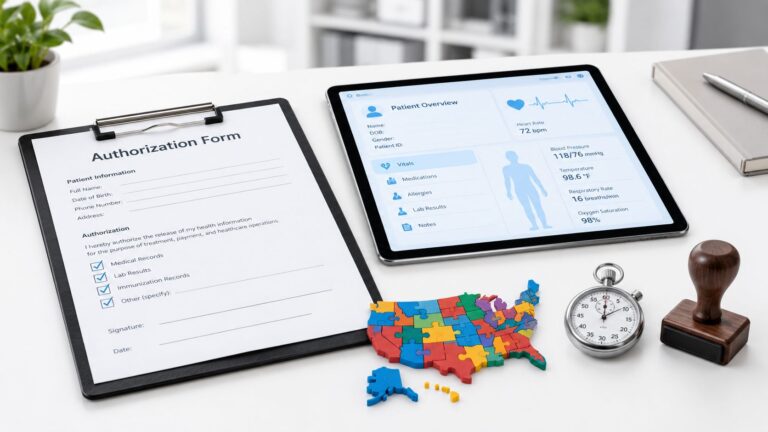

A patient arrives at the pharmacy on Monday morning expecting to start a newly prescribed medication. The pharmacist submits the claim, the system rejects it, and a short message says prior authorization required. The patient is directed to call the medical office, while the pharmacy sends a fax that may sit in a shared inbox until someone notices it. The prescription hasn't been denied clinically, but the patient still leaves without the medication.
That scene captures the practical problem with pharmacy prior authorization. The process is presented as a payer review, yet it often begins with a rejected claim at the pharmacy counter. The clinic then has to identify the reason for the rejection, collect supporting records, submit the request, monitor the decision, respond to denials, and confirm that the patient receives the drug.
Prior authorization is widespread in drug coverage, particularly for specialty therapies. It can protect formularies from inappropriate use, but it can also create delays, rework, confusion, and abandonment. This guide explains what happens after the rejection, how the workflow should be divided among staff, where electronic tools help, and why approval is only a midpoint rather than a completed access event.
What Happens at the Pharmacy Counter
The rejection becomes the patient's problem first
The pharmacist runs the patient's prescription through the pharmacy benefit system. Instead of a payable claim, the response may include a reject code indicating that the medication needs prior authorization, that the drug isn't covered, that a preferred alternative must be tried, or that the quantity exceeds the plan's limit. The message shown to the pharmacy may be abbreviated and may not explain the clinical documentation the payer expects.
The pharmacy places the prescription on hold. Staff may contact the prescriber through a fax, telephone call, electronic pharmacy message, or payer-linked portal. The patient may see only one part of this chain: a medication that isn't ready and a request to contact the doctor.
That communication gap matters. The pharmacist often knows that the claim failed, but not whether the prescriber has received the payer's criteria. The practice may receive a fax without a clear indication of whether the issue is a simple quantity correction or a full clinical review. The patient assumes one organization owns the entire problem, while responsibility is split across the pharmacy, prescriber, payer, and pharmacy benefit manager.
Practical rule: Treat every pharmacy rejection as an access event that needs an owner, not as a message waiting for someone to interpret later.
Soft and hard rejects require different responses
A soft reject may allow the pharmacist to resolve the issue through an override, clarification, quantity adjustment, or direct outreach. For example, the pharmacy may be able to correct a billing detail or ask the prescriber to resend a prescription that fits the plan's limits. A pharmacist-initiated intervention can sometimes prevent a formal prior authorization from entering the clinic queue.
A hard reject generally requires prescriber action. The pharmacy can't override the payer's clinical requirement, and the clinic must submit information such as diagnosis, treatment history, laboratory findings, or evidence that preferred alternatives weren't appropriate. Staff should record the exact rejection message and any reference number before contacting the payer or pharmacy.
The distinction isn't always obvious from a fax. A practice that treats every message as a standard prior authorization may waste time on an issue the pharmacist could resolve. A practice that assumes every rejection is administrative may miss a hard clinical requirement and delay treatment further.
The counter is the first handoff
Prior authorization expanded steadily in Medicare Part D. One industry summary reported that it applied to 8% of covered drugs in 2007 and 24% in 2019, while Medicare prescription drug plans and Medicare Advantage prescription drug plans reached 28% and 26% of drugs subject to prior authorization in 2021, respectively (industry summary of prior authorization utilization). Specialty drugs face a heavier burden, with prevalence above 40% in several therapeutic areas, including multiple sclerosis, chronic myeloid leukemia, multiple myeloma, psoriasis, and rheumatoid arthritis, according to the same cited analysis.
The pharmacy counter therefore isn't an edge case. It's often the front door to a workflow that affects specialty care, maintenance therapies, and new prescriptions alike.
How Pharmacy Prior Authorization Works
Start with the claim, not the form
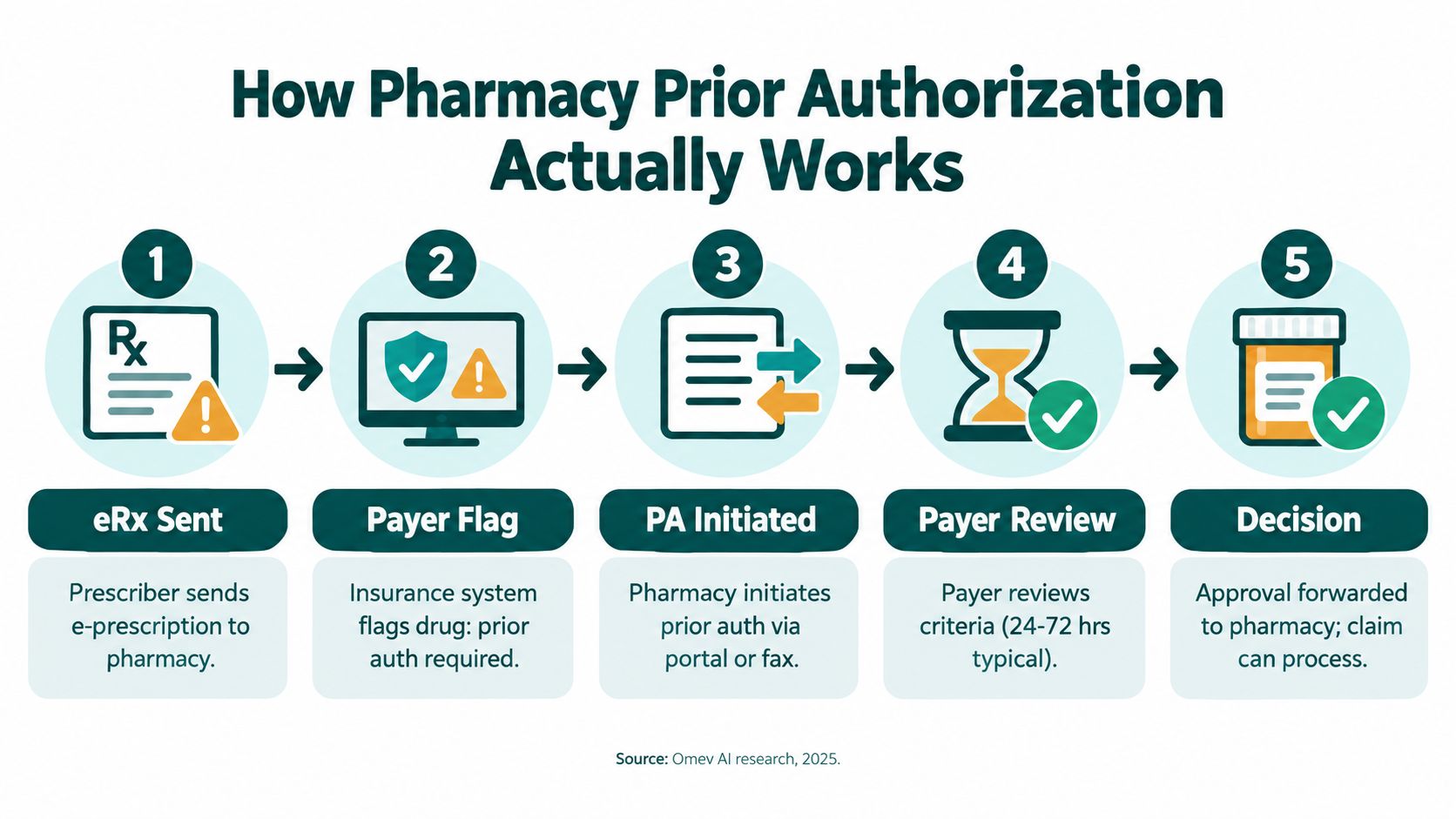
At the pharmacy counter, the process starts with a rejected claim, not a completed authorization form. The sequence usually looks like this, although payer portals and pharmacy benefit managers can change who handles each step:
The prescription reaches the pharmacy. The pharmacy submits the claim to the patient's pharmacy benefit. If prior authorization is required, the response identifies the coverage obstacle and may indicate whether the issue involves authorization, coverage, routing, or another claim condition.
The clinic confirms the requirement. Staff should verify the rejection reason, payer, member information, drug, strength, quantity, and dispensing pharmacy. An outdated insurance record or incorrect payer can create what appears to be a clinical problem.
The request is initiated. The pharmacy may start the request, or prescriber staff may submit it through an electronic portal, EHR workflow, fax, or telephone process. The practice needs to confirm which route the payer accepts for that product and plan.
The payer reviews the criteria. Reviewers may assess diagnosis, labeled use, prior treatment, contraindications, laboratory findings, quantity, and prescriber information. Some requests can be resolved from the submitted records. Others require clarification, an appeal, or a peer-to-peer conversation.
The pharmacy receives the decision. Approval does not dispense the medication automatically. The pharmacy still has to reprocess the claim, confirm the prescription is routed correctly, and address any remaining cost, network, quantity, or availability issue.
Match documentation to the payer's question
Build the request around the specific coverage rule rather than a generic clinical narrative. If the payer asks whether the patient tried a preferred drug, provide the medication name, dose, dates, response, and reason for discontinuation. If it requests a laboratory value, submit the result, date, and relevant reference information. For use outside the labeled indication, explain the medical rationale and supporting evidence without claiming that the plan covers more than its policy allows.
A new start may require the initial diagnosis and baseline documentation. A maintenance medication may require evidence of continued response, adherence, monitoring, or prior approval history. Staff should check the authorization's expiration date and determine whether the next request is a renewal instead of a new submission.
The pharmacy benefit manager generally administers coverage for drugs dispensed through a pharmacy. A medication administered in a clinic may route through the medical benefit instead, with different forms, coding, vendors, and review rules. The same active ingredient can therefore follow different authorization paths based on its formulation, administration site, and billing method.
For a plain-language explanation of the operational handoffs, practices can review PatientNotes prior authorization insights. Practices serving Medicaid patients may also need Medicaid prior authorization support, since portal requirements, state rules, and renewal processes can differ.
A pharmacy prior authorization utilization analysis reported that approximately 70% of prior authorization requests begin at the pharmacy after a rejected claim. In the same transaction-level evidence, only 7% were approved on the patient's first fill attempt, while 54% were ultimately approved. The practical lesson is direct: capture the rejection early, assign follow-up, and track the claim through the pharmacy's next billing attempt. A “submit and wait” workflow leaves too many requests stalled between the counter and the clinic.
Common Denial Reasons and How to Address Them
Denials fall into two practical groups. Clerical denials involve member details, prescriber identifiers, incomplete forms, wrong pharmacy routing, or missing signatures. Clinical denials involve medical criteria, preferred alternatives, diagnosis, quantity, or evidence. Route clerical issues to the staff member who can correct the transaction. Send clinical disputes to the prescriber or clinical reviewer.
The strongest appeal doesn't argue that the drug is generally valuable. It explains why this patient meets the plan's stated criteria and why the requested treatment is appropriate now.
| Denial reason | What the payer wants | Documentation to submit | Typical outcome with strong evidence |
|---|---|---|---|
| Step therapy not met | Proof that preferred alternatives were tried or aren't appropriate | Medication history, dates, doses, response, adverse effects, and contraindications | The payer may approve after the sequence is documented or an exception is supported |
| Diagnosis doesn't match labeled criteria | A covered diagnosis or a substantiated exception | Assessment, relevant chart notes, diagnostic findings, and a focused medical-necessity explanation | The request may be reconsidered if the diagnosis was entered incorrectly or the exception is allowed |
| Quantity exceeds plan limits | A reason the higher quantity is clinically necessary | Dosing rationale, treatment schedule, prior response, and the plan's applicable limit | A corrected quantity may process, or an exception review may follow |
| Drug is non-formulary | Medical necessity for an exception | Preferred-drug history, intolerance, contraindications, and supporting clinical literature when relevant | Approval depends on the plan's exception criteria |
| Lab values are missing | Objective evidence tied to the policy | Dated laboratory results, relevant ranges, and interpretation in the clinical record | A complete submission can resolve an otherwise incomplete review |
| Preferred alternative failure isn't documented | A clear record of treatment failure | Chart notes showing inadequate response, adverse effects, or clinical unsuitability | The payer may accept the exception when the record directly answers the requirement |
Write to the criterion
A useful appeal sentence has three parts: the patient's condition, the failed or unsuitable alternative, and the requested exception. For example: “The patient has [diagnosis] and experienced [documented response or adverse effect] with [preferred alternative] during [treatment period]. Because [specific clinical reason], I'm requesting coverage of [drug and dose] under the plan's medical-necessity exception.”
Don't attach a large undifferentiated chart and expect the reviewer to find the answer. Highlight the relevant visit note, medication history, laboratory result, and prior authorization reference. Peer-reviewed evidence can support the rationale when the plan permits it, but published literature won't repair a missing diagnosis or an absent treatment history.
Practices should maintain a payer-specific denial log. Record the drug, plan, rejection reason, missing item, submission route, decision, and next action. Over time, that log can reveal recurring clerical errors, outdated templates, or payer criteria that staff should check before the prescription reaches the pharmacy.
A dedicated insurance prior authorization workflow can help separate intake, clinical review, submission, follow-up, and appeal ownership. The value comes from consistent execution, not from assigning every denial to the same person.
Urgency Pathways and Decision Timeframes
At the pharmacy counter, a patient may have only a few doses left when the claim rejects. The practice should choose the response based on clinical urgency, drug type, payer rules, and current supply. “Urgent” means that standard processing could materially affect care or cause an inappropriate interruption. It does not mean the office wants a quicker answer.
| Pathway | Typical timeframe | Qualifying criteria | Federal coverage under CMS-0057-F |
|---|---|---|---|
| Standard | Payer-specific, often several business days or longer | Routine initiation, renewal, or exception request without immediate clinical risk | CMS requires 7 calendar days for covered standard requests, but the rule's decision-time requirements do not apply to drugs |
| Expedited | Payer-specific and clinically justified | Delay could seriously jeopardize the patient's life, health, or ability to regain maximum function | CMS requires 72 hours for covered expedited requests, with the drug exception noted above |
| Emergency supply or emergency route | Defined by payer or state program | The patient needs temporary access while formal review is pending | Rules vary by program and state, so staff must verify the applicable requirement |
The table requires careful interpretation. CMS's final rule applies to Medicare, Medicaid, CHIP, and Marketplace payers covered by the rule. CMS states that covered payers will generally need to implement prior authorization API requirements beginning January 1, 2027. The rule also requires specific denial reasons beginning in 2026, while its decision-time requirements do not apply to drugs. See the CMS interoperability and prior authorization final rule.
A Medicare Advantage or Medicaid patient therefore does not automatically receive a seven-day or 72-hour pharmacy decision. Staff must confirm whether the request concerns a drug or a service, whether the payer falls within the rule, and which pharmacy-benefit standards the plan applies.
Use a defensible urgency note
An expedited request should describe the risk of delay rather than rely on the word “urgent.” Include the diagnosis, current symptoms or treatment status, medication, consequence of interruption or delay, and requested response time. The prescriber makes the clinical judgment. Staff must send the explanation with the supporting records and confirm that the payer received them.
For Medicare Advantage Part D drugs, the plan's expedited process may use a faster window than the federal rule described above. Medicaid programs may provide emergency supplies under state or plan rules. Commercial plans differ, so staff should follow the plan's published instructions and document the representative's name, call reference, date, and promised timeframe.
The counter outcome still depends on follow-up. A request marked urgent can remain unresolved if the pharmacy, payer, and practice do not share the same status, so assign ownership for checking the claim and updating the patient.
Electronic Prior Authorization and the Federal Rule Shift
Electronic prior authorization can remove manual handoffs, but it does not remove payer criteria or incomplete records. A useful setup connects prescribing with benefit information, identifies requirements before the patient reaches the pharmacy, and carries structured clinical data into the request. That timing matters at the counter, where an unresolved electronic request can still become a rejected claim or an abandoned prescription.
Common components include NCPDP SCRIPT transactions for pharmacy-benefit workflows, payer portals for plans that use a different route, and EHR prompts that appear when a prescriber selects a medication. Electronic benefit verification and real-time prescription benefit tools can show coverage conditions, restrictions, or a prior authorization flag earlier in prescribing. They also expose a practical trade-off. A covered alternative may be easier to obtain, while the clinically preferred drug may require a complete exception request.
What the federal rule changes
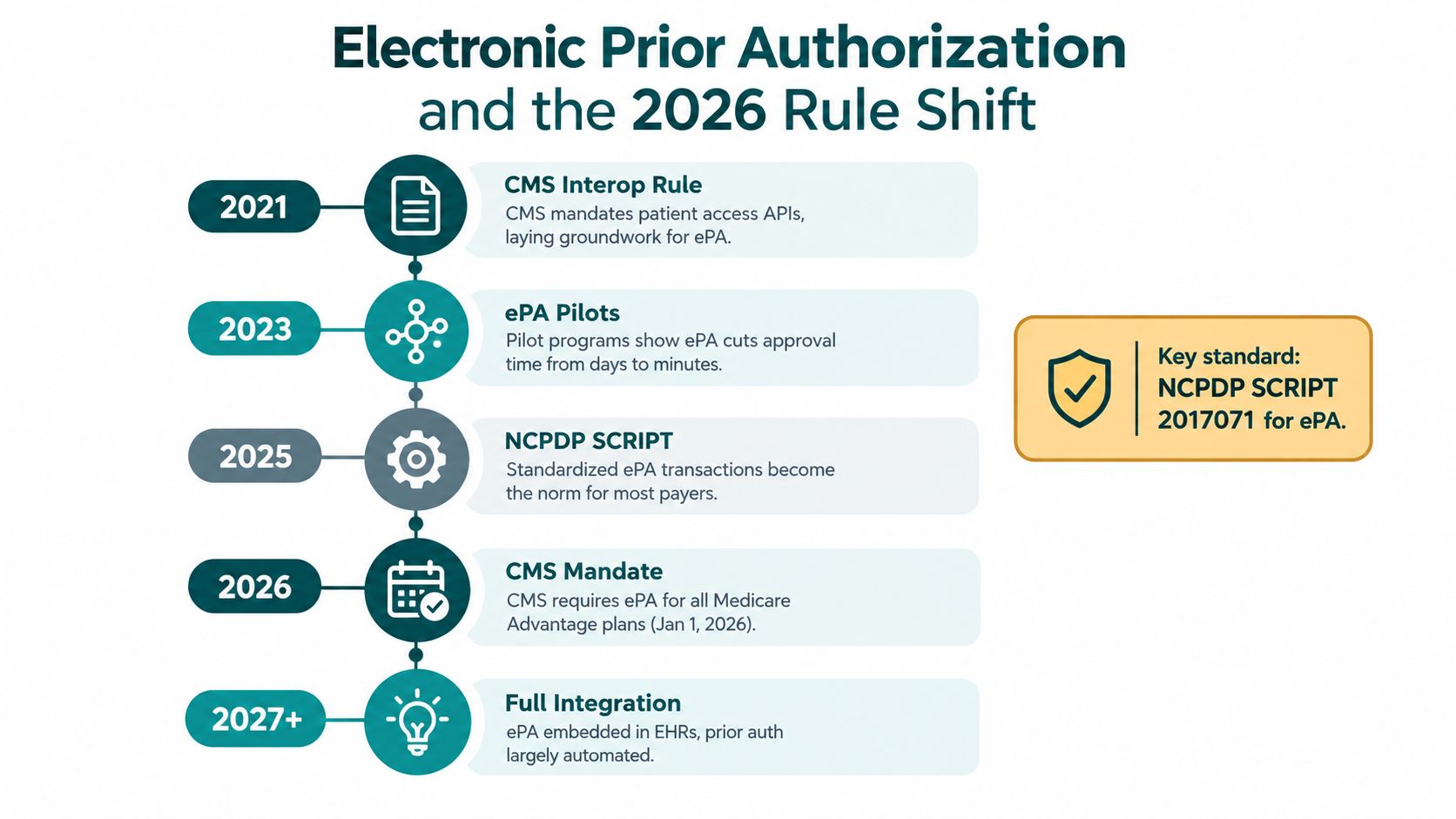
CMS's rule addresses interoperability and prior authorization for covered medical items and services. It requires affected Medicare Advantage, Medicaid managed care, CHIP, and certain Marketplace payers to support applicable APIs and provide decision information within specified timeframes. The rule's decision-time provisions do not cover pharmacy-benefit drug decisions, so practices must separate medical-service requirements from drug-authorization procedures. The CMS implementation information explains the implementation timeline and scope.
The timeline spans the 2026 denial-reason requirements and API deadlines beginning in 2027. For pharmacy teams, the operational question remains immediate: which requests follow federal requirements, and which follow the plan's pharmacy process? A portal may be electronic while still requiring manual document selection, separate credentials, or a phone call. Electronic submission does not prove that the request is complete or that the pharmacy received the determination.
CMS's Part D guidance requires sponsors to submit utilization-management rules at the point of sale, including prior authorization, step therapy, and quantity limits that are not based on FDA maximum daily dose limits. It also identifies practices that are not allowable, including steering physicians or beneficiaries toward a sponsor's or PBM's mail-order pharmacy through prior authorization (CMS Part D Benefits Manual).
Automation still needs human review
Specialty injectables, biologics, oncology medicines, and other complex therapies often require information that the EHR does not structure reliably. A reviewer must confirm that the diagnosis, treatment history, laboratory findings, and requested dose match the payer's criteria. Practices should test whether electronic submissions produce traceable confirmations and whether staff can see pending, approved, denied, and expired requests in one queue.
The workable design is controlled automation. Software reduces repetitive entry, while staff handle clinical judgment, exceptions, patient communication, and escalation. That division protects the patient from a silent gap between electronic approval and what the pharmacy can dispense.
Templates and Workflow for Prescribers and Staff
A pharmacy prior authorization process works better when each handoff has a named owner. The prescriber makes the clinical decision. Staff gathers and transmits records. The pharmacy reports the claim response and dispensing status. A manager monitors aging requests and escalates exceptions.
Ready-to-use communication templates
Prescriber-to-pharmacy callback
“This is [practice name], calling about [patient name or identifier] and [drug, strength, and quantity]. Please provide the exact reject message, the payer reference number, whether this is a soft or hard reject, and the accepted submission route. We'll confirm the next action and document it in the patient's authorization record.”
Prescriber-to-payer medical-necessity request
“Patient: [name]. Diagnosis: [diagnosis and ICD-10]. Requested medication: [drug, strength, dose, and quantity]. Preferred alternatives tried: [names, dates, doses, response, and reason stopped]. Relevant laboratory values: [test, result, and date]. Clinical reason for exception: [concise patient-specific rationale]. Please review under the plan's applicable exception criteria.”
Patient message when treatment is delayed
“Your pharmacy reported that the insurance plan requires prior authorization for [medication]. Our office has submitted the request or is gathering the information needed to submit it. We'll update you when we receive a decision. Please contact us promptly if you're running out of an existing medication or if your condition worsens.”
The patient message should never promise approval or imply that the pharmacy alone controls the timeline. Practices can adapt these scripts alongside top business process documentation templates to create consistent internal procedures.
Assign work by role
| Role | Primary responsibility | Required handoff |
|---|---|---|
| Prescriber | Confirm indication, clinical urgency, alternatives, and medical rationale | Signs or approves the request and participates in peer-to-peer review when needed |
| MA or LPN | Gather chart notes, medication history, laboratory results, and payer details | Sends a complete packet to the authorization queue |
| Prior authorization specialist | Submit, track, respond, appeal, and document every status change | Reports pending, denied, approved, and aging requests to the practice manager |
| Pharmacy technician | Capture the exact rejection, reference number, and pharmacy status | Communicates whether the claim processed and whether the medication is available |
| Front office or patient coordinator | Notify the patient and confirm pickup or next pharmacy action | Records contact attempts and unresolved barriers |
A remote authorization specialist can fit into this model when request volume is uneven, staff coverage is limited, or clinicians are spending time on payer follow-up. The role should have restricted access, documented escalation rules, and no authority to make a clinical decision. Practices evaluating that option can review the responsibilities of a prior authorization specialist.
Workstation checklist
- Capture the rejection: Record the exact message, date, pharmacy, payer, drug, quantity, and reference number.
- Classify the issue: Mark it clerical, clinical, soft reject, hard reject, renewal, standard, or expedited.
- Confirm ownership: Assign one staff member and a due date.
- Collect evidence: Attach the diagnosis, treatment history, labs, and relevant chart note.
- Submit and verify: Save the confirmation number and submission route.
- Schedule follow-up: Set a payer-specific check date instead of relying on memory.
- Escalate deliberately: Contact the payer when the stated timeframe passes or the request remains untraceable.
- Close the loop: Confirm approval, claim adjudication, pharmacy availability, patient notification, and pickup status.
Track submission time, decision time, denial reason, appeal status, and final fill outcome. A workflow can't improve what the practice doesn't record.
Why Approval Does Not Always Mean the Patient Fills
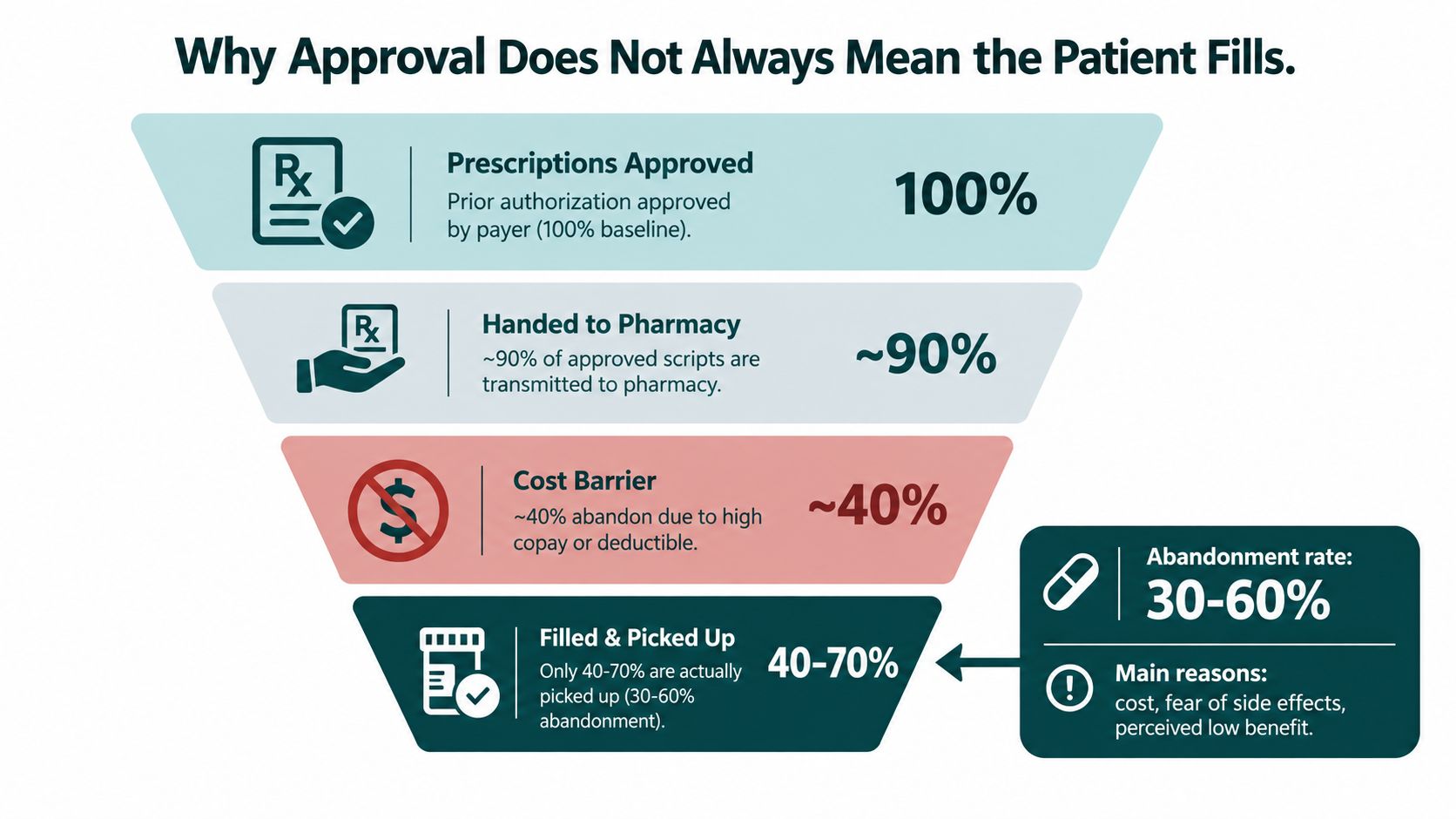
A payer approval can arrive while the prescription still sits unresolved at the pharmacy. In transaction-level evidence involving 205,896 branded medication dispensations initially rejected for prior authorization, 35% were processed in one day. The remaining 65% took a median of 6 days to resolve, and only 54% were ultimately approved. Approval is therefore a midpoint, not proof that treatment started.
The final barrier may be the pharmacy claim, the patient's cost, network routing, inventory, transportation, or uncertainty about the next step. A patient may hear that the authorization was approved but receive no call that the prescription is ready. A specialty medication may need transfer to an in-network pharmacy. A later refill can fail because the authorization expired or the approved quantity was exhausted.
Find the dropout point
Keep the case open until the dispensing process has been checked. A practical post-decision sequence includes:
- Same decision day: Confirm that the approval reached the dispensing pharmacy and that the claim processes.
- Next business-day check: Ask whether the medication is available and whether the patient has been notified.
- Patient contact: Confirm the expected pickup, delivery, specialty-pharmacy transfer, or remaining barrier.
- Exception handling: Send cost, network, or clinical questions to the appropriate staff member.
- Renewal planning: Record the authorization expiration and begin renewal work before the final fill is at risk.
A useful dashboard separates approved, filled, picked up, transferred, patient unreachable, and abandoned. Those categories identify whether the practice has a submission problem or a post-approval access problem. The counter is where that distinction becomes visible.
The systematic review in the Journal of Managed Care & Specialty Pharmacy found that pharmacy prior authorization can delay treatment initiation by 3.6 to 31 days, depending on drug class, with payer processing times ranging from 6.7 to 21 days (systematic review of prior authorization delays). The operational implication is clear: staff must follow the request after submission and continue checking after approval.
A tightly controlled workflow can produce a different result. A multicenter retrospective study of 1,744 specialty-medication submissions found a mean turnaround time of 2.1 days in an integrated, electronic, centralized specialty-pharmacy process (peer-reviewed electronic prior authorization study). That result is not a promise for every practice. It shows how completeness checks, standardized documentation, centralized tracking, and immediate escalation can shorten delays.
Ask one practical question: “Where did access stop?” If staff cannot answer, the authorization was not managed to completion.
The 2025 Surescripts survey found that 29% of patients reported a prior-authorization delay in the previous 12 months, rising to 36% among patients taking two or more daily prescriptions (Surescripts prior authorization survey). Those patient-reported results support follow-up after approval as part of access management, rather than an optional courtesy.
The Takeaway
Pharmacy prior authorization begins at the counter, but it ends only when the patient can obtain and use the medication. Practices should capture the exact rejection, assign ownership, submit evidence that answers the payer's criteria, monitor the decision, and confirm the pharmacy claim and patient pickup.
Build the workflow around the points where requests fail, especially unclear handoffs, incomplete documentation, missed follow-up, and post-approval barriers. Review payer-specific rules regularly, distinguish pharmacy-benefit drug requirements from medical-benefit processes, and confirm how CMS requirements apply to the particular request before promising a timeframe.
Medical Virtual Assistants connects U.S. medical practices with pre-vetted LATAM staff who can handle prior authorization submission, tracking, payer follow-up, and patient-status communication during your clinic hours. If your team needs consistent ownership of the authorization queue, visit Medical Virtual Assistants to discuss the role and workflow that fit your practice.