

A Tuesday morning at the front desk is usually where medical billing in the USA starts to go wrong. Someone swipes the wrong insurance card, the scheduler misses secondary coverage, the visit note gets coded before the diagnosis is fully confirmed, and the claim bounces back weeks later. By then, the problem isn't “just billing” anymore. It's a chain of avoidable handoff failures that slow cash, create patient confusion, and force your team into rework.
The practical answer is simple: medical billing is a connected revenue system, not a back-office task. It starts before the visit with eligibility and authorization checks, moves through documentation and coding, then ends only when payment is posted, reconciled, and followed up. That's why front-desk accuracy, coding specificity, denial management, and patient communication all belong in the same operating model.
For small and mid-sized practices, that shift matters. You don't need a giant billing department to run this well, but you do need clear ownership, clean workflows, and realistic expectations about where revenue leaks happen. The sections below break down the claims pipeline, payer mix, denials, compliance, staffing models, and the daily habits that move cash.
What Medical Billing in the USA Actually Means
A lot of practices still talk about billing as if it starts when the claim leaves the office. That's too late. By then, the front desk has already captured or missed coverage, the clinical team has already documented the visit, and the biller is left cleaning up problems that were created upstream.
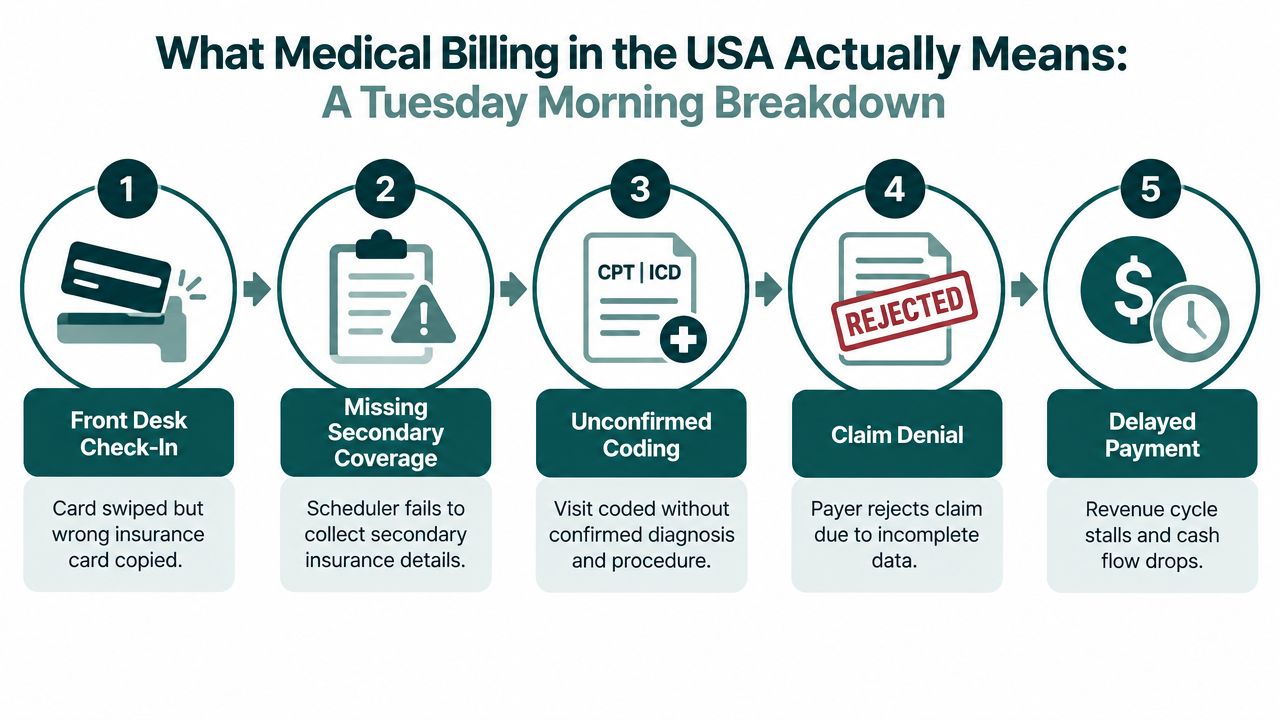
Billing begins before the patient is seen
In a functioning practice, billing starts at scheduling. Staff verify the patient's plan, check whether a referral or prior authorization is required, and confirm whether there's secondary coverage. If that doesn't happen, the visit may still be medically appropriate, but the claim can still be incomplete.
That's why the most valuable billing work often happens before the encounter, not after it. A clean front-end process gives the biller a better chance of producing a clean claim, and the payer a better chance of paying it without delay. It also reduces the need to re-contact patients later for information they should've been asked for at intake.
Billing is really three jobs at once
Operationally, billing has three core functions. First, it translates clinical work into code sets that payers understand. Second, it sends the claim through the right path, usually through a clearinghouse, with all required fields intact. Third, it follows the money until payment is posted and the account is closed.
That last part gets ignored too often. Posting an electronic remittance advice isn't the end of billing if the patient still has a balance, the payer underpaid, or the denial needs an appeal. In a practice that runs well, the billing team sits between the front desk, the clinicians, the coder, and collections, and everyone understands that a miss in one place becomes work in another.
Practical rule: if a claim keeps getting denied for the same reason, the fix is rarely “resubmit faster.” The fix is usually in registration, documentation, or authorization.
The easiest way to think about billing is as a measurable system. You can inspect eligibility accuracy, coding precision, clean-claim rates, denial reasons, days in A/R, and patient collection behavior. Once you treat it that way, you can improve it like any other operational process.
The Claims Pipeline From Check-In to Payment
The claims pipeline works best when each handoff has a named owner. In smaller practices, that may be one biller wearing several hats. In larger groups, it may involve schedulers, medical assistants, coders, billers, and a revenue-cycle lead. Either way, the order of operations matters more than the title on the badge.
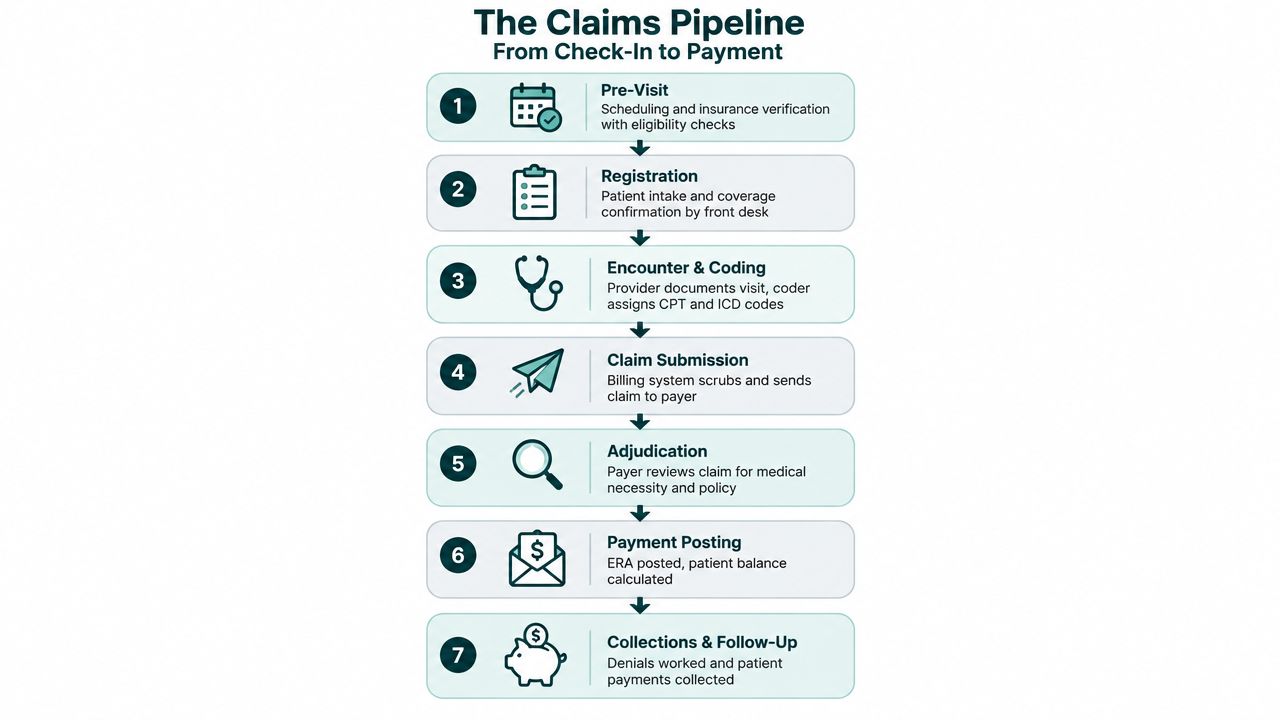
The first stage is pre-visit work. Scheduling should trigger eligibility checks, benefit confirmation, and prior authorization review when needed. This is also where staff catch coverage changes, deductible exposure, and whether the plan has special referral rules. If a practice skips this, it often learns about the problem only after the denial arrives.
The second stage is registration and check-in. Staff confirm identity, collect insurance cards, capture primary and secondary coverage, and obtain the patient's required forms and responsibility estimates. This is also the point where a good office sets expectations about copays and balance billing without sounding defensive or confusing the patient.
The third stage is documentation and coding. The provider's note has to support the CPT, ICD-10-CM, and HCPCS Level II codes selected. A coder or biller should review specificity, medical necessity, modifiers, and any obvious inconsistencies before the claim moves forward. When notes are vague, the biller can't ethically “make the claim fit.”
The fourth stage is charge capture and claim scrubbing. Charges are entered or pulled from the EHR, then checked against edits for missing fields, modifier issues, NPI mismatches, and other basic defects. A scrubber can catch a lot, but it can't fix a bad note or missing coverage.
The fifth stage is submission and adjudication. The claim is sent through the clearinghouse to the payer, and the payer reviews it against policy, medical necessity, and benefit rules. If the claim comes back clean, the remittance advice should be posted without delay.
The final stage is payment posting, reconciliation, and follow-up. If the payment doesn't match the expected amount, or the claim is denied, someone has to work the appeal, secondary claim, or patient balance. That's where the cycle closes, or stalls.
For insurance verification workflows, a practical reference is this guide to how to verify insurance for medical practices. It fits naturally at the front end, where so many avoidable denials begin.
Each stage protects the next one. When the earlier step is sloppy, the later step becomes expensive.
Who Pays the Bill and Why Payer Mix Matters
Payer mix isn't background noise. It shapes how fast money comes in, how much follow-up the office needs, and how much tolerance you have for denials and delayed payment. A practice with mostly commercial insurance behaves differently from one with a large Medicaid book, even if the visit volume looks similar on paper.
| Payer Category | Typical Reimbursement | Days to Payment | Denial Risk | Admin Burden |
|---|---|---|---|---|
| Commercial Insurance | Usually the fastest and often the highest contracted rate | Often faster than public programs | Moderate, but dependent on contract rules and prior auth | Moderate |
| Medicare | Predictable fee-schedule payment through CMS | Slower than commercial in many practices | Moderate to high when documentation is thin | Moderate to high |
| Medicaid | Usually lower reimbursement and state-specific rules | Often slower and less predictable | Higher because state rules vary | High |
| Self-Pay | No payer contract buffer | Depends on patient payment behavior | No payer denial, but high nonpayment risk | High |
Commercial plans are usually the most operationally forgiving, but they still create work. Prior authorization, network rules, and plan-specific edits can delay care if the office doesn't track them tightly. Practices with a heavy commercial mix can still get burned if they assume all commercial payers behave the same way.
Medicare is more predictable on the fee-schedule side, but coverage rules are strict. Denials often happen when documentation doesn't match the service, or when the practice doesn't align with local and national coverage policy. Medicaid is its own environment in every state, so the office needs local enrollment, authorization, and filing discipline.
Self-pay is where the emotional and operational pressure gets obvious. Patients often expect the office to explain the bill in plain English, even when the root problem was eligibility, coordination of benefits, or a benefit exclusion. That's why patient communication has to be built into the billing workflow, not treated as an afterthought.
If your practice is mostly commercial, you can usually support faster A/R turn if the rest of the workflow is stable. If you're Medicaid-heavy, you need tighter cost control, higher volume, and stronger front-end verification just to keep the same cash rhythm. Payer mix should drive staffing, software, and follow-up cadence, not sit in a spreadsheet nobody uses.
Why Claims Get Denied and What the Numbers Show
Denials are not random. They usually point back to a process defect that was present before the claim was submitted. If you map them correctly, they become a workflow improvement list instead of a monthly frustration report.
Denials usually start upstream
Eligibility and coverage problems tend to show up as front-end denials. Missing prior authorization, stale coverage, coordination of benefits gaps, and timely filing misses usually trace back to registration and scheduling. Coding-related denials often come from vague documentation, modifier misuse, unbundling, or a mismatch between the note and the code selected.
Credentialing and network issues are a separate category. If a provider isn't properly enrolled or the billing entity isn't aligned with the payer, the claim can fail even when the note is perfect. That's why billing teams need a tight loop with credentialing and provider onboarding.
Rule of thumb: if a denial repeats, treat it as a process signal, not an isolated claim problem.
In U.S. physician revenue cycle operations, a first-pass claim denial rate around 5% to 10% is commonly treated as the acceptable operating band, while published industry averages are often cited closer to 9% to 12%; best-performing organizations target under 5%. The operating lesson is clear, even if the exact number varies by specialty and payer mix. Small improvements in front-end eligibility, coding, and prior-authorization controls can reduce rework because many denials reflect upstream defects rather than payer whim. Medical denial benchmarks for physician practices
| Common Denial Reason | Origin Stage | Typical Fix |
|---|---|---|
| Eligibility not active | Pre-visit or registration | Verify coverage before the visit and recheck on arrival |
| Missing prior authorization | Scheduling or pre-service | Build authorization review into scheduling and referrals |
| Coding mismatch | Documentation and coding | Audit note specificity and code-to-diagnosis linkage |
| Modifier error | Charge capture or coding | Train staff on payer-specific modifier rules |
| Credentialing or network mismatch | Enrollment and contracting | Confirm provider and group status before billing |
| Timely filing miss | Back-end follow-up | Track filing deadlines and claim aging daily |
| Coordination of benefits gap | Registration and patient intake | Capture all active coverage and ask the right questions |
The practical fix is categorization. Denials should be grouped by reason code, origin stage, payer, and provider. Then they should be assigned back to the person or team that controls the upstream step. Resubmitting the same broken claim just wastes time and hides the root cause.
Recent industry coverage also points to a more complex denial environment, with payer audits and medical-necessity disputes becoming more visible. The point for a practice manager is not to chase every industry headline. It's to recognize that denial management now needs root-cause analysis, not just batch follow-up.
HIPAA, Business Associates, and Realistic Compliance
HIPAA compliance in billing is not about having fancy software or claiming that a vendor is “HIPAA certified.” It's about controlling how protected health information is used, disclosed, accessed, and safeguarded in everyday work. For billing teams, that matters because they handle eligibility data, claim content, patient balances, and payer communications.
A compliant Business Associate Agreement must spell out the permitted and required uses and disclosures of PHI, prohibit the business associate from using or disclosing PHI beyond what the contract or law allows, and require appropriate safeguards to prevent unauthorized use or disclosure. That's the baseline. If the agreement is vague, the practice is exposed before anyone even logs into the system. HHS sample business associate agreement provisions
The compliance question is not whether a practice can eliminate all risk. It can't. The question is whether the practice has reasonable safeguards, role-based access, documented training, and a response plan that gets used when something goes wrong. That is the standard most small and mid-sized practices can meet without drowning in bureaucracy.
What realistic compliance looks like
Good billing operations usually rely on a few habits that aren't glamorous but work. Staff should only see the minimum PHI they need for their role. Devices should be secured, email should be used carefully, and access logs should be reviewed often enough to spot obvious misuse. Training should happen before a new person starts handling PHI, then be refreshed on a regular basis.
A written incident response plan matters because accidents happen. If a vendor is breached or a file is sent to the wrong recipient, the office should know who investigates, who documents, who notifies, and who decides next steps. Under HIPAA, if a covered entity knows a business associate has materially breached the agreement, the covered entity must take reasonable steps to cure the breach or end the violation. If that fails and termination isn't feasible, the issue must be reported to HHS OCR. HHS guidance on covered entities and business associates
For practices using remote billing staff, a clear compliance stack helps. This practical guide to HIPAA-compliant virtual assistants is relevant because the billing team often needs the same access controls, PHI discipline, and BAAs as any other vendor relationship.
A missing BAA isn't a paperwork issue. It can turn a routine vendor into a compliance problem. The safer model is simple, documented, and boring, which is exactly what you want in billing.
How Practices of Different Sizes Run Billing
The right billing model depends on volume, specialty complexity, and how much management bandwidth you have. A solo primary care office does not need the same structure as a mid-sized multi-specialty group, and a growing practice can outgrow its billing setup long before it outgrows its clinical space.
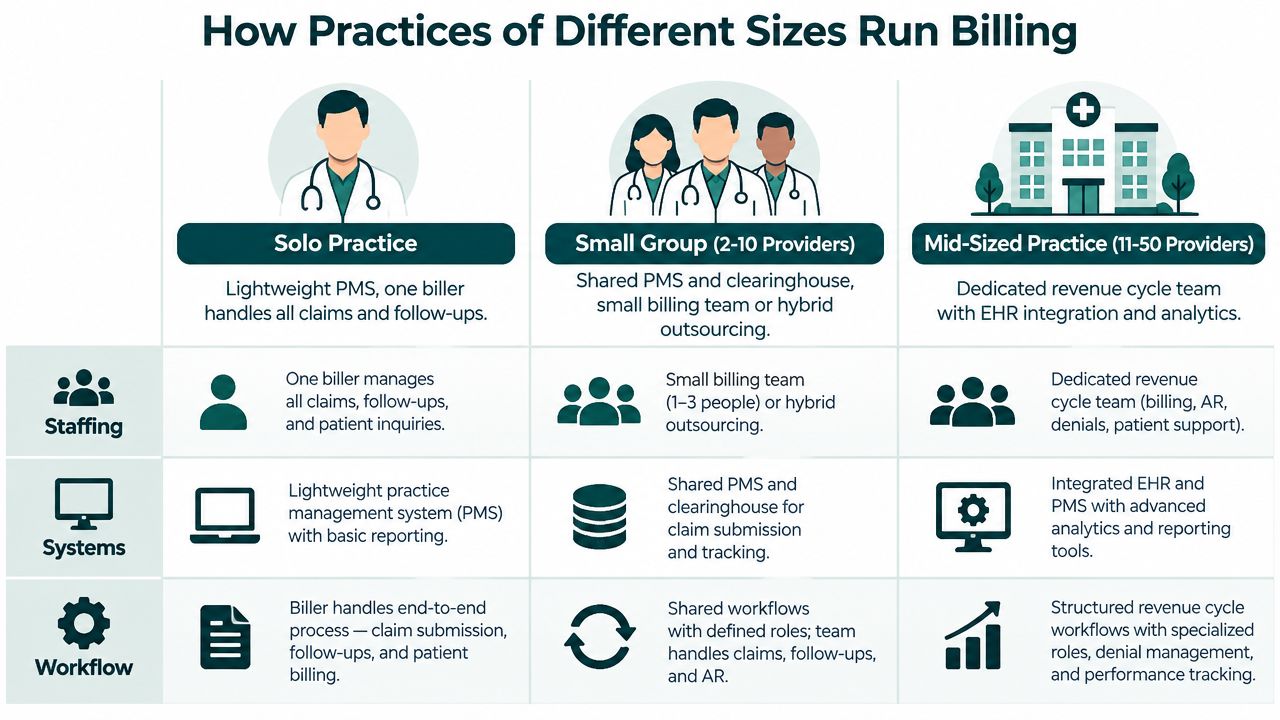
Solo and small group practices
Solo and small group offices usually lean on a lightweight practice management system, one in-house biller, or a small outsourced partner. That setup keeps fixed cost lower, which matters when visit volume is modest or uneven. The trade-off is usually depth, especially on denial follow-up and reporting.
That trade-off is manageable if the practice has simple payer patterns and a stable staff. It becomes risky when the provider mix expands, procedures get more complex, or the front desk starts missing key insurance details. At that point, the billing workload often shifts from “manageable” to “constant cleanup.”
Mid-sized practices
Mid-sized groups usually need more structure. They often combine an internal billing lead with remote staff, outsourced support, credentialing help, and more regular analytics. That extra layering gives the practice more control over denial patterns, A/R aging, and payer performance across providers or locations.
The downside is coordination. More people can mean more handoffs, and more handoffs can mean more room for gaps if responsibilities aren't written down. A mid-sized group needs clearer ownership than a small office, not just more software.
Choosing the model that fits
If you're evaluating in-house vs. outsourced billing, use a practical scorecard:
- Control: In-house gives you tighter day-to-day oversight, but it also puts more burden on your manager.
- Cost: Outsourcing can reduce fixed payroll pressure, but only if the vendor works denials and follows claims through.
- Scalability: Remote and outsourced teams usually scale faster than office-only staffing.
- Reporting: Better vendors usually give stronger analytics than a single overloaded biller can maintain.
- Continuity risk: A one-person billing department is fragile when that person is out sick, quits, or gets pulled into other tasks.
Medical Virtual Assistants places pre-vetted LATAM billing support, including medical billing services, for practices that need flexible coverage without building a larger in-house team. That kind of model can work well when the office wants US-hours support and a narrower staffing commitment.
The right model is the one that matches your claim complexity and your tolerance for management overhead. Size matters, but workflow complexity matters more.
Best Practices That Move the Revenue Cycle
The fastest gains usually come from tightening a few basic controls, not from rethinking the whole department. A practice that fixes front-end verification, charge capture, denial ownership, and patient payment follow-up will usually feel the improvement before it sees a dramatic organizational change.
Start with the front desk and end with the patient
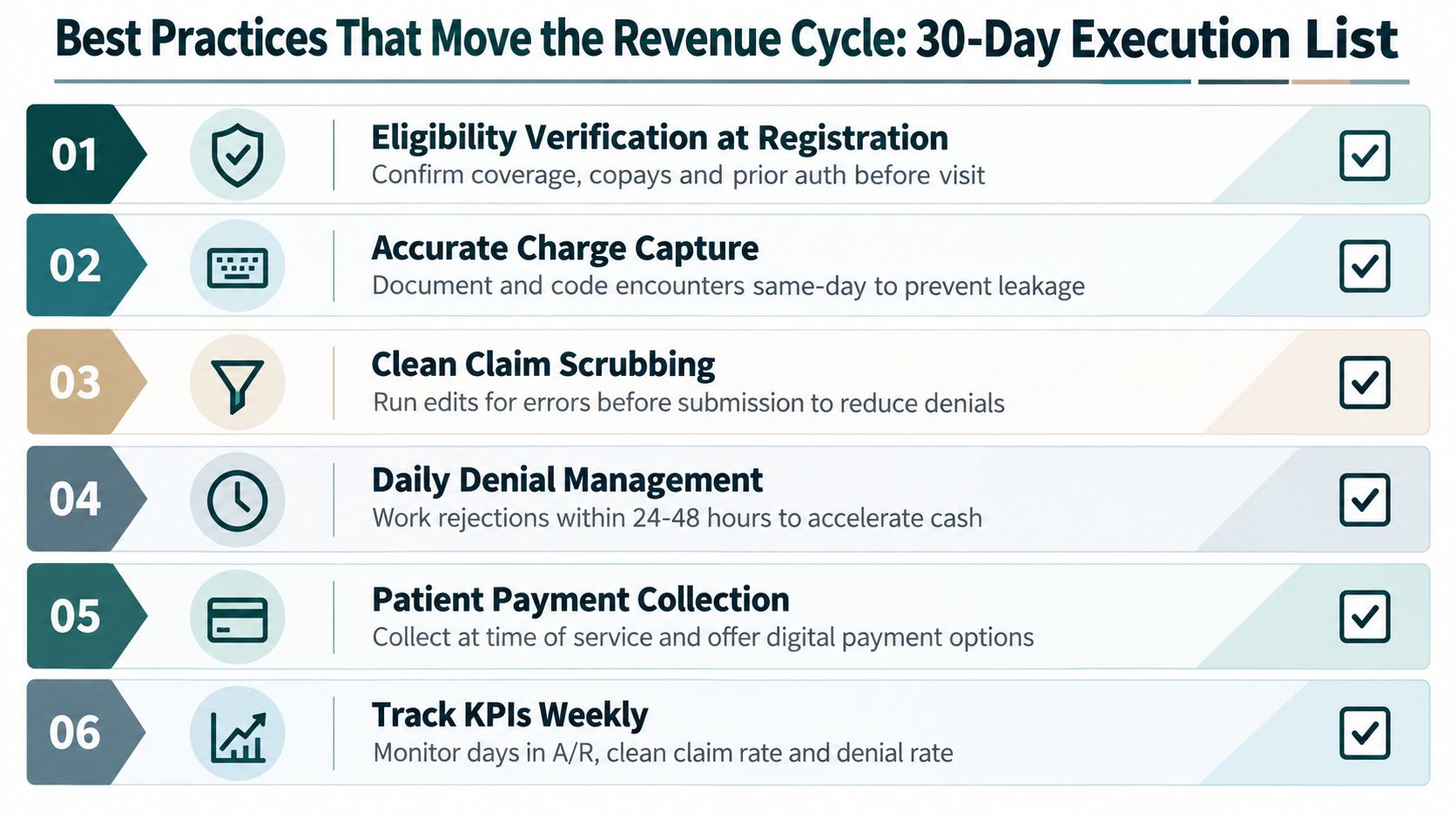
Eligibility verification belongs at registration, before the patient leaves the front desk. That means coverage details, copays, deductibles, and prior authorization flags are checked early enough to prevent surprise denials later. If the practice uses remote support for this, the role needs a script, a checklist, and clear escalation rules.
Accurate charge capture should happen the same day as the encounter whenever possible. The longer the gap between the visit and the charge entry, the more likely details get lost or simplified. Clean claim scrubbing should then catch obvious defects before submission, especially missing fields, modifier errors, and diagnosis linkage problems.
Put denials back where they started
A denial should be assigned to the stage that caused it. Registration issues go back to front office workflows. Coding issues go back to documentation or coder review. Payer-policy disputes go to the denial specialist or billing lead.
Daily denial work matters because delays make the claim harder to recover. Older A/R becomes harder to collect, and the team spends more time chasing information than resolving the issue. That's why weekly aging reviews and short follow-up cycles are more effective than waiting for month-end cleanup.
Useful operating habit: every denial code should have one owner, one fix, and one deadline.
Patient statements need the same discipline. They should be clear, itemized, and sent with multiple payment options, not buried in vague language that forces the patient to call the office for an explanation. The outreach sequence for unpaid balances should be defined in advance so staff aren't improvising with every case.
A practical 30-day execution list looks like this:
- Verify coverage at scheduling and check-in.
- Document and code encounters the same day.
- Run claims through payer-specific edits before submission.
- Work denials within a short, consistent follow-up cycle.
- Post patient payments promptly and reconcile balances.
- Review days in A/R, denial reasons, and clean-claim performance weekly.
One peer-reviewed review found that reminder calls decreased no-show rates by an average of 19%, and another study found automated calls performed worse than personal reminder calls in one setting, which shows workflow design matters even in appointment management. Peer-reviewed review of reminder call effectiveness The billing lesson is the same one front desks learn the hard way, consistency beats guesswork.
The Takeaway
Medical Billing in the USA works best when you treat it as one continuous system, not a stack of disconnected tasks. Front-end accuracy drives coding accuracy, coding accuracy drives cleaner claims, and cleaner claims drive more predictable cash flow. When compliance, staffing, and payer follow-up are built into the same workflow, the practice spends less time rescuing revenue and more time protecting it.
The core metrics don't change much across practice sizes. Days in A/R, first-pass resolution, denial rate by reason, and net collection behavior tell you whether the system is healthy or leaking. The right staffing model depends on volume, specialty complexity, and internal capacity, and remote billing support is one workable option when you need flexibility without hiring a full in-house team.
If your practice needs help with front-end verification, billing follow-up, or denial work, Medical Virtual Assistants places pre-vetted remote support for U.S. clinics and can align that help to your hours and workflow. Visit Medical Virtual Assistants to see how billing, intake, and administrative support can fit into a cleaner revenue cycle.