

A busy specialty clinic can look calm from the waiting room and still be buried in authorization work behind the scenes. The phone is ringing about a delayed MRI, the physician is asking whether a treatment can be scheduled this week, and someone has a payer portal open on another screen trying to find out why a request is still pending. That's where the pre authorization specialist earns the title.
The role is less about pushing paperwork and more about absorbing throughput friction so clinicians, schedulers, and front-desk staff don't have to keep stopping their day to chase payer decisions. In a system where physicians report an average of 43 prior authorizations per physician per week and 12 hours of staff-and-physician time spent on the work each week, the job has become a real operations function, not an occasional admin task (AMA survey summary). The same survey found 94% of physicians say prior authorization delays necessary care, 78% say it often or sometimes leads patients to abandon treatment, and 95% say it contributes to burnout (AMA survey summary).
A good specialist owns the request from intake to decision, keeps the queue moving, escalates when it stalls, and makes the rest of the practice look more organized than it feels on a hard week. A weak one becomes a human filing cabinet, copying status updates without clearing bottlenecks. The difference is workflow ownership, not just clerical speed.
What a Pre Authorization Specialist Actually Does
On a Wednesday afternoon, the prior auth lead in a busy orthopedic group is juggling three things at once. A peer-to-peer call is set for 2 p.m., a patient is on hold asking why the MRI isn't scheduled, and the provider just dropped a new order into the work queue with incomplete supporting notes. That is a normal day in this role, and it shows why the work sits at the center of access, scheduling, and patient communication.
A pre authorization specialist gathers the clinical documentation a payer expects, checks coverage rules, submits the request, tracks the response, and pushes the case forward if the payer asks for more information or denies it. The work often includes diagnosis coding confirmation, procedure code lookups, documentation cleanup, portal submission, and status follow-up. In many practices, the specialist also becomes the person who explains where the request stands to providers and patients without overpromising a timeline.
Practical rule: if the specialist is doing the work well, clinicians shouldn't have to interrupt clinic flow to chase a portal update or answer a basic coverage question.
What the role is not
It's not the same thing as billing, even though the two functions often touch the same claim lifecycle. It's not a medical assistant role, because the job isn't about rooming patients or taking vitals. It's also not a clinician role, because medical necessity decisions still belong with licensed providers and payer reviewers, not an admin handoff.
That distinction matters in hiring. A person who can submit forms quickly but can't recognize what's missing in the chart will still create delays. A person who knows the clinical context but doesn't own follow-up will leave cases sitting until a scheduler, nurse, or provider notices the gap.
For practices trying to standardize this function, a useful starting point is a clear policy that defines who collects notes, who submits, who checks status, and who tells the patient what happens next. If you're building that workflow around Medicaid-heavy cases, a focused Medicaid prior authorization support process can help you separate payer-specific variation from the core workflow.
The Submission-to-Decision Workflow Step by Step
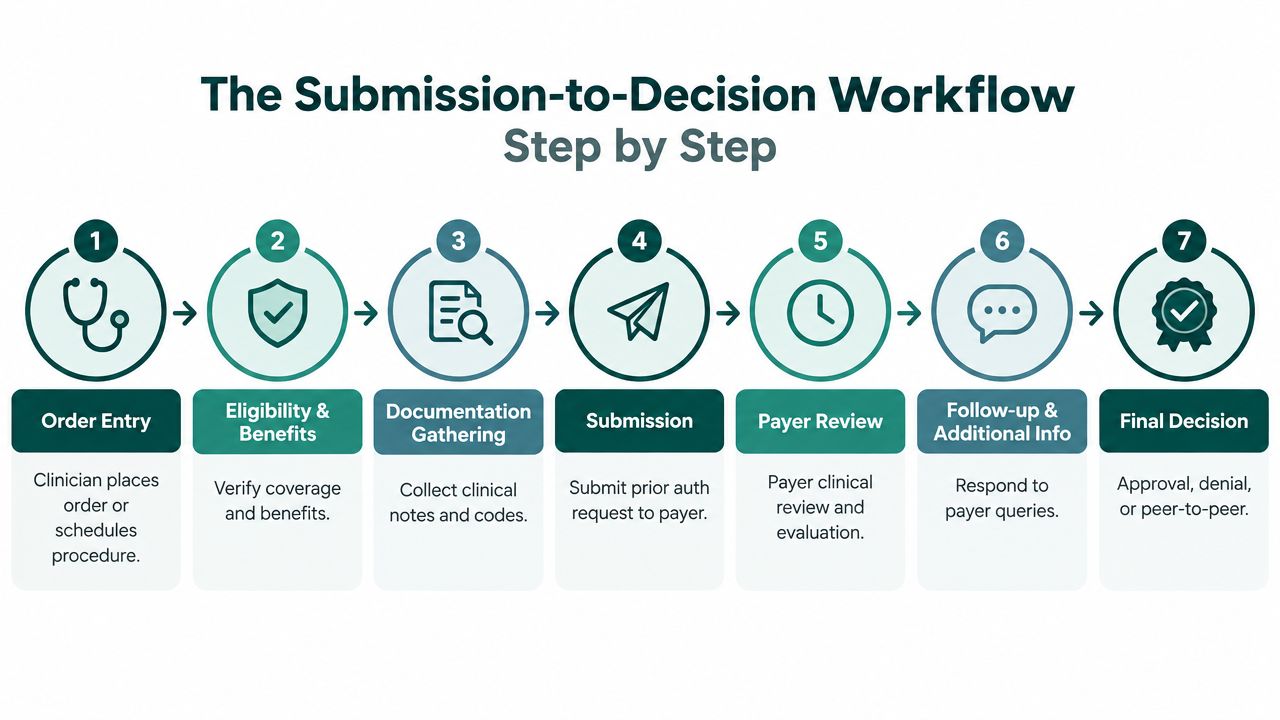
The cleanest authorization process starts before the payer ever sees the request. A clinician places the order, or a scheduler flags a procedure that will need approval, and the specialist checks eligibility and benefits first. If coverage doesn't match the service, you want to know that before the patient is scheduled, not after a slot has been reserved and the chart is already moving.
The handoffs that usually decide the speed
The next stop is documentation. The specialist pulls notes from the EMR, checks labs or imaging if the payer requires them, and packages the request in the format the payer portal or phone team expects. After submission, the work shifts to monitoring, because many requests don't fail at the moment of submission, they fail when nobody notices that the payer asked for one missing item.
Then comes the review cycle. If the payer needs a peer-to-peer, clarification, or appeal, the specialist sets that up and keeps the case visible until it resolves. The final handoff is back to scheduling and patient communication, and that's where good workflow often breaks down even when the approval itself is straightforward.
A useful way to think about the queue is simple:
- Order enters the workflow and is tagged for authorization.
- Coverage is verified before time is wasted on the wrong plan or benefit.
- Clinical documents are collected in payer-ready form.
- The request is submitted through portal or phone.
- The payer reviews it and may ask for more detail.
- The specialist responds to queries, escalates, or prepares an appeal.
- The decision returns to scheduling, billing, and the patient.
If you need a second operational lens, a focused insurance prior authorization workflow overview can help staff compare payer steps without turning every case into a custom project.
The weak points are usually familiar. Notes aren't complete, labs are missing, payer portals time out, callback windows are narrow, or denial reasons come back vague enough that a second submission is nearly inevitable. The specialist's job is to catch those problems early enough that they don't become service-date failures.
Metrics That Show Whether the Role Is Working
Volume counts can fool people. A team that submits more requests isn't necessarily doing better if those requests bounce back, age in a queue, or force more phone follow-up. The useful question is whether the role is reducing friction between the order and the decision.
The metrics that matter
| Metric | What It Tracks | Why It Matters |
|---|---|---|
| Average turnaround time | Time from order to final decision | Shows whether the queue is moving fast enough for scheduling and treatment planning |
| First-pass approval rate | Requests approved without rework | Reveals whether documentation quality matches payer expectations |
| Denial mix by reason code | Why requests get denied | Helps identify whether the issue is eligibility, documentation, coding, or medical necessity |
| Resubmission rate | How often a request must be sent again | Signals friction in the submission package and payer-specific rule gaps |
| Peer-to-peer frequency | How often a case needs live clinical discussion | Shows where clinical review is becoming the bottleneck |
| Aging of pending cases | How long requests sit unresolved | Flags silent backlog before it becomes a patient access problem |
A mid-sized practice doesn't need a perfect scorecard to get value from this. It needs a consistent one. If pending cases are clustering beyond a couple of days, staff will start working from memory instead of process, and that's where errors multiply.
Practical rule: if weekly submission volume is going up while approval quality is flat or worse, you've probably hired more motion, not more throughput.
How to read the numbers without fooling yourself
The danger is celebrating output while the backlog grows underneath it. A specialist can send many requests and still miss the cases that need a phone call, a resubmission, or a clinical attachment. For that reason, denial reasons and pending aging are often more useful than raw counts when a manager is deciding whether the role needs more support.
Tie the metrics to patient access signals too. If appointments are being rescheduled, procedures are slipping past intended service dates, or staff are telling patients “we're still waiting,” the authorization process is affecting care even when the portal says a request is technically in process.
Staffing Models for the Pre Authorization Function
The right staffing model depends on how your practice absorbs payer work today. Some offices need a person sitting inside the workflow with direct access to clinicians and the EMR. Others need coverage more than physical proximity. The mistake is choosing a model by habit instead of by case volume, payer mix, and how often staff already spend time on payer calls.
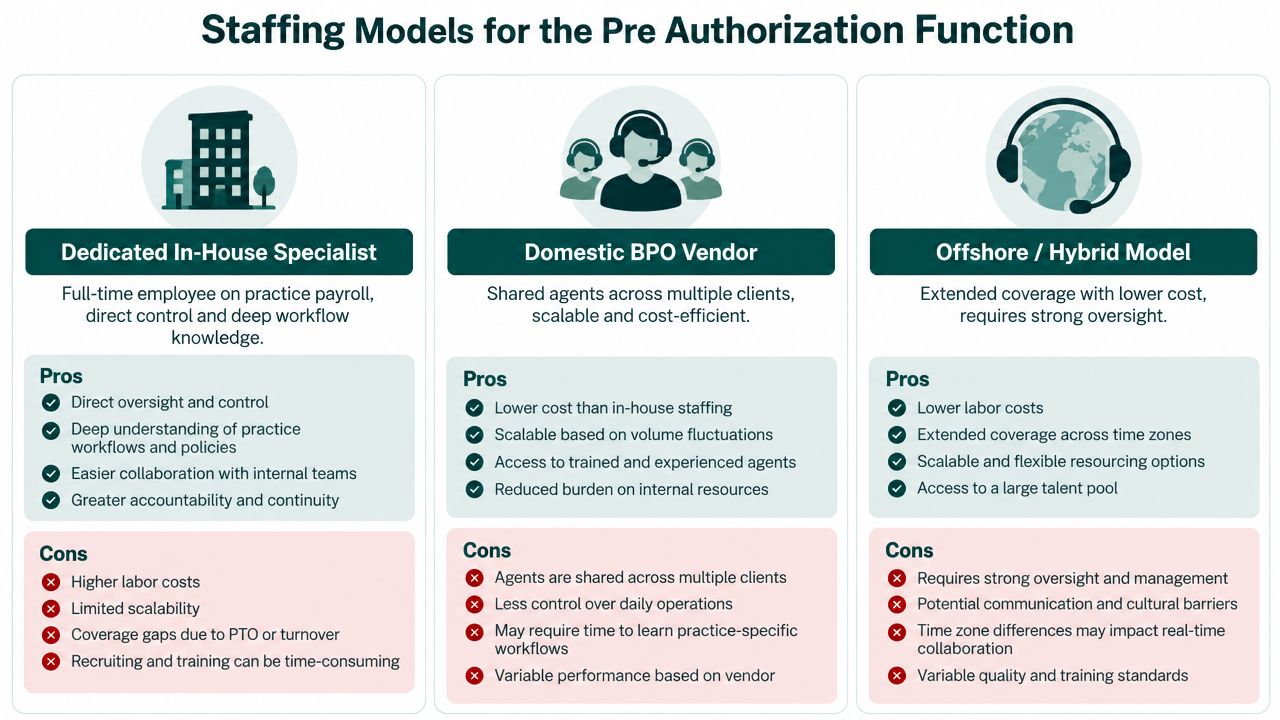
The three models in practice
A dedicated in-house specialist gives you the most context. The person learns your physicians, your common procedures, and the quirks of your payer mix, and escalation is fast because everyone is in the same building. The downside is single-point failure. If that person leaves, the queue can unravel quickly.
A domestic BPO vendor can spread coverage across multiple clients and absorb staffing spikes, which helps when volume is unpredictable. The trade-off is continuity. If the vendor rotates agents mid-case, payer knowledge gets fragmented and the clinic has to re-explain itself.
A remote LATAM-based specialist can work inside your systems during U.S. business hours and preserve the same-day rhythm many practices need. The main risk is time-zone overlap if your peer-to-peer calls or payer callbacks happen outside the coverage window. It works best when the practice has a clear handoff process and a manager who wants visibility without micromanaging.
What usually breaks
The failure pattern is rarely subtle. In-house models break when one skilled person quits and nobody else knows the payer-specific routines. Outsourced models break when handoffs are too generic and cases keep restarting with new faces. Remote models break when the team does not protect enough overlap for live escalation.
If your staff already spends a lot of time on payer calls, the right model is usually the one that removes the most interruptions from the clinicians' day, not the one that looks cheapest on paper. Case complexity, payer mix, and escalation speed matter more than the label on the staffing arrangement.
Hiring Profile and Onboarding Checklist
A strong hire for this role usually comes from medical billing, utilization review, or another authorization-heavy revenue cycle role. They need to be comfortable moving between payer portals, EMR records, and clinical notes without losing the thread. They also need the temperament to handle repeated denials or incomplete responses without getting sloppy.
For practices screening candidates, I'd look for three things first: payer portal fluency, comfort with CPT and ICD-10 lookups, and a history of clean documentation. If someone gets rattled every time a payer asks for another note, they'll slow the queue down even if they know the forms.
A good authorization hire doesn't just submit faster. They leave a cleaner audit trail for the rest of the team.
First 30 days that actually matter
Onboarding should be concrete, not abstract. Give the new hire EMR sandbox access, a payer-by-payer cheat sheet for submission quirks, and time to shadow live calls before they own anything important. They should also use one consistent standard for authorization numbers, reference IDs, and case notes so anyone in the practice can pick up the thread later.
HIPAA operating habits need to be routine, not aspirational. That means locked screens, no PHI in personal email, and credentialed portal logins only. For anything involving insurance verification flow, a clear how to verify insurance workflow helps new staff understand where coverage checks end and authorization work begins.
A simple first-month checklist works well:
- Week 1: EMR and payer portal training, plus documentation standards.
- Week 2: Shadow submissions and eligibility checks on live cases.
- Week 3: Handle active cases with supervision and case review.
- Week 4: Manage independent cases and review performance with the supervisor.
If week one goes badly, the issue is usually not speed. It's whether the person can follow the practice's documentation rhythm, remember payer-specific steps, and keep patient communication accurate under pressure.
Where Automation Helps and Where It Still Fails
Automation helps most when the task is structured and repeatable. Eligibility checks, formulary lookups, status polling, and auto-populating forms from EMR data all fit that pattern. Those are the parts of the work where a specialist should expect software to reduce manual clicks and cut duplicate data entry.
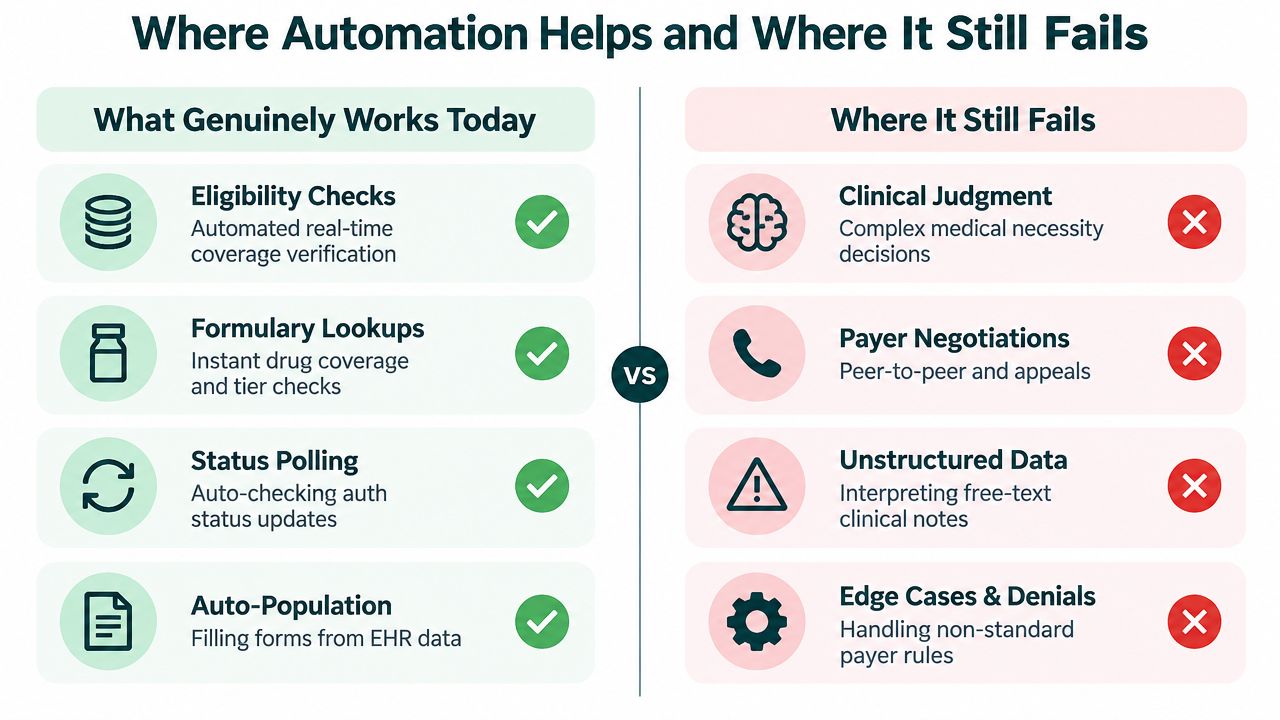
What still needs a human
The hard cases are the ones that need judgment. Medical necessity narratives, peer-to-peer preparation, retroactive authorizations, and payer exceptions still depend on someone who can read the chart, understand what the payer is asking for, and decide what to send next. Free-text clinical notes also remain a problem, because the payer may want a structured answer that the chart never presented in a neat field.
That's why “AI prior auth” should be evaluated carefully. In many cases, the technology shortens the front half of the workflow, but a human still has to absorb the last mile, especially when a payer wants clinical context rather than structured data. If a vendor can't show where the case re-enters human review, you may just be moving the queue instead of shrinking it.
A practical procurement question is whether the tool reduces resubmissions and follow-up calls, or changes who does them. If the answer is vague, the workflow probably will be too.
The Takeaway and Next Step for Practice Managers
The pre authorization specialist is not a back-office extra. The role is a throughput function that protects schedules, reduces avoidable clinician interruptions, and keeps treatment plans from stalling while everyone waits on a payer decision. Practices that treat authorization as isolated paperwork usually lose time to rework and callback loops, while practices that treat it as a measurable workflow have a better shot at steady turnaround and fewer avoidable denials.
The simplest decision framework is to ask three questions. How many auths are moving through the practice each week. How often do cases slip past the intended service date. And is denial trending reviewed weekly, or only after problems have already piled up. The answers tell you whether you need one in-house specialist, a layered team, or a remote-staffed hybrid model with tighter oversight.
Pull two weeks of authorization data, trace the handoffs, and identify the single biggest stall point before you hire or outsource anything. Once you know where the work slows down, staffing becomes a workflow decision instead of a guess.
If your practice needs a steady authorization workflow without adding more chaos to the front desk or nursing team, Medical Virtual Assistants can help you evaluate the right remote support model for your payer mix and clinic hours. Their team places pre-vetted medical virtual assistants who can handle prior authorization, insurance verification, and related admin work inside your existing process, so you can focus on patient care instead of chasing payer callbacks.