

Most medication prior authorizations don't stall because staff forgot to make one more phone call. They stall because the practice is running a fragmented process. That matters because a national pharmacy-claims analysis found that 65% of branded prescriptions processed through prior authorization were not resolved in one day and instead took a median of 6 days (national claims analysis). A separate 2026 report adds a harder truth: only 54% were ultimately approved, so a faster turnaround can still end in a denial rather than access (PubMed report on approval and denial outcomes).
If you want to know how to speed up prior authorization for medication, the short answer is this: build a tighter operating system, not just better paperwork. The practices that move medication PAs fastest usually do four things well. They verify benefits and payer rules before the prescription reaches the queue. They submit a complete packet the same day. They track every request against a clear payer clock. And they escalate stalled or high-risk cases early instead of waiting for the patient to call back upset.
That approach is especially important for specialty medications, oncology, behavioral health, rheumatology, neurology, and any practice where a refill delay can interrupt treatment. In one Medicare Part D study, adding a new prior authorization requirement for an established oral anticancer drug increased the odds of discontinuation within 120 days by 7.1 times and delayed the next refill by 9.7 days on average (Medicare Part D study). In operational terms, this is why speed has to mean fewer preventable delays, fewer incomplete packets, and fewer requests left sitting in a portal with no owner.
Why Medication Prior Authorizations Stall and What Faster Really Means
One detail matters more than the median turnaround. In the 2026 reporting on branded prescriptions that were initially rejected for prior authorization, one-quarter of denied claims were denied within 1 day, while another 19% were denied only after several days (report on PA resolution outcomes). That split is the clearest sign that medication PA speed is a system problem. Some requests fail fast because the first submission was misrouted, incomplete, or outside plan criteria. Others sit because no one is actively managing the clock.
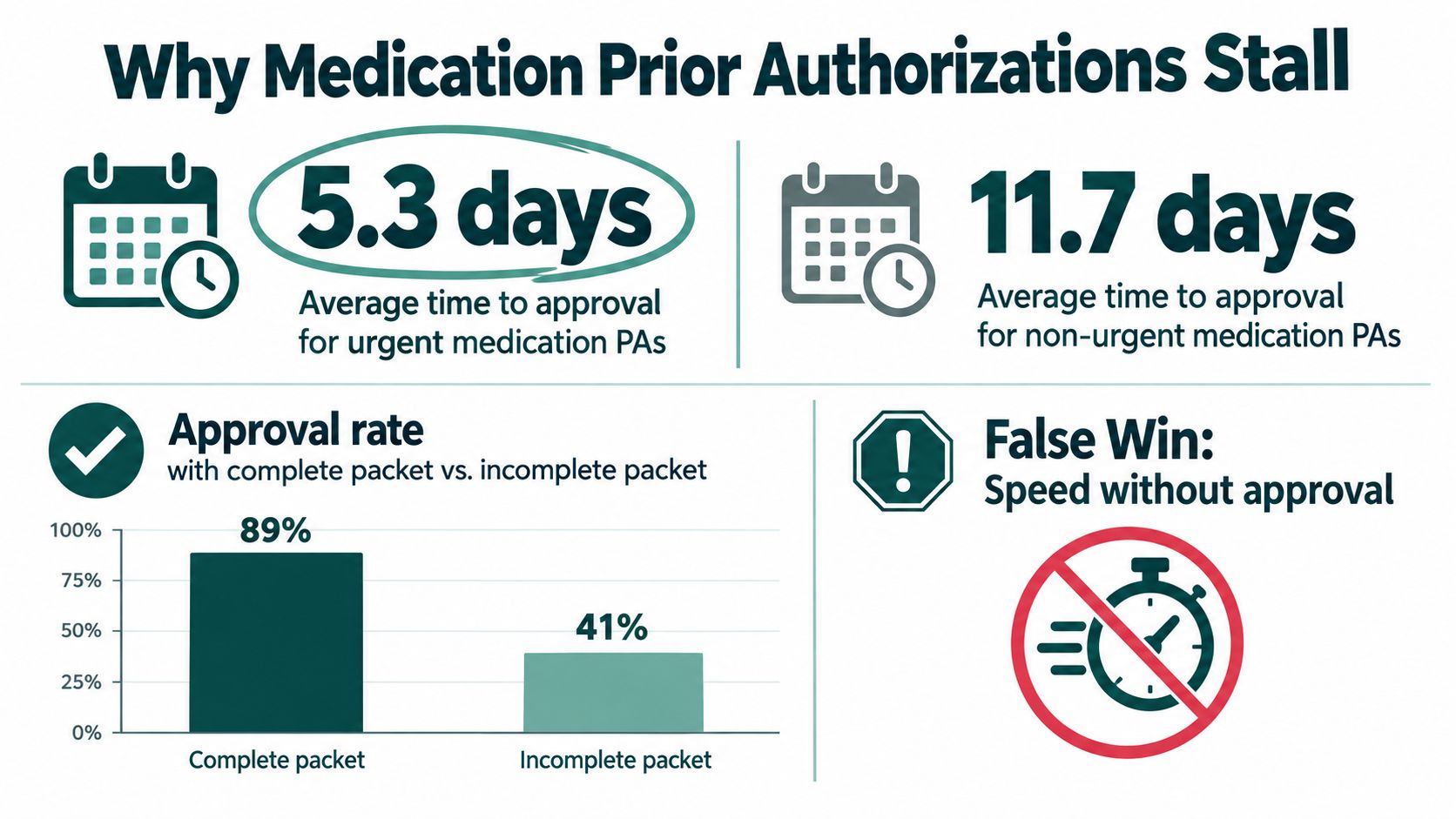
Speed isn't the same as access
A submitted PA is not the same as a progressing PA.
In practice, there are two very different failure patterns. The first is the fast denial. The drug is nonformulary, the wrong benefit was billed, step therapy was not addressed, or the note never established medical necessity in the payer's terms. The second is the long-tail case. The form was sent, but an attachment is missing, the request landed in the wrong portal queue, the payer asked for more information, or the case has no clear owner inside the practice.
That distinction changes how a team should define success. A high-volume clinic does not get better results by pushing every request out the door faster. It gets better results by preventing avoidable one-day denials and shortening the cases that would otherwise drift for a week with no intervention.
Practical rule: Measure clean first-pass approvals, days to decision by payer, and the share of requests that needed rework. Submission timestamp alone does not tell you much.
What a high-performing workflow actually looks like
The fastest PA teams I have seen do not rely on heroic follow-up. They build control points into the process so the request is less likely to fail early or disappear later.
That usually includes:
- Front-end triage: separate urgent starts, refill continuity cases, and high-cost specialty drugs from lower-risk routine requests so staff know what cannot wait.
- Routing discipline: confirm the correct benefit, payer form, portal, and specialty pharmacy path before submission so the case reaches the right queue the first time.
- Active aging: review open requests by age and next action, not just by date received.
- Escalation rules: set a trigger for payer follow-up, provider response, and urgent escalation before the request becomes a patient access problem.
This is basic operations work, but it is where turnaround improves. The same principle shows up in other queue-driven work. Cases stall when there is no owner, no deadline, and no next action. That is also why teams studying pipeline recovery pay attention to tools that Frida helps re-engage stalled pipelines. Medication PA queues need the same discipline. Every request needs an owner, a payer clock, and a defined escalation path.
Build a Complete Packet Before You Submit
The cleanest way to speed medication prior authorization is to prevent rework. A complete packet doesn't just help the payer decide faster. It keeps the request out of the correction loop where missing notes, wrong forms, or unclear rationale add days.
Practices that struggle here often have the same root problem: the prescription is sent, the PA team reacts later, and key information has to be chased down from the chart, the provider, or the patient. That sequence is backward. The packet should be built before submission, not assembled in pieces after the rejection arrives.
Start with benefit and formulary verification
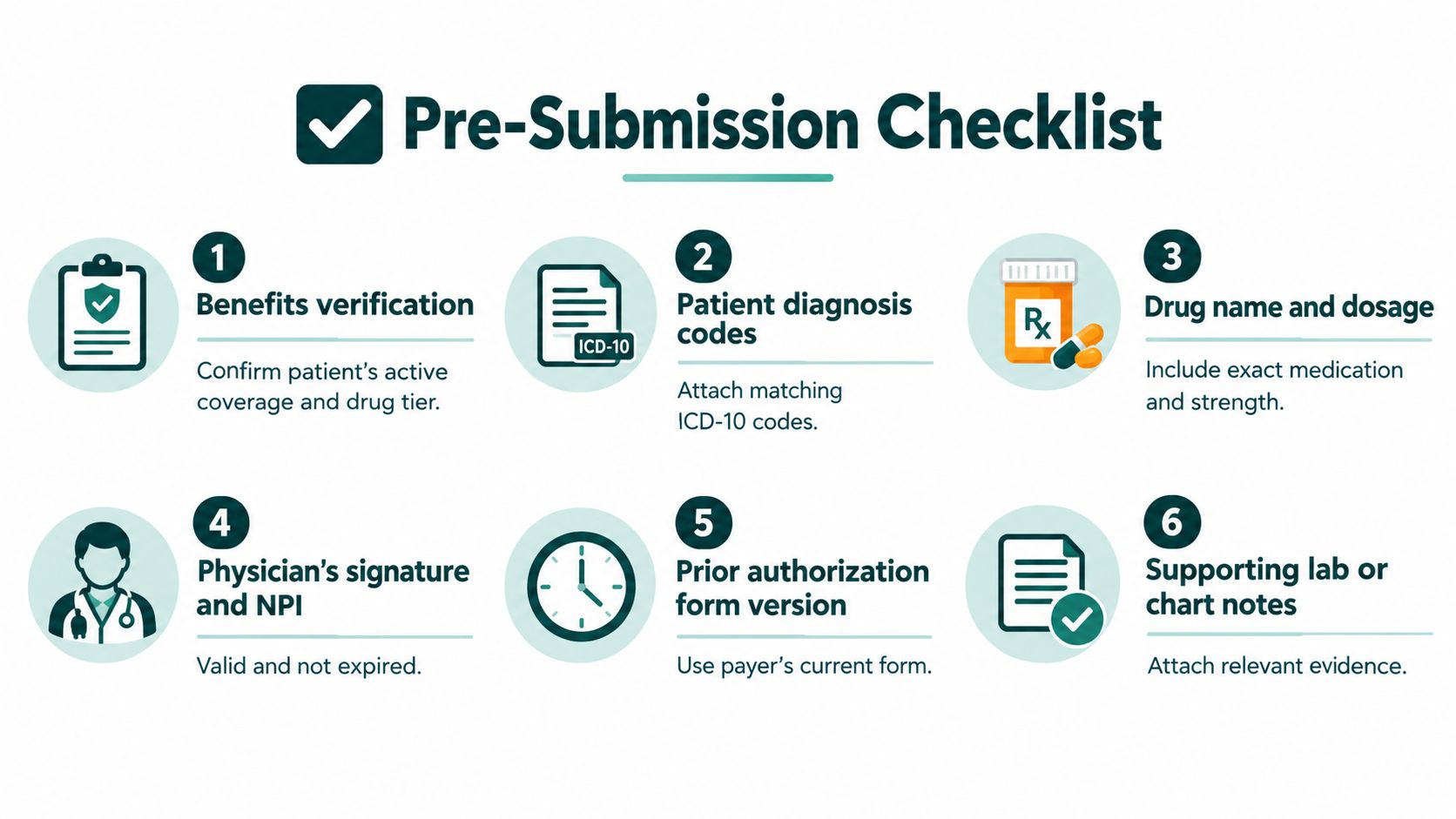
Before anyone fills out a PA form, confirm the basics. Is the patient's pharmacy benefit active? Is the prescribed drug on formulary? Is there a preferred alternative, step requirement, specialty pharmacy restriction, or quantity limit? If you skip this step, staff may spend time building a perfect packet for the wrong channel or the wrong product configuration.
For example, a neurology clinic might receive a prescription order for a brand medication, but the patient's plan may require a specific generic trial first or may only cover the drug through a designated specialty pharmacy. Submitting without checking that first creates preventable denials that look clinical but are really operational.
Gather the clinical story in the format the payer expects
The strongest PA packets tell a short, organized story. They don't dump the chart into a portal and hope an analyst pieces it together.
Your standard packet should usually include:
- Patient and plan identifiers: full member details exactly as they appear on the card and in the portal.
- Medication details: drug name, strength, route, frequency, quantity, and intended duration.
- Diagnosis support: matching ICD-10 coding and chart documentation that clearly supports the prescribed use.
- Treatment history: prior therapies tried, therapy failures, adverse effects, contraindications, or reasons they weren't appropriate.
- Clinical evidence from the chart: relevant labs, imaging, progress notes, or specialist assessments when those directly support criteria.
- Prescriber details: correct NPI, signature requirements, and any plan-specific attestation language.
A rheumatology office, for instance, often needs treatment history presented in sequence. “Failed prior agents” is too vague. Staff should list what was tried, why it stopped, and whether the issue was lack of efficacy, intolerance, or contraindication. That distinction often matters.
In medication PAs, “complete” means the packet answers the payer's likely next question before the payer has to ask it.
Use payer-specific templates, not one generic checklist
A general checklist helps, but it won't replace payer-specific execution. One plan may require chart notes from a defined recent period. Another may focus heavily on step therapy history. A third may need documentation entered into an electronic PA workflow instead of attached as free-form notes.
That's why practices benefit from maintaining a simple internal reference by major payer and common drug class. It doesn't need to be elaborate. A spreadsheet or shared document can work if it's maintained. The point is to stop asking the same questions repeatedly.
Build a pre-submission checklist your staff can actually use
The best checklist is short enough to survive busy clinic days. If it's too long, people skip it. If it's too vague, it doesn't prevent errors.
A workable pre-submit review often includes:
- Coverage confirmed
- Correct payer or PBM channel identified
- Current form or portal selected
- Diagnosis and medication match chart support
- Treatment history documented clearly
- All required attachments included
- Provider signature and identifiers checked
- Urgency level marked correctly
Many managers discover they don't need more effort first. They need fewer handoffs. If the front desk starts the process, nursing adds notes later, and billing follows up after a rejection, nobody sees the whole packet. One accountable owner, even if others contribute inputs, usually works better.
Submit Cleanly and Follow Up on Day One
Once the packet is ready, execution matters. Practices lose time through the wrong submission channel, outdated forms, attachment errors, and passive follow-up. A strong packet can still stall if it lands in the wrong place or enters the queue without confirmation.
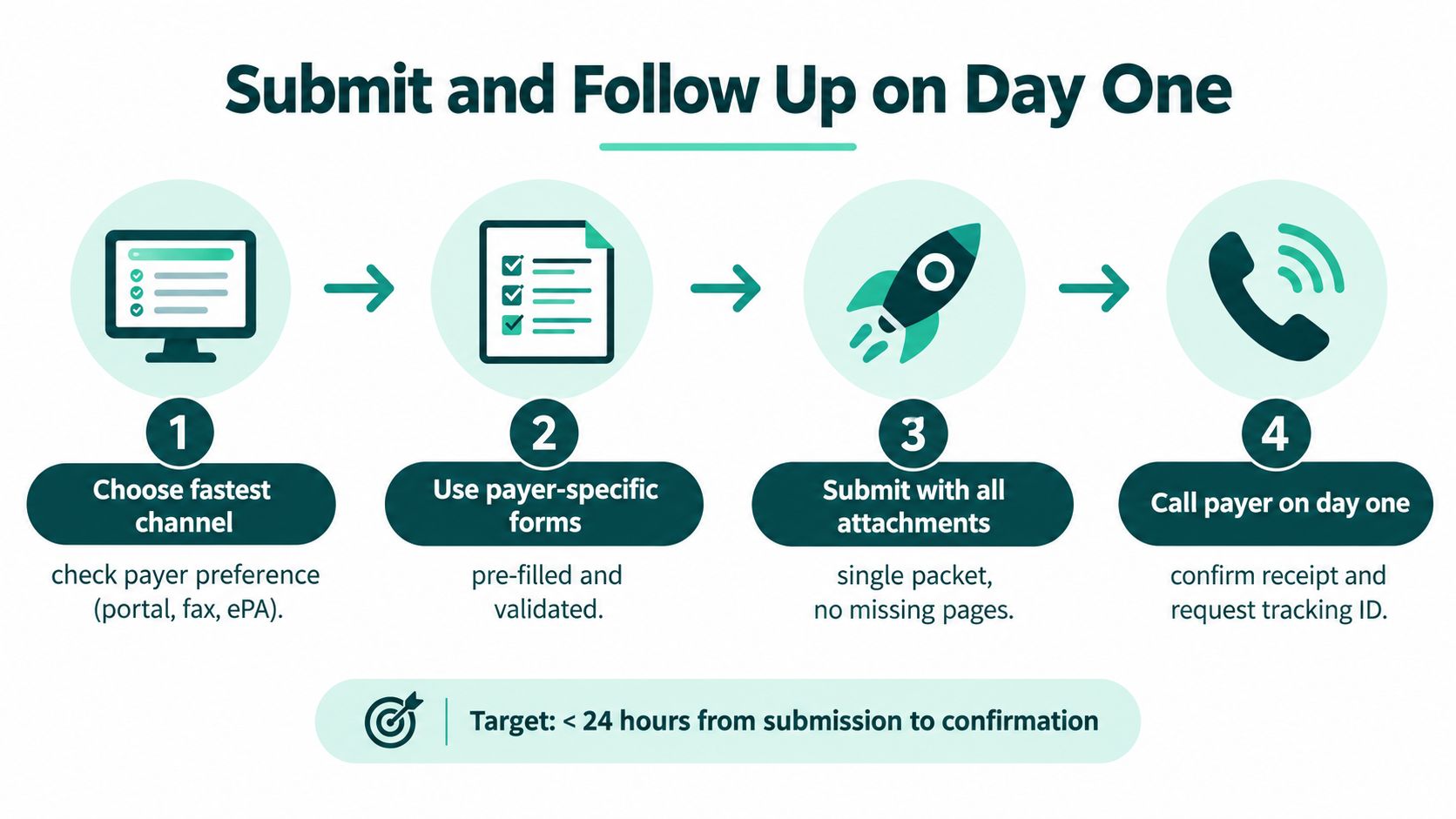
The operational standard should be simple: submit the same day the packet is complete, then verify receipt the same day whenever the payer workflow allows it.
Pick the fastest valid channel for that payer
Not every payer processes requests the same way. Some move faster through a portal. Some still rely heavily on fax for certain medication classes. Some use an ePA tool but still require separate clinical attachments. Speed comes from using the payer's preferred intake method correctly, not from forcing every request through one standard route.
If your team handles medication PAs regularly, keep a channel guide by payer. Note where authorizations should go, what attachment formats are accepted, and whether a tracking number is generated immediately. For teams building or refining that function, a focused reference on insurance prior authorization workflows can help define the handoffs and ownership points that prevent duplicate work.
Write to criteria, not to the chart
One common mistake is sending a long narrative that never answers the plan's criteria. The payer analyst is usually looking for very specific items. Diagnosis, prior treatment history, contraindications, and rationale for this drug now. If those details are buried inside several pages of notes, the request slows down even when the information exists.
A better approach is a concise clinical summary that maps directly to likely review points. For example:
- diagnosis and relevant severity
- therapies already tried and result
- why formulary alternatives aren't appropriate
- what chart evidence is attached to support the request
That summary shouldn't replace chart notes. It should point the reviewer to the answer quickly.
Confirm receipt before the request ages unnecessarily
Practices often assume submission equals receipt. It doesn't. Faxes fail. Portal attachments don't always save correctly. Cases can sit as drafts, pend for missing information, or route to the wrong bucket.
A same-day follow-up process usually includes:
- Check for a tracking ID: If there isn't one, the request may not be in process.
- Verify attachment completeness: Confirm all pages or files are visible to the payer.
- Document the contact: Record the date, time, representative name when available, and any status detail in the EMR or tracking log.
- Resolve immediate defects: If a form is outdated or a field is missing, correct it the same day instead of letting the case sit.
A medication PA should never be “submitted and waiting” if nobody has confirmed the payer can actually see the full packet.
Fast denials often come from small preventable errors
Some of the quickest denials come from mechanics, not medicine. A box left unchecked. A missing signature. A mismatch between diagnosis wording and chart support. An urgency flag used incorrectly. Those are frustrating because they create the appearance of action without progress.
That's why I favor a one-page submission cover template for high-volume drug classes. It gives staff a final visual check before transmission. If your team can catch the obvious misses before the payer does, you keep more requests out of the fast-no category and reduce the time spent on avoidable resubmissions.
Track Every Request Against Payer Clocks and Escalate Early
Many practices know how to submit a PA. Far fewer know how to manage the queue once the request is in motion. That's where speed is won or lost. Medication prior authorization moves faster when every open request has an owner, an age, a payer clock, and a defined next step.
For medical items and services, CMS's Interoperability and Prior Authorization Final Rule requires impacted payers, beginning primarily in 2026, to send decisions within 72 hours for expedited requests and within 7 calendar days for standard requests (CMS final rule announcement). Even where a specific medication workflow isn't governed the same way, those timeframes are useful operating benchmarks for queue discipline.
Turn payer deadlines into an internal work rhythm
External deadlines only help if your internal process is tighter than the payer's. If your staff waits several days before checking status, you've already lost the advantage of any formal response clock.
For medication PAs, I recommend managing the queue in age buckets. New submissions, requests awaiting same-day confirmation, cases pending additional information, urgent requests approaching the expedited threshold, and standard requests nearing the outer limit should never sit together as one undifferentiated list.
A practical tracking log should include:
- Request type
- Submission date and time
- Urgency designation
- Payer or PBM
- Current status
- Owner
- Next follow-up date
- Escalation trigger
- Patient therapy risk note
If you manage Medicaid-heavy volume, this gets even more important. A CMS fact sheet for the 2026 proposal says state Medicaid fee-for-service programs, Medicaid managed care plans, and CHIP managed care entities would need to decide drug prior authorizations no later than 24 hours after receipt for prescription drugs (CMS drug prior authorization proposal fact sheet). Practices dealing with those plans should separate drug PAs from non-drug authorizations immediately at intake. Teams that need support with those plan-specific workflows often build a dedicated playbook for Medicaid prior authorization operations.
Use a decision matrix so staff know when to escalate
Without clear rules, staff either escalate too early and create noise or wait too long and let avoidable delays grow. The answer isn't more reminders. It's a small decision matrix everyone follows.
| Request Type | Payer Clock | Tracking Trigger | Next Action |
|---|---|---|---|
| Urgent medication PA | 72 hours for expedited requests under the CMS benchmark for impacted payers | No determination or meaningful update by the next business-day review | Call payer, verify status, request escalation, alert prescriber if therapy timing is at risk |
| Standard medication PA | 7 calendar days for standard requests under the CMS benchmark for impacted payers | No clear status movement after routine follow-up checkpoints | Confirm completeness, contact payer, resubmit only if intake failure is confirmed |
| Medicaid drug PA under the proposed 2026 framework | 24 hours after receipt for prescription drugs in the CMS proposal | No decision within the internal next-day review window | Escalate promptly, verify receipt time, and separate from non-drug queues |
| Request pended for additional information | Varies by payer | Any same-day deficiency notice | Send missing documentation immediately and confirm the case remains active |
| Likely denial based on formulary or step edits | Varies by payer | Early payer feedback suggests criteria mismatch | Route to prescriber for alternative therapy, appeal decision, or revised clinical rationale |
Escalate with purpose, not just volume
Calling repeatedly without a reason doesn't move many cases. Targeted escalation does. Staff should know the difference between a request that needs a status check, one that needs corrected documentation, and one that needs provider intervention for appeal or an alternative therapy discussion.
Queue rule: If a patient could run out of medication before the next routine follow-up point, the case isn't routine anymore.
This is also where managers should study why issues escalate in the first place. In any service queue, better trigger design and ownership can reduce escalation rates over time. The same lesson applies here. If your team is escalating the same drug-plan combinations every week, that's a sign to redesign the intake rules, not just work harder.
Avoid Common Bottlenecks With Staffing Technology and Workflow Governance
A lot of practice leaders assume technology will solve prior authorization delays if they just add ePA tools, payer portals, or AI-assisted review. Sometimes it helps. Sometimes it creates a cleaner-looking backlog. Medication PA speed depends less on whether the workflow is digital and more on whether someone is actively governing the queue.

Automation can help, but it can also hide delays
The cautionary example is already visible in recent reporting. A review of Medicare AI prior-authorization pilot records found cases that exceeded the promised turnaround, including one request unanswered for 83 days. The same reporting noted that about 30% of 1,276 direct prior authorization requests received in January were already 6 to 21 days old, and one vendor's average turnaround peaked at 8.97 days before improving to 0.51 days by week 11 (Medscape summary of pilot records).
That doesn't mean automation is a bad idea. It means automation without oversight can create a backlog that looks organized but still harms patients.
Median payer speed doesn't eliminate practice-side delays
KFF's summary of insurer metrics reported that the median time from submission to determination for standard requests was about 1 day for Medicare Advantage, Medicaid managed care, and the ACA Marketplace (KFF review of prior authorization metrics). That's a useful reminder that some plans are capable of moving quickly.
If your practice is still seeing long delays under those conditions, the bottleneck may be internal. Common examples include attachments uploaded to the wrong field, no one checking portal responses daily, front-desk staff handling PAs only between calls, or refill requests entering the queue too close to the patient's run-out date.
Assign the work based on volume and complexity
Not every practice needs a full-time prior authorization specialist. Some do. The deciding factors are usually medication mix, payer complexity, refill sensitivity, and how often providers prescribe drugs that require layered criteria review.
A dedicated specialist usually makes sense when:
- The practice handles specialty or high-cost medications regularly
- Refill continuity matters, such as oncology, rheumatology, neurology, endocrinology, or psychiatry
- Payer mix is broad, with multiple PBMs and Medicaid managed care plans
- Denials and resubmissions are recurring operational issues
- Providers and MAs are losing too much time chasing status instead of handling clinical work
Distributed staffing can work in lower-volume settings, but only if roles are explicit. Front desk can't absorb complex medication PAs as an extra task and still manage phones, check-in, and scheduling well.
Governance matters more than one more tool
Before you buy another software layer, tighten the operating rules. Technology should support a process that already has clear ownership and review points.
A practical governance model includes:
- One queue owner per request: even if multiple staff contribute documents
- Daily status review: not just when a patient calls
- Drug-class playbooks: common criteria and attachment requirements by payer
- Denial reason logging: so recurring defects become training targets
- Provider escalation rules: clear thresholds for peer-to-peer, appeal, or alternative therapy decisions
- Performance monitoring: turnaround, approval pattern by payer, rework causes, and open cases by age
If you're rethinking admin support more broadly, it helps to connect medication PA work with neighboring revenue-cycle functions rather than treating it as isolated back-office noise. That's one reason practice managers often review PA staffing alongside medical billing services and payer follow-up workflows. The handoffs between eligibility, PA, claim submission, and denial management are tighter than many teams realize.
For teams mapping that kind of redesign, a broader strategic workflow automation guide is useful because it treats automation as a governed process change, not a magic shortcut.
The Takeaway
Medication PA speed is an operating model issue. Teams that treat it that way close more gaps than teams that focus only on forms. Faster means fewer avoidable denials, fewer stalled renewals, and fewer patients reaching a run-out date because a request sat in the queue without a clear owner.
A practical closing test is simple:
If your delays come from missing chart support, inconsistent payer criteria checks, or staff sending work through the wrong channel, tighten the workflow you already have. If delays come from queue age, specialty drug complexity, high appeal volume, or daily follow-up work that your front desk or MA team cannot reliably absorb, assign a dedicated PA specialist.
Use these two questions to decide which path fits your practice:
- Are requests delayed because the team lacks a standard process, or because no one has enough protected time to run that process every day?
- Do fewer than a handful of high-cost or high-scrutiny drug classes drive a large share of your PA volume, rework, and payer calls?
If the answer to the first question is process, fix ownership, triage, and escalation rules before adding headcount. If the answer is capacity, or if a small set of branded and specialty medications creates repeated long-tail work, a dedicated specialist usually pays off through better follow-up discipline and fewer avoidable restarts.
That is the goal. Build a system that prevents fast denials and shortens the cases that would otherwise drift for days.
If your practice needs consistent help with medication prior authorizations, Medical Virtual Assistants provides pre-vetted, HIPAA-aligned remote healthcare staff who can work inside your U.S. clinic hours on submission, tracking, and payer follow-up. You can learn more about their prior authorization and administrative staffing support at Medical Virtual Assistants.