

A referral is faxed to a specialist, but no one confirms receipt. The patient becomes the messenger between offices, while the primary care team assumes the appointment is progressing. That failure shows why care coordination needs more than communication. Each handoff requires a named owner, a defined next action, and a record that the action occurred.
A patient may schedule an appointment, wait for insurance verification, need a referral, complete intake forms, see a specialist, and require follow-up afterward. Any step can fail independently. Missing approval can delay imaging, an incomplete record can make a provider repeat work, and an unanswered message can leave a clinical question in the wrong queue. The operational cost can include delayed care, avoidable staff time, privacy risk, lost revenue, or a break in continuity.
AHRQ defines care coordination as deliberately organizing patient-care activities and sharing information among everyone involved so care is safer and more effective. In a U.S. medical practice, that work crosses the front desk, referral management, documentation, revenue cycle, behavioral health, and transitions of care. The examples in this article examine who owns each handoff, what information must move, where trained remote staff can help, and which controls protect patients, privacy, revenue, and continuity.
Remote staff can handle administrative and documentation tasks within an approved scope. They cannot diagnose, provide independent clinical advice, or replace licensed judgment. Give them secure system access, documented scripts, clear escalation rules, and a clinical supervisor who remains accountable for decisions. A workable process also states what happens when information is missing, a patient does not respond, or a clinical concern requires immediate review.
Care coordination examples that protect access and revenue
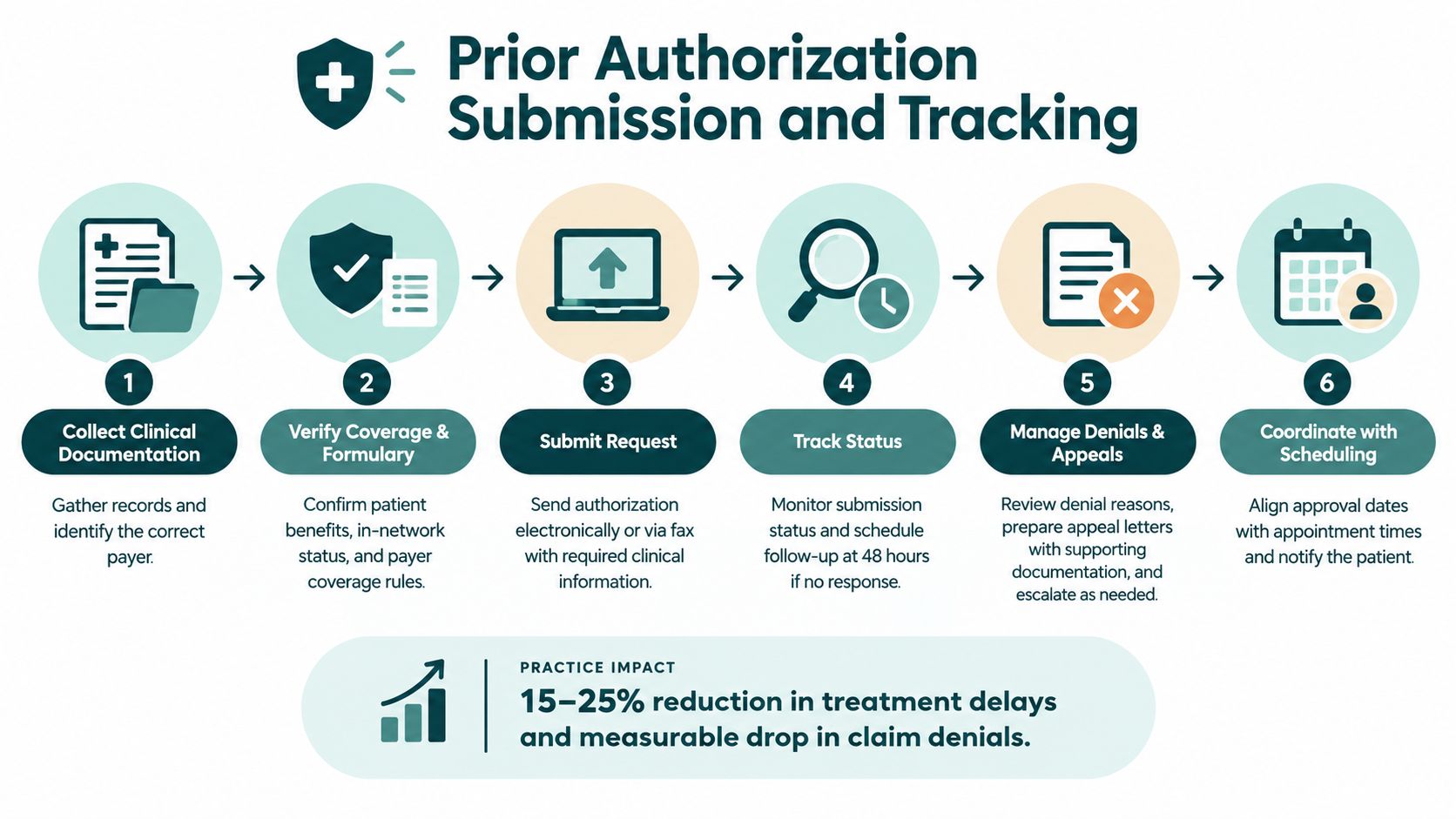
1. Prior authorization submission and tracking
A prior authorization workflow begins when a provider orders a service, medication, or referral that requires payer approval. The ordering provider owns the clinical rationale, while the prior authorization specialist owns the administrative file. That file should contain the order, supporting documentation, diagnosis information, payer requirements, submission record, and next follow-up date.
Submission is only one handoff. The assigned coordinator tracks the request, records payer responses, follows up on delays, and routes missing information to the correct owner. A denial should go to the provider or designated clinical reviewer for a medical-necessity decision, while administrative corrections remain with the authorization team.
A cardiology practice might route an echocardiogram order to a coordinator who confirms payer requirements before scheduling. A behavioral health clinic may check formulary restrictions before a prescribed medication is filled. An orthopedic center may assign a specialist to monitor surgical authorization and prepare the file for a provider-led appeal if the payer denies the request. These workflows protect access, but they also require staff time, documented ownership, and a clear decision about when a case needs clinical review.
Practical rule: An authorization isn't complete until the practice has documented the payer's decision and communicated the result to scheduling, the provider, and the patient.
The tracking dashboard should show the patient, service, payer, submission date, current status, required documents, next follow-up, and escalation owner. A standard checklist reduces avoidable resubmissions. A denial log helps managers identify recurring documentation gaps and payer-specific problems. Remote prior authorization specialists can collect records, submit requests, and track responses through approved systems. Clinical staff must make or approve medical-necessity statements and appeal arguments.
2. Insurance eligibility and benefits verification
Eligibility verification connects the appointment schedule with the payer's current information. Before the visit, an insurance verification specialist confirms active coverage, network status, benefit limitations, copay or deductible information, and whether the planned service needs authorization. The verification result belongs in the electronic medical record or practice-management system, with the date, payer contact details, source of the information, and unresolved uncertainty.
In primary care, the verifier may identify a coverage gap before check-in and alert the patient or manager. In a mental health clinic, the coordinator may confirm behavioral-health benefits and session limitations during intake. Dental, orthodontic, and specialty practices may also need to explain annual maximums or treatment-specific exclusions. Staff should describe what the payer reported without promising that the payer will cover the service.
Use insurance verification services when dedicated capacity is needed for this work, while keeping a firm boundary between verifying benefits and guaranteeing payment. Payer information can change, and a verification call does not remove every claim risk. The practice still owns patient communication, financial policy, and the final decision about how to proceed.
A reliable process includes:
- Standardized capture: Record active status, network information, patient responsibility, limitations, authorization requirements, and the source of the information.
- Manager escalation: Flag new patients, inactive coverage, conflicting payer data, and unusual benefit restrictions for review before the visit.
- Patient-friendly communication: Explain what the payer reported and distinguish an estimate from a final obligation.
- Schedule integration: Place verification in appointment preparation instead of leaving it to the front desk during check-in.
3. Appointment confirmation and reminder workflows
A patient who does not confirm may create an unused appointment slot, delayed care, and avoidable scheduling work. The coordinator owns the outreach record, confirms attendance, provides arrival and preparation instructions, records the patient's response, and alerts scheduling when a cancellation or reschedule creates an open slot. If the patient does not respond, the workflow should specify whether staff send another approved message, call again, or leave the appointment in place.
A primary care practice may ask patients to bring current insurance information. A pediatric clinic may remind a parent about forms or documents needed for a new patient visit. A dermatology practice handling a procedure may use the confirmation call to review preparation instructions that the clinical team has already approved. Remote patient coordinators can manage routine outreach, unanswered messages, rescheduling, waitlist calls, and patients with more complicated preparation needs.
The script should contain only information the practice has authorized staff to communicate. It should identify the appointment, location, arrival expectations, required documents, preparation instructions, and the correct number for clinical questions. Staff should not improvise medical guidance or discuss sensitive details where another person could overhear.
Consent and communication preferences belong in the patient record. Document whether the patient prefers phone, text, portal, or email reminders, and honor opt-out requests. Automated reminders can handle routine confirmations, while staff escalate clinical questions and exceptions to the appropriate team. A virtual phone system can support distributed teams, and you can set up a virtual number affordably without replacing your existing practice line, provided access and recording controls are configured first.
Care coordination examples that prepare the clinical team
4. New patient intake and medical records coordination
New patient intake combines scheduling, forms, insurance, records requests, and chart preparation. The patient intake coordinator sends the appropriate packet after scheduling, follows up on incomplete information, requests records from prior providers, verifies coverage, and enters approved information into the practice system. The clinical team then receives a chart that is ready for review rather than an administrative backlog to solve during the visit.
For primary care, that may include records from previous physicians and a current medication list. A cardiology practice may need prior electrocardiograms, stress-test results, imaging, and referral notes. A mental health clinic may collect screening responses and prior treatment information, while ensuring that sensitive material is routed according to the provider's workflow.
The coordinator shouldn't interpret screening results, reconcile clinical discrepancies independently, or decide which historical condition is clinically significant. Those tasks belong to licensed or designated clinical staff. The remote coordinator can identify missing information, enter data according to approved procedures, and flag allergies, adverse reactions, medications, or other items that require provider attention.
A useful intake control includes:
- One source of truth: Use the patient portal or approved intake system rather than scattered email attachments.
- Records ownership: Assign one person to request, follow up on, receive, index, and route records.
- Exception flags: Mark incomplete forms, conflicting demographics, missing medications, and urgent provider-review items.
- Patient access support: Offer alternatives for patients who have limited portal access or need language assistance.
5. Real-time clinical documentation and EMR note closure
A virtual medical scribe supports care coordination by moving information from the encounter into the electronic medical record while the visit is taking place. The provider remains responsible for the clinical content, assessment, plan, orders, and signature. The scribe documents only within the agreed workflow and should never make an independent diagnosis, change a treatment plan, or sign on the provider's behalf.
In primary care, the scribe may capture the history, medication discussion, examination findings, and plan as the provider speaks. In mental health, the workflow may include session content, treatment-plan updates, and safety-related documentation, with any concern immediately escalated according to the clinic's protocol. In orthopedics, the scribe may organize information from a preoperative or postoperative visit and prepare the note for surgeon review.
AHRQ's care-coordination framework includes communicating information, creating a proactive plan, monitoring follow-up, and supporting self-management. Documentation is the connective tissue that makes those activities visible to the next person on the care team. A note that is drafted quickly but contains unsupported or inaccurate content creates a new safety problem.
Set a specialty-specific template, define how a remote scribe will hear a virtual visit, explain the scribe's role to patients, and require provider review before signing. Quality assurance should include regular spot checks for accuracy, completeness, appropriate attribution, and protection of sensitive information. Same-day closure can be a useful internal target, but the provider's review remains the controlling step.
6. Inbound call triage and message management
Inbound call coordination begins with classification, not clinical advice. A virtual medical receptionist determines whether the caller needs scheduling, records assistance, billing support, a refill message, a nurse callback, or urgent escalation. The receptionist records the reason for the call, relevant details, urgency category, preferred callback method, and destination queue.
A primary care office may route routine appointments to scheduling and symptom questions to a nurse or provider. A pediatric practice may receive calls from parents who need a clinical response rather than a receptionist's opinion. A dermatology clinic may separate cosmetic consultations, urgent concerns, prescription questions, and billing calls into different queues.
The routing tree should be written in plain language. It should tell staff what they can complete, what information they must collect, what they must never advise, and when to escalate immediately. Scripts should also include emergency instructions approved by the practice, without asking unlicensed staff to assess or diagnose the patient.
A remote receptionist can answer calls during clinic hours, manage overflow, document messages, and monitor unresolved items. The practice should review whether the phone system logs calls securely and whether the remote worker can access the correct patient record without seeing unrelated information. A medical receptionist and administrative skills team can support this work when the role is defined around routing and documentation rather than clinical triage.
A fast answer isn't enough. The message must reach the right person with enough context to act.
Care coordination examples that close the loop outside the practice
7. Referral coordination and external provider communication
A referral remains open until the patient receives the outside service, the referring practice receives the result, and a clinician reviews what happens next. Assign one owner to confirm that the receiving office obtained the referral, check appointment status, monitor authorization requirements, and retrieve the specialist's report. The receiving practice needs a corresponding process for returning findings, recommendations, and follow-up instructions to the referring clinician.
Practices still running referral traffic by fax should review the SendItFax healthcare guide for secure transmission options while a portal-based tracking log is put in place. Transmission confirms delivery of a document, not completion of care.
A primary care coordinator might send a cardiology referral with the relevant history, medication list, test results, and clinical question. A gastroenterology practice should return procedure and pathology reports through an approved channel. In behavioral health, a therapist referring a patient to psychiatry needs confirmation that medication management was scheduled, plus a method for notifying the therapist about follow-up needs.
The handoff should identify the information required for the next decision: referral order, clinical question, relevant records, insurance details, authorization status, appointment information, and final report. Administrative staff can check that these items are present and route missing records. They should not reinterpret clinical findings or summarize them in a way that changes the specialist's meaning. The referring provider reviews the report and decides whether treatment, testing, or patient contact is required.
A referral log can show the referral date, destination, authorization status, appointment date, results received, provider review status, and next action. Follow-up timing should reflect clinical priority and payer or specialty requirements rather than one universal interval. A medical credentialing services team may help organize external-provider information and administrative coordination, but credentialing does not replace referral tracking or clinical review.
8. Insurance denial review and appeals
Denial management connects the payer, billing team, clinical documentation staff, coding function, and provider. The denial specialist identifies the reason, such as missing authorization, a coding mismatch, a coverage exclusion, incomplete records, or a medical-necessity question. The practice then chooses the appropriate response: correct and resubmit, appeal, request documentation, or write off the balance under its policy.
A primary care practice may find that referral claims repeatedly lack supporting records. An orthopedic center may route a procedure denial to billing for file assembly and to the surgeon for clinical input. A behavioral health clinic may need a revised workflow when payer-specific telehealth or place-of-service requirements cause recurring denials.
Remote billing assistants can monitor remittance advice, categorize denial reasons, gather records, prepare draft appeal packets, and track deadlines. They should not alter clinical documentation, create unsupported medical-necessity language, or submit an appeal requiring provider attestation without review. Each appeal needs a named owner, a deadline, and a documented next action.
A denial dashboard should show:
- Root cause: Separate preventable process errors from coverage decisions outside the practice's control.
- Payer pattern: Group denials by payer, service, provider, and reason.
- Deadline control: Display appeal and resubmission deadlines.
- Clinical escalation: Send documentation and medical-necessity questions to the appropriate provider.
- Feedback loop: Share recurring problems with scheduling, authorization, coding, and clinical teams.
Recovery dollars matter, but AHRQ identifies coordination measures such as patient confusion, contacts needed to schedule care, unnecessary tests or hospitalizations, and patient hassle in its Care Coordination Measures Atlas. Apply that same lens to denials. Track whether the workflow prevents repeat errors and reduces avoidable contacts for staff and patients.
Care coordination examples for documentation, communication, and continuity
9. Clinical documentation for specialty follow-up
A second documentation scenario appears after the initial visit, when several teams need a consistent account of what happened next. Consider an orthopedic follow-up after imaging or therapy. The provider discusses symptoms, reviews results, changes restrictions, and updates the plan. A documentation specialist can prepare the note, attach the correct report, route orders, and place the chart in the provider's review queue.
This differs from general visit scribing because the handoff may involve outside imaging, physical therapy, surgery scheduling, and the primary care physician. The note must make the next step clear. It should distinguish completed actions from pending actions and identify which team is expected to contact the patient.
A remote scribe can support note preparation and EMR navigation when the practice gives that person controlled access and a defined template. The provider must confirm the clinical content, sign the note, approve orders, and make decisions about treatment. In mental health, additional care is needed around highly sensitive notes, proxy access, and the handling of safety-related information.
The operating control is a pending-action queue. It should show the patient, action, responsible person, due point, and completion status. Without that queue, a well-written note can still leave an imaging order, therapy referral, or patient callback unaddressed.
10. Message management across clinical and administrative queues
A message can begin as an administrative request and become a clinical issue. A patient may call to reschedule, mention a medication problem, ask about a test result, and request a work note in the same conversation. The receptionist needs a method for separating those requests, documenting them accurately, and routing each one to the correct queue.
The practice manager should define categories for scheduling, medication, results, records, billing, forms, referrals, and urgent concerns. Each category needs an owner, a response expectation, and an escalation path. The remote staff member can collect information and route the message, but shouldn't decide whether symptoms are benign, whether a medication should change, or whether a result is normal.
A secure phone and messaging system should identify the patient correctly and minimize unnecessary disclosure. Staff should verify identity using the practice's approved process before discussing protected information. They should also avoid copying sensitive details into unsecured notes or personal devices.
A daily queue review catches messages that were routed incorrectly or left without a response. Managers should sample completed messages for clarity and check whether the receiving clinician had enough information to act. The goal is not just fewer calls. It's fewer unresolved handoffs and fewer patients repeating the same request.
11. Referral results and closed-loop communication
Referral coordination deserves a separate workflow for the return journey. Sending the patient to a specialist is only the outbound half. The practice must know whether the appointment occurred, whether the report arrived, whether the referring provider reviewed it, and whether the patient received the next instruction.
CMS illustrates this connected model with a patient whose emergency-department records, test results, and new medication enter the electronic health record, trigger an alert to the primary care physician, support a cardiology referral, and lead to a later primary-care check-in after chart review. The example shows why care coordination depends on information moving across settings, not merely on assigning a task.
The receiving practice should use a results queue rather than relying on a report to land unnoticed in an inbox. A medical records specialist can index the report, match it to the correct patient and referral, route it to the provider, and record that review occurred. The provider then determines whether the plan changes and whether another message or appointment is required.
Remote administrative staff can also contact the specialist office when a report is missing and notify the patient that the practice is still working to obtain it. They shouldn't interpret the report or communicate clinical conclusions without provider-approved language. A referral is closed only when the necessary result has been received, reviewed, and connected to the next action.
Care coordination examples for transitions and patient financial support
12. Patient payments, self-pay collection, and account resolution
Patient payment coordination involves more than asking for money. The billing assistant explains the account, confirms that charges and insurance activity are documented, identifies questions requiring billing review, and applies the practice's financial-assistance and payment-plan policies consistently. The patient should understand what the practice is requesting and whom to contact if the account appears incorrect.
A primary care practice may assign an assistant to contact patients about aging balances and document each conversation. A specialty clinic may review expected out-of-pocket responsibility before a procedure. A community health center may screen for available hardship assistance and connect eligible patients with the appropriate program or community resource.
Remote billing staff can send statements, answer approved account questions, record payment arrangements, process payments through authorized systems, and escalate disputes. They shouldn't make undocumented promises, waive balances outside policy, or pressure patients who may qualify for assistance. Clear scripts help, but empathy and accurate account information matter more than aggressive collection language.
Controls should include:
- Written arrangements: Record the agreed terms and provide the patient with confirmation.
- Multiple payment channels: Use the practice's approved portal, phone, or mail options.
- Hardship pathway: Train staff to identify when a financial counselor or manager should review the account.
- Audit trail: Document contacts, disputes, payments, adjustments, and escalations.
- Privacy protection: Limit account access to the information needed for the assigned task.
13. Post-discharge transition follow-up
Discharge follow-up is one of the clearest care coordination examples because the patient moves from a hospital or facility back into community care. The practice needs a discharge notification, summary, medication changes, follow-up recommendations, and a named person responsible for contacting the patient or caregiver. That owner confirms what the patient understands, identifies barriers, and routes clinical concerns to a nurse or provider.
The historical need is substantial. A federal review reported that about 19% of Medicare hospital admissions resulted in readmission within 30 days, avoidable rehospitalizations in 2004 cost Medicare $17.4 billion, and nearly 31% of Medicare beneficiaries discharged from hospitals experienced two or more transfers to different care settings. These figures explain why medication reconciliation, discharge calls, referral scheduling, and communication with post-acute providers became central coordination tasks. The federal review of care transitions provides the historical context.
A remote coordinator can monitor an approved worklist, obtain missing discharge documents, contact the patient, schedule the follow-up visit, confirm medication access, and document barriers. The coordinator must escalate symptoms, medication discrepancies, or safety concerns according to the practice's clinical protocol. A provider or qualified clinical staff member remains responsible for clinical assessment and decisions.
14. Multidisciplinary transition planning
Some patients move among primary care, specialists, behavioral health, home services, pharmacies, and community organizations. A multidisciplinary transition plan gives each participant the same current information, including the patient's goals, medication list, follow-up appointments, pending tests, responsible clinician, and unresolved barriers.
The STAAR program at Massachusetts General Hospital combined reliability-focused discharge processes, cross-team communication, and post-discharge follow-up. Over a four-year implementation period, its reported 30-day readmission rate fell from 21.0% before the intervention to 14.5% afterward, a 30% relative decrease. The BMJ Innovations report on the STAAR program describes the intervention and its results.
The lesson for a smaller practice isn't to copy the hospital program wholesale. It's to make the handoff reliable enough that a patient doesn't become the sole messenger between organizations. A remote medical records specialist or patient coordinator can assemble the transition packet, confirm receipt, maintain the task list, and document outreach. The clinical team must establish the care plan, determine escalation thresholds, and review changes.
The network outside the clinic can be the hardest part. A 2026 Commonwealth Fund comparison across 10 countries reported that most primary care physicians didn't receive specialist reports within a week, and roughly four in 10 U.S. primary care physicians identified limited information about community providers as a major barrier when coordinating with social services. The Commonwealth Fund comparison of care coordination across 10 countries highlights why electronic connectivity alone doesn't guarantee timely communication.
12-Point Care Coordination Comparison
A useful comparison asks more than whether a workflow saves time. It identifies who owns the handoff, which information must move, where remote administrative staff can assist, and which control keeps clinical decisions with licensed staff. The table below compares twelve workflows without assigning unsupported performance percentages.
| Workflow | Implementation complexity | Handoff owner and information | Remote support | Controls and practical value |
|---|---|---|---|---|
| Prior Authorization Submission and Tracking | High, payer rules and multiple steps | Authorization specialist owns status; clinical team supplies diagnosis, order, and rationale | Submit requests, monitor portals, document payer responses | Provider approval, deadline tracking, fewer avoidable treatment delays |
| Insurance Eligibility and Benefits Verification | Moderate, payer systems vary | Verification staff owns the check; front desk receives coverage and cost details | Confirm eligibility, record benefits, flag uncertainty | Verify before service, protect privacy, reduce claim and billing disputes |
| Appointment Confirmation and Reminder Workflows | Low to moderate | Scheduling team owns contact preferences and appointment status | Send approved reminders, record responses, offer open slots | Consent-based messaging, accurate schedules, better slot utilization |
| New Patient Intake and Records Coordination | Moderate, several information sources | Intake coordinator owns completeness; clinician reviews history | Send forms, request records, index documents, flag gaps | Identity checks, minimum necessary access, prepared charts |
| Clinical Documentation and EMR Note Closure | Moderate to high, training and review required | Provider owns the note; scribe supports documentation | Draft notes, organize dictated content, route for signature | Provider review, access controls, clear correction process |
| Inbound Calls and Message Management | Low to moderate | Reception team owns routing; clinician owns clinical response | Capture caller details, schedule, document, and route messages | Escalation rules, message timestamps, no independent diagnosis |
| Referral Coordination and External Provider Communication | Moderate, outside offices may respond differently | Referral coordinator tracks the order and report; ordering clinician reviews findings | Send records, confirm receipt, monitor outstanding reports | Referral log, consent checks, escalation for missing results |
| Denial Review and Appeals | High, coding and clinical documentation may both matter | Billing lead owns the case; clinician supports medical rationale | Categorize denials, assemble records, track appeal deadlines | Coding review, provider sign-off, audit trail |
| Patient Payments and Account Resolution | Moderate, financial and privacy controls apply | Billing team owns balances; financial staff handles patient questions | Process payments, explain statements, document arrangements | PCI-compliant tools, identity verification, hardship escalation |
| Lab and Imaging Result Follow-Up | Moderate, results require clinical interpretation | Ordering clinician owns review and patient communication | Monitor incoming results, route abnormal flags, document outreach attempts | No result interpretation by remote staff, closed-loop status |
| Care Plan Task Tracking | Moderate, multiple roles share work | Care manager or designated clinician assigns tasks and due dates | Maintain task queues, send reminders, record completion | Named owner per task, overdue escalation, current plan in the EMR |
| Medication Refill Coordination | Moderate, refill rules and clinical review apply | Prescribing clinician owns approval; staff verifies request details | Collect pharmacy and medication information, route refill requests | Medication reconciliation, allergy checks, clinician authorization |
Remote staff can maintain queues, gather information, and document activity. They should not approve treatment, interpret results, promise coverage, or resolve clinical uncertainty. Each workflow needs a named owner, a documented handoff, and an escalation path that the practice can audit.
How to assign remote staff without weakening clinical control
Remote healthcare staff are most useful when the practice separates coordination work from clinical authority. A patient intake coordinator can request records, but a provider decides what those records mean. An insurance verification specialist can report payer information, but shouldn't guarantee coverage. A virtual receptionist can identify an urgent-sounding message and escalate it, but shouldn't triage the condition independently.
A practical role map can look like this:
- Virtual medical receptionist: Answers calls, schedules visits, confirms appointments, documents messages, and routes clinical questions.
- Patient intake coordinator: Sends forms, follows up on missing information, requests records, and prepares the chart.
- Insurance verification specialist: Checks eligibility and benefits, records payer information, and flags uncertainty.
- Prior authorization specialist: Submits and tracks requests, gathers documentation, and escalates clinical questions.
- Medical records specialist: Indexes records, tracks referrals, obtains missing reports, and manages document queues.
- Medical billing assistant: Reviews denials, follows payer activity, manages statements, and documents account resolution.
- Virtual medical scribe: Drafts encounter documentation in the EMR for provider review and signature.
The practice should limit each role's access to the systems and patient information needed for its work. Use individual logins, appropriate permissions, secure communication channels, documented training, and periodic access reviews. A Business Associate Agreement should be in place where applicable, and the practice should confirm its obligations with qualified compliance counsel. HIPAA alignment or training doesn't mean a vendor or employee is officially “HIPAA certified,” because HHS doesn't recognize an official HIPAA certification.
Before assigning a workflow, write the escalation rule in a form a new employee can follow. For example, “route all medication discrepancies to the nurse queue,” or “don't communicate a denial appeal outcome until the billing manager approves the message.” The rule should identify the destination, required information, urgency, and backup owner.
How to measure whether care coordination actually happened
Task completion alone can create a false sense of control. A referral may be marked sent even though the specialist never received it. A post-discharge call may be logged even though the patient couldn't explain the medication plan. A message may be closed without documenting who reviewed the result or what happens next.
AHRQ's care-coordination measurement framework maps operational activity to specific questions. It includes establishing accountability, communicating information, facilitating transitions, assessing needs and goals, creating a proactive plan, monitoring follow-up, supporting self-management, linking patients to community resources, and aligning resources with patient and population needs. AHRQ's care-coordination activities framework gives practices a useful structure for assigning ownership.
Track a small set of measures tied to the workflow:
- Completion: Was the referral received, appointment scheduled, report returned, or follow-up completed?
- Turnaround time: How long did the handoff take from initiation to the next confirmed action?
- Exception rate: How often did the workflow require escalation, resubmission, correction, or manager intervention?
- Patient friction: Did patients need repeated contacts, clarify confusing instructions, or report unnecessary hassle?
- Clinical review: Did the authorized clinician review the information and document the next decision?
For remote teams, process measures are especially valuable because they show whether added capacity is improving reliability rather than merely moving work to another queue. Review the data by specialty, payer, provider, and workflow. A measure that improves one department while increasing unresolved work elsewhere isn't a complete operational improvement.
Common implementation failures in medical practices
Care coordination usually breaks at boundaries. The referral coordinator assumes the specialist will send results automatically. The front desk assumes the nurse saw the message. The billing team assumes the authorization was recorded in the order. The patient assumes someone is watching the next step. Each assumption creates a gap.
Another failure is assigning work without giving the person authority to complete the administrative portion. If a coordinator can't access the payer portal, referral inbox, or records system, the workflow still depends on a busy clinician. If a scribe has no template or provider review window, documentation accumulates despite the extra staffing.
Avoid these patterns:
- Unowned queues: Every queue needs a primary owner and backup.
- Hidden exceptions: Staff need a visible place to record failed calls, missing records, payer delays, and patient barriers.
- Unclear clinical boundaries: Remote staff need written instructions for what to route and what they must never decide.
- Duplicate documentation: Decide where the authoritative status lives so employees don't maintain conflicting spreadsheets and notes.
- No feedback loop: Review recurring errors with the team that creates the originating information.
- Overreliance on automation: Automated reminders and alerts can support the process, but they don't replace judgment, patient contact, or closed-loop confirmation.
Start with one high-friction workflow rather than staffing every administrative function at once. Map the current steps, identify the most common failure point, assign each handoff, define the escalation boundary, and measure completion, turnaround time, and exceptions. Expand only after the practice can explain what improved and what still requires redesign.
The Takeaway
The strongest care coordination examples have the same operating features. They protect access and safety through clear call-routing and escalation rules, prevent delays through intake, eligibility, authorization, and referral tracking, and strengthen continuity through accurate documentation and closed-loop communication. The work is distributed, but accountability isn't vague.
Practice managers should choose one workflow that regularly creates delays or repeated contacts. Assign every handoff to a defined role, document what information must move, establish the point where licensed staff must review or decide, and measure completion, turnaround time, and exception rates before expanding support.
Remote roles such as virtual receptionists, patient intake coordinators, insurance verification specialists, prior authorization specialists, medical records specialists, billing assistants, and scribes can support these workflows when access controls, training, secure systems, provider review, and an appropriate Business Associate Agreement are in place. They can increase operational capacity without replacing clinical judgment or licensed care.
Medical Virtual Assistants connects U.S. medical practices with pre-vetted LATAM healthcare talent aligned with U.S. clinic hours, including staff for reception, intake, documentation, revenue-cycle work, and care coordination. If you're evaluating remote support for one of these workflows, review the available roles and discuss a scope that keeps administrative ownership clear while leaving medical decisions with your clinicians.
Medical Virtual Assistants offers pre-vetted LATAM healthcare staff who can work within your clinic hours and support calls, intake, referrals, documentation, prior authorization, insurance verification, and billing workflows. Visit Medical Virtual Assistants to evaluate a role around the handoff your practice most needs to stabilize.