

Prior authorization is a payer approval step where your practice checks whether a service requires approval, submits medical-necessity documentation, and waits for a payer decision before delivering care. Under the CMS 2024 rule, affected programs must generally respond within 72 hours for expedited requests and 7 calendar days for standard requests beginning in 2026.
The process sounds like a simple yes-or-no checkpoint. In practice, it's a queue owned by several people, shaped by payer-specific rules, and often slowed by missing records, unclear status updates, or a patient who can't wait indefinitely. A physician may order an advanced imaging study, specialty medication, procedure, or durable medical equipment, but the order alone doesn't complete the work. Someone must verify the requirement, assemble the evidence, submit the request through the correct channel, monitor the review, and manage whatever happens next.
For practice owners and managers, the operational question is not only how prior authorization works. It's who does what, when the work is complete, and how the practice protects the patient's care plan after approval or denial. This guide follows that lifecycle from the first insurance check through appeals, rescheduling, patient communication, and staffing.
How Does Prior Authorization Work at a Glance
Prior authorization is a utilization-management process. Before a payer will cover certain drugs, imaging studies, procedures, or specialty services, a clinician or member of the practice staff must obtain approval. The payer reviews the request against plan rules and may approve it, deny it, or ask for more information.
This isn't an occasional administrative nuisance in many practices. The American Medical Association's 2024 physician survey found that physicians completed an average of 43 prior authorizations per week and spent about 12 hours weekly on the work. The same survey reported that 94% of physicians said prior authorization delays necessary care, 78% said it often or sometimes causes patients to abandon recommended treatment, and 27% said requests are often or always denied.
The practice-side lifecycle
A reliable workflow has distinct ownership at each stage:
- Identify the requirement. Staff verify the patient's active plan, the ordered service, and whether authorization is required.
- Define the clinical request. The provider documents the diagnosis, proposed treatment, medical rationale, and relevant treatment history.
- Gather evidence. Staff collect notes, results, prior therapy records, forms, and payer-specific attachments.
- Submit correctly. The request goes through the payer's portal, electronic transaction, fax process, or phone workflow.
- Track the queue. A named owner records the submission date, reference number, status, follow-up date, and deadline.
- Act on the decision. Approval requires scheduling and expiration tracking. Denial requires a patient plan, reconsideration, appeal, peer review, or alternative therapy discussion.
Small practices often underestimate the staffing needed because the work is distributed across front-desk employees, nurses, medical assistants, providers, and billing staff. A practical overview of health work for small business can also help owners think about administrative capacity more broadly, but prior authorization still requires healthcare-specific training and controlled access to patient information.
What Prior Authorization Is and Why Payers Require It
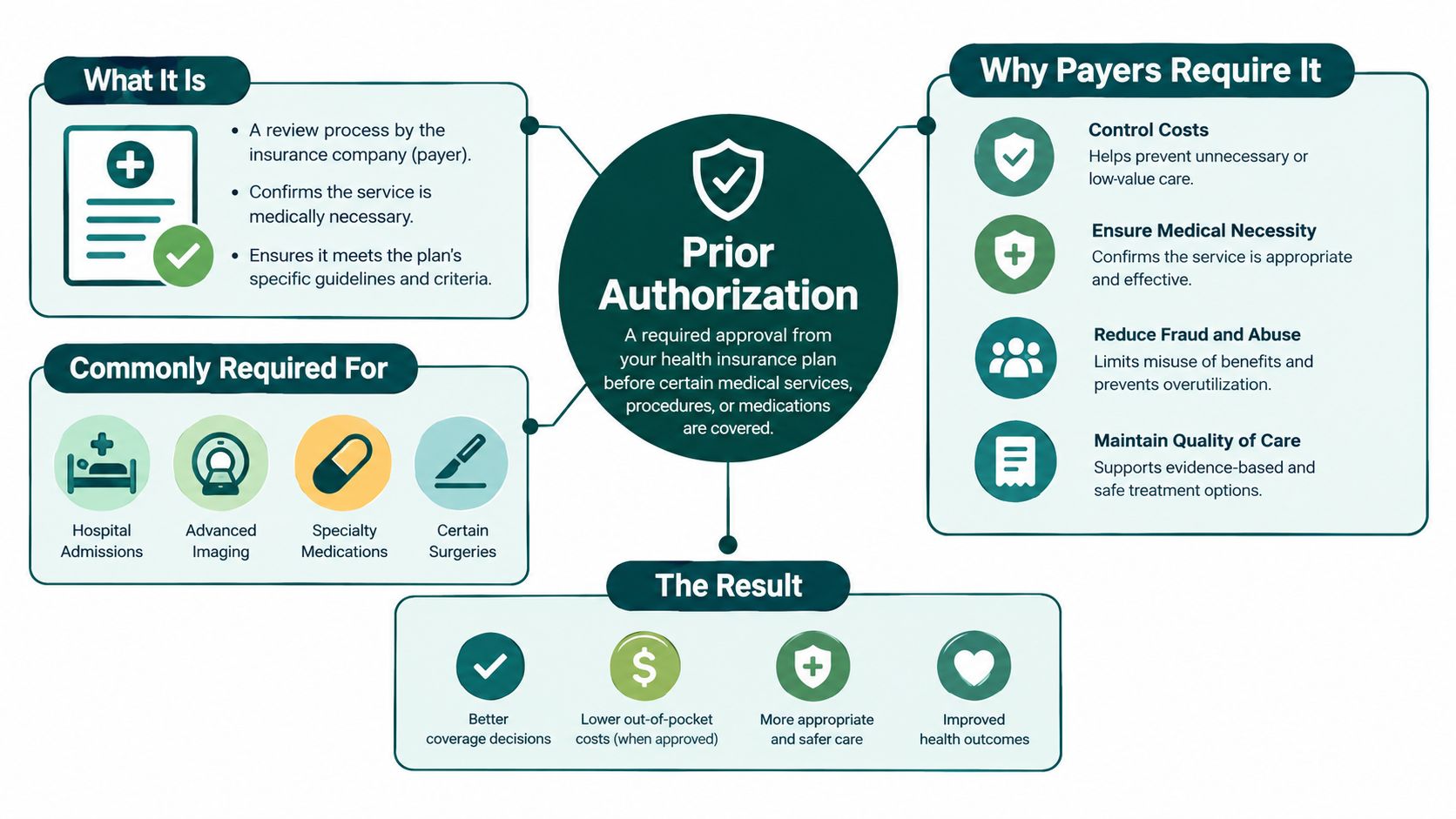
Think of prior authorization as a building permit. A contractor may know exactly how to complete a project, but the local authority requires a review before construction begins. In the same way, a provider may believe a medication, procedure, imaging study, or specialty service is clinically appropriate, while the payer requires supporting evidence before agreeing to cover it.
The payer's review generally evaluates whether the requested service meets the plan's coverage rules and medical-necessity criteria. If the practice delivers a service without required authorization, the claim may later be denied even when the provider believes the care was appropriate. That risk is why the authorization check belongs near the beginning of the workflow, not after the appointment has already occurred.
What commonly triggers review
Authorization requirements vary by payer, plan, state, service, diagnosis, and patient benefit design. Common examples include:
- Specialty medications, especially drugs with coverage restrictions or step-therapy requirements.
- Advanced imaging, such as certain MRI, CT, or specialized diagnostic studies.
- Procedures and surgery, including services that require evidence of conservative treatment.
- Durable medical equipment, where the payer may require detailed records and an order.
- Specialty services, particularly when the plan uses network or referral controls.
The same service may require approval under one plan but not another. A patient's insurance card, portal response, formulary, or payer representative may provide the first indication, but staff should confirm the requirement using the current plan-specific process.
Why payers use the gate
Payers generally use prior authorization to manage utilization, apply coverage criteria, encourage lower-cost or preferred therapies, and reduce inappropriate or fraudulent billing. Those objectives can be reasonable in principle. Providers, however, experience the process as a delay mechanism when the criteria are unclear, the submission channel is unreliable, or the payer requests information already present in the medical record.
The trade-off is therefore operational as well as clinical. A review may prevent an unsuitable service, but a slow or inconsistent review can interrupt a treatment plan. KFF found that 51% of insured adults had needed prior authorization in the previous 2 years, and many described the process as difficult to manage in its health tracking poll.
Operational rule: Treat the authorization requirement as a workflow trigger. Don't wait for the payer to reject a claim before asking whether approval was needed.
Who Initiates a Prior Authorization and What Documentation You Need
The provider's office usually initiates the request. The payer defines the requirement and reviews the submission, but the practice must identify the service, prepare the clinical evidence, and send the request through the required channel. Patients may provide an insurance card, answer intake questions, or help explain previous treatment, but they shouldn't be expected to manage the practice's authorization queue.
The provider supplies the clinical rationale. A front-desk employee, insurance verification specialist, medical assistant, nurse, billing employee, or dedicated prior-authorization coordinator may handle the administrative work. The right assignment depends on the service and the practice's policies, but administrative staff should never independently diagnose, select treatment, or make a clinical determination.
Documentation by request type
| Request Type | Typical Documentation | Common Submission Channel |
|---|---|---|
| Specialty medication | Diagnosis, prescription details, prior therapies, relevant lab results, and the payer's drug-specific form | E-prescribing workflow, payer portal, electronic prior authorization, fax, or phone |
| Imaging | Order, diagnosis code, symptoms, examination findings, prior imaging, and clinical notes | Payer portal, electronic medical record workflow, fax, or phone |
| Procedure | Procedure code, diagnosis, treatment history, operative rationale, imaging or lab evidence, and signed notes | Payer portal, electronic submission, fax, or phone |
| Durable medical equipment | Order, diagnosis, functional need, supporting examination, and required forms | DME or payer portal, fax, or other payer-designated channel |
A request can be clinically sound and still stall because one attachment is missing or the diagnosis code doesn't support the requested service. Before submission, the assigned owner should confirm:
- Patient and plan: Verify eligibility, member identification, group information, payer name, and the exact plan.
- Service details: Match the order, procedure code, medication, dosage, location, and rendering provider.
- Clinical evidence: Include the diagnosis, relevant findings, treatment history, test results, and the provider's rationale.
- Payer form: Use the current plan-specific form and answer every required field.
- Submission record: Save the confirmation, reference number, date, channel, and expected follow-up date.
- Patient timing: Record the intended appointment or treatment date so the request can be escalated appropriately.
Front-loading complete documentation reduces avoidable back-and-forth. A workflow study cited by CMS's prior authorization and pre-claim review information found that automating payer identification, documentation retrieval, and status notification reduced median authorization time by 33.9%, from 4.2 to 2.8 business days, and reduced the 90th percentile by about one week.
Practices that want to formalize the eligibility and payer-information portion of this workflow can review insurance verification services. Verification doesn't replace clinical review, but it can prevent the request from starting with the wrong payer or inactive coverage.
The Payer Review Process and Timelines
Consider a patient whose provider orders an imaging study that requires approval. The practice first confirms the active plan and requirement, then submits the order, diagnosis, clinical notes, and supporting history. The payer receives the request, assigns a tracking number, and checks whether the submission is complete. From there, the request may move through automated criteria checks, administrative review, or clinical review by a nurse or other payer representative.
The payer may approve the request, deny it, approve only part of it, or ask for more information. A request for records isn't a final denial, but it is a deadline-sensitive event. The practice must determine exactly what is missing, obtain the provider's input when needed, submit the additional material, and update the tracking record.
What standard and expedited mean
An expedited request is appropriate when waiting through the ordinary process could seriously jeopardize the patient's health or ability to regain maximum function. The provider, not an administrative employee alone, should determine whether the clinical circumstances justify expedited handling and document the reason.
The CMS Interoperability and Prior Authorization Final Rule provides a regulatory anchor for affected Medicare Advantage, Medicaid, CHIP, and federally facilitated Marketplace programs. As described in the CMS final rule announcement, impacted payers must generally issue decisions within 72 hours for expedited requests and 7 calendar days for standard requests beginning in 2026. Commercial payer procedures and actual practice-level turnaround can still vary, so staff should confirm the applicable plan rules rather than assume every request follows the same clock.
The rule also requires an affected payer to support a FHIR-based Prior Authorization API. In plain terms, an API allows the practice's electronic systems to exchange structured request and response information with the payer instead of relying entirely on manual portal entry, fax, or phone calls. The CMS fact sheet on the interoperability and prior authorization rule explains that the API must identify covered items and services, show documentation requirements, and support request and response exchange.
What faster exchange changes
Electronic exchange can reduce rekeying, improve visibility into status, and make it easier to identify missing information. It won't eliminate payer-specific criteria, clinical review, incomplete provider notes, or the need to explain an exception. A small practice still needs a human owner who knows when a request was submitted, what the payer asked for, and when escalation is appropriate.
A useful operational record contains the request date, urgency level, payer, service, reference number, current status, missing items, next follow-up date, and patient communication history. If staff can't answer those questions quickly, the technology hasn't solved the queue.
Practices also need to separate authorization work from credentialing and enrollment tasks. A specialist may be able to help with medical credentialing services, but credentialing status, payer enrollment, and authorization submission are related administrative functions, not interchangeable steps.
Why Prior Authorization Requests Get Denied
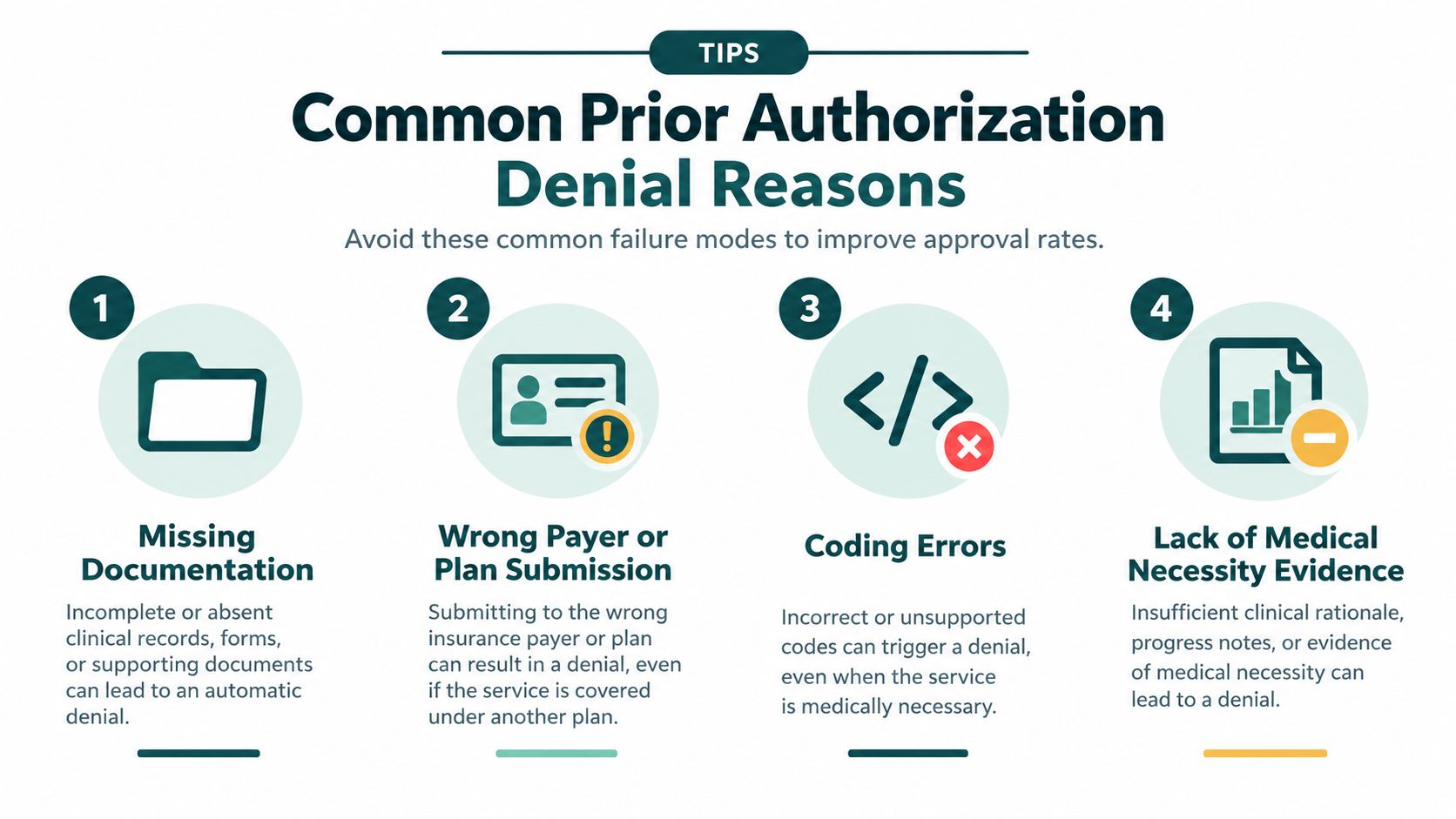
Denials usually fall into recognizable categories. Some reflect preventable practice errors. Others reflect a payer's coverage policy, a clinical disagreement, or a benefit exclusion that better documentation won't change. The manager's job is to distinguish those situations quickly instead of treating every denial as a documentation problem.
Missing or incomplete evidence
The payer may not receive the latest office note, test result, treatment history, signed order, or required form. Staff can reduce this failure by using a request-type checklist and reviewing the payer's current requirements before submission. The provider's note should connect the diagnosis and findings to the requested service rather than merely listing a code.
Wrong payer or plan
A patient may have changed coverage, carry more than one plan, or present an insurance card that doesn't identify the correct authorization administrator. Verify eligibility and authorization responsibility before collecting clinical records. Submitting a complete request to the wrong entity still produces delay.
Coding mismatch
The diagnosis, procedure, medication, place of service, or ordering provider may not align across the order, form, and clinical note. Staff should compare the submitted codes with the provider's documentation and the payer's criteria. They should escalate uncertain coding questions to the appropriate coding or clinical resource rather than guessing.
Medical-necessity and step-therapy gaps
Some plans require evidence that a patient tried a preferred medication, conservative treatment, or another covered option first. If the patient failed or couldn't tolerate that option, the record should state what was tried, the result, and why the requested treatment is appropriate. If no exception exists and an alternative is clinically acceptable, switching to a covered therapy may be faster than pursuing a weak appeal.
Administrative defects
Unsigned orders, expired referrals, wrong provider identifiers, missing clinical signatures, and incorrect patient details can stop a request before meaningful clinical review. A second-person quality check is useful for high-cost procedures and time-sensitive care, but it shouldn't create a new bottleneck for routine submissions.
Physician reports show that denials are not evidence of poor practice performance. The AMA reported that 27% of physicians said requests were often or always denied in its 2024 survey, and its prior authorization reform update reported that 69% of physicians said prior authorization leads to ineffective initial treatments and 42% said it pushes patients into immediate care or emergency department visits.
Use denial data for process improvement, not blame. A practice may find that its preventable issues cluster around missing notes, while another practice's denials mainly reflect a plan's step-therapy policy. Keeping structured authorization records in a properly governed environment is part of that review. Teams evaluating storage and reporting approaches can use this discussion of cloud versus on-prem healthcare data as a starting point, then confirm security, contractual, and compliance obligations with qualified professionals.
What Happens After Approval or Denial
Approval isn't the finish line. It changes the work from obtaining permission to using that permission correctly before it expires.
The coordinator should record the authorization number, approved service, units or quantity, servicing location, effective date, expiration date, and any conditions. The scheduling team needs that information before booking the patient, and the billing team needs the authorization number attached to the claim when required. If the patient misses the authorized window, the practice may need to start the process again.
When the payer approves
A practical post-approval sequence looks like this:
- Confirm the decision letter. Check that the approval matches the ordered service, provider, location, quantity, and date range.
- Update the record. Store the authorization number and expiration information where authorized staff can find it.
- Coordinate scheduling. Offer an appointment within the approval window and account for referral, facility, or medication logistics.
- Alert the patient. Explain what was approved, what happens next, and whether any separate financial responsibility remains.
- Monitor completion. Confirm that the service occurred and that the claim or dispensing process used the authorization information correctly.
When the payer denies
A denial should trigger a decision tree, not an automatic appeal. First, determine whether the denial resulted from missing information, a correctable administrative issue, a medical-necessity disagreement, a benefit exclusion, or a plan requirement the patient hasn't met. Correctable defects may be handled through reconsideration or resubmission. Clinical disputes may justify a provider-to-provider or peer-to-peer discussion, followed by a formal appeal if the plan allows it.
The practice should check the denial letter for the appeal deadline, required form, submission address or portal, supporting evidence, and available escalation path. External review may be available in some circumstances, but rules vary by plan and jurisdiction, so practices should confirm the applicable process with the payer or a qualified compliance professional.
What to tell the patient
Silence damages trust faster than a clear delay notice. Use plain language and avoid promising an approval:
Initial update: “Your insurance requires approval before the service can be scheduled. We've submitted the request and will contact you when the plan responds.”
More-information update: “The plan asked for additional records. We're obtaining them from the clinical team and will update you after the new information is submitted.”
Denial update: “The plan didn't approve the request under its current criteria. The provider is reviewing whether to appeal or use a covered alternative, and we'll explain the next step before you need to make a decision.”
A patient may abandon recommended treatment when a request stalls. The AMA survey cited earlier found that 78% of physicians reported patients often or sometimes abandon treatment because of prior authorization delays. The practice can't control every payer decision, but it can prevent the patient from being left without a status, an alternative, or a documented follow-up plan.
Running Prior Authorization Efficiently in Your Practice
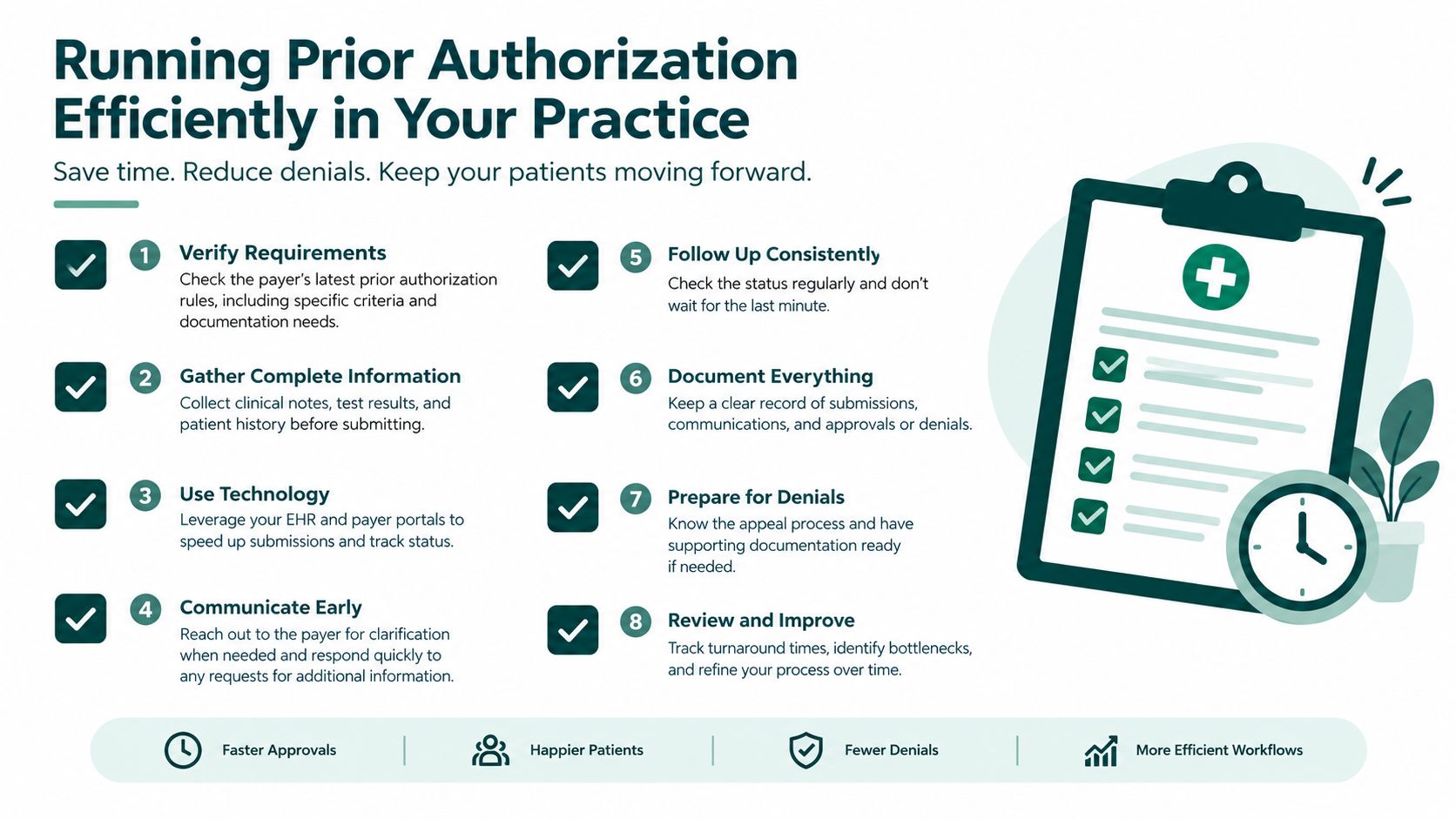
Efficiency comes from ownership and routine, not from choosing one magic tool. Many practices still work across payer portals, phone calls, faxed forms, electronic health record tasks, and scanned decision letters. A portal may improve submission speed while creating a separate status queue. A remote employee may extend coverage while requiring careful permissions, training, and escalation rules.
Match the work to the role
Training existing front-desk staff can work when the authorization volume is modest and the team has protected time. It often fails when the same employee must answer phones, check patients in, schedule visits, and monitor several payer queues at once. A dedicated coordinator provides clearer accountability but adds staffing cost and requires a defined workload.
Remote support can handle administrative tasks such as checking requirements, assembling records, submitting requests, recording reference numbers, following up with payers, and escalating missing clinical information. It shouldn't independently interpret medical necessity, alter a treatment plan, disclose information outside approved workflows, or make a clinical decision. The provider remains responsible for the clinical rationale.
For practices considering remote staffing, Medical Virtual Assistants offers pre-vetted LATAM healthcare personnel, including prior-authorization support that can submit, track, and escalate requests during U.S. practice hours. Bilingual English and Spanish capability may help with patient updates, but the practice still needs a documented communication policy and appropriate access controls.
Build a visible queue
Use the EHR, a payer worklist, or a secure task system that lets authorized staff see:
- Request owner: The person accountable for the next action.
- Payer and channel: The plan, administrator, portal, fax, or phone route used.
- Clinical status: Waiting for provider information, submitted, additional records requested, approved, denied, or appealed.
- Dates: Submission date, next follow-up date, appointment date, and authorization expiration.
- Patient contact: What was communicated, when, and by whom.
Review the queue at a fixed cadence. Escalate requests that are aging, tied to a near-term appointment, or waiting on a provider response. Track denial rate, turnaround time, incomplete-submission rate, and aged requests by payer and service type. Those measures show whether the problem is documentation, payer response, staffing capacity, or scheduling.
A 2025 provider survey reported uneven use of electronic prior-authorization platforms, with only 16% of office administrators and 24% of clinicians using them for more than 40% of submissions, while about a quarter of requests still used fax or phone, as reported by the survey announcement. That reality makes a fallback process necessary even as electronic standards expand.
Primary care teams can also benefit from separating authorization ownership from general inbox work. A role designed for primary care and internal medicine practices may fit when the queue includes imaging, referrals, procedures, medication requests, and recurring patient communication.
The Takeaway
Prior authorization is a lifecycle your practice owns from the first eligibility check through the final claim or alternative treatment plan. The essential steps are to confirm the requirement, submit complete documentation, track payer review, respond to requests for information, record approval conditions, and manage denials without leaving the patient uninformed.
The strongest operational improvements are practical. Assign one clear owner to each request, front-load the records the payer is likely to need, record every deadline and expiration date, and review denial patterns by payer and service. Build patient communication into the queue so an approval, delay, or denial always produces a documented next step.
If your practice has more authorization work than your current team can reliably track, consider whether a trained remote coordinator can handle submission, follow-up, status documentation, and escalation while providers retain clinical responsibility.
Medical Virtual Assistants connects U.S. medical practices with pre-vetted remote healthcare staff who can support prior authorization, insurance verification, billing coordination, and payer follow-up during U.S. practice hours. Visit Medical Virtual Assistants to review staffing options for a more accountable authorization workflow.