

A medical transcriptionist converts provider dictation and speech-recognition drafts into accurate, EHR-ready clinical reports while protecting patient information and flagging inconsistencies. The role is shrinking, with the U.S. Bureau of Labor Statistics projecting a 4% decline from 2025 to 2035 while still expecting about 6,200 openings per year on average because practices and hospitals still need people to catch errors, standardize notes, and keep records usable.
If you manage a practice, this question usually comes up when providers are dictating between visits, the chart still isn't closed by late afternoon, and someone has to decide whether the answer is transcription, scribing, better speech recognition, or a different remote support model. That's where many teams get stuck. They know the note has to be finished, but they don't always know which part of the documentation process needs a human.
The practical answer is that a medical transcriptionist handles post-visit documentation cleanup and conversion. They turn recorded speech into formal reports, correct speech-recognition output, research unclear terminology, and format the final note so it can live properly in the chart. For practices comparing staffing options, it also helps to understand how this role relates to other documentation and healthcare support paths. Hiring teams that want broader exposure to healthcare and life sciences roles sometimes review marketplaces such as the LatoJobs life sciences page to see how documentation work fits into the wider clinical support labor pool.
Introduction to What a Medical Transcriptionist Does
A medical transcriptionist takes a provider's spoken dictation and turns it into a written clinical document that can be reviewed, finalized, and stored in the electronic health record. In many practices, that means history and physicals, operative notes, discharge summaries, consultation reports, and other chart documentation that needs to be accurate enough for care continuity, billing support, and legal defensibility.
The core job sounds simple until you watch it happen in a real workflow. A physician may dictate quickly between rooms, use shorthand, skip part of a sentence, or rely on specialty language that general staff won't recognize. The transcriptionist has to listen carefully, understand the medical context, and convert that audio into a structured note without guessing at unclear meaning.
Practical rule: Transcription is not just typing faster. It's documentation quality control applied to spoken clinical information.
That distinction matters more now because many practices already use speech recognition. In that environment, the transcriptionist often isn't creating text from scratch. Instead, the work shifts toward editing, proofreading, correcting medical terminology, and making sure the final note matches what the provider intended to say.
For practice managers, the useful question isn't only what does a medical transcriptionist do. It's where that person fits in the workflow, how the role differs from scribing, what privacy safeguards are required, and whether this is a long-term staffing function or a narrower documentation support need.
How Medical Transcription Turns Dictation Into an EHR Ready Note
At 5:40 p.m., a physician finishes the last patient, dictates three quick summaries into a phone, and heads to the parking lot. By the next morning, those recordings need to become notes that another clinician can follow, a coder can read, and the EHR can store without confusion. That conversion step is where transcription still matters.
Where the audio starts
The older model was highly manual. The Bureau of Labor Statistics described transcriptionists working from headset-and-foot-pedal systems to prepare reports from emergency visits, imaging studies, operations, chart reviews, and discharge summaries, then route those reports back for physician signature or correction (BLS historical occupation description). Many practices no longer use that exact setup, but the starting point is still the same: spoken clinical information enters the workflow in audio form and has to be converted into a chart-ready document.
The input may come from a handheld recorder, a mobile app, an EHR dictation tool, or speech recognition that produces a rough draft first. The technology changed faster than the documentation standard did.
A helpful comparison is this: speech recognition produces text, but transcription produces usable documentation. For managers reviewing process design, general guidance on how to transcribe audio accurately helps explain why microphone quality, speaker habits, and review steps affect note quality long before a provider signs anything.
What happens between dictation and the final note
A transcriptionist usually works in one of two lanes. They either convert raw audio into text, or they clean up a machine draft that is close but not dependable yet. In both cases, the job is less like clerical typing and more like copyediting a clinical report where a single wrong word can change meaning.
That means checking whether a phrase is medically plausible, correcting medication names and procedure terms, expanding shorthand into standard chart language, and placing content into the format the practice uses for that note type. If the recording says "hypertension" but the surrounding sentence clearly points to "hypotension," the issue has to be flagged for review, not passed through because the audio software inserted a familiar word.
Ambiguity is common. Providers dictate fast, change direction mid-sentence, refer to prior visits from memory, or assume the listener knows the specialty context. A skilled transcriptionist handles that the way a good proofreader handles a messy contract. They do not rewrite the author's meaning. They make the document readable, consistent, and safe to review.
Why "EHR ready" means more than typed out
An EHR-ready note is not just a block of text with decent spelling. It has the right sections, uses language the next user can interpret, and fits the practice's routing rules for review, signature, and filing. If that structure is missing, the note may sit in suspense, bounce back to the provider, or create extra work for coding and records staff.
This is also where transcription differs from nearby support roles. A scribe captures the visit in real time. Speech recognition converts speech to words. Transcription sits in the middle as a documentation-quality function, often after the encounter and before final sign-off. In smaller practices, that function may overlap with document routing or chart completion tasks handled by staff in roles related to a medical records clerk.
The role is smaller than it once was. It still fills a specific gap. Whenever audio is unclear, machine output is unreliable, or the note needs a trained human editor before it becomes part of the legal record, transcription remains part of the workflow.
Core Duties and Daily Responsibilities in Practice
At 4:30 p.m., the visit schedule is finished, but the documentation work is not. One provider has left a rushed operative dictation, another has a speech-recognition draft with medication errors, and referral staff are waiting on a signed note before they can send records out. In that moment, the transcriptionist is doing more than typing. They are helping the practice turn unfinished narration into a usable clinical document.
Producing the right report for the right clinical context
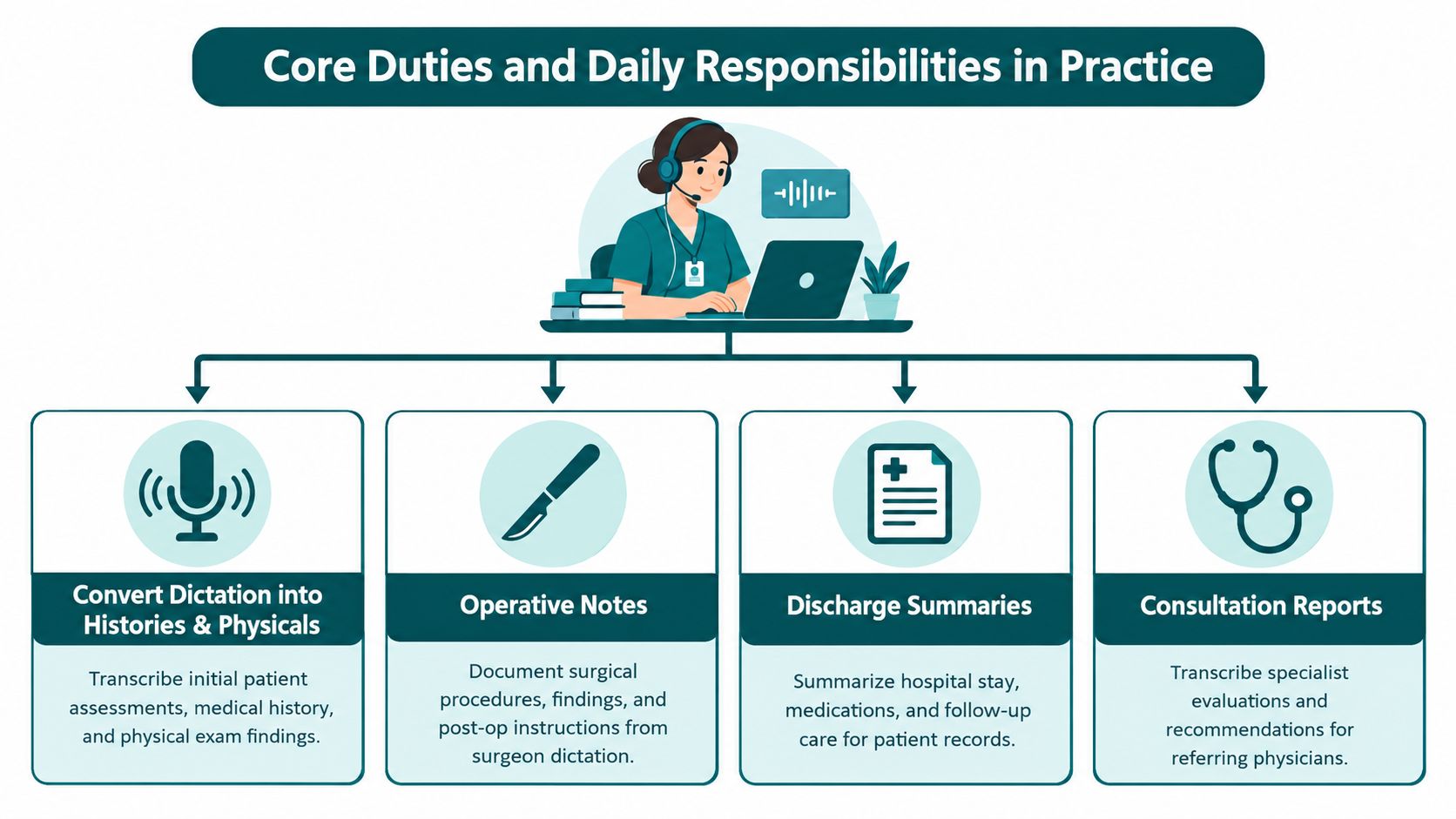
A medical transcriptionist converts dictated encounters into formal reports such as history and physicals, operative notes, discharge summaries, and other patient record documents. The task sounds straightforward until you look at how different those documents are in daily practice.
An operative note has to read differently from a consult. A discharge summary has its own logic. A family medicine follow-up may be brief, while a specialty note may depend on very specific terminology, abbreviations, and section order. The transcriptionist has to identify the document type quickly, then format it so the provider, coder, and downstream staff can all use it without rework.
That document judgment is part of the job, not an extra step.
Editing machine output and catching what software misses
In many practices, the workload has shifted from typing every word from audio to cleaning up speech-recognition drafts. The function is smaller than it used to be, but it still matters when machine output is technically readable and still wrong in ways that create chart risk.
Career guidance from the U.S. Bureau of Labor Statistics describes medical transcriptionists as workers who listen to voice recordings, review and edit reports, and translate medical abbreviations into full form when needed (medical transcriptionists occupational overview). That aligns with what happens in real workflows. The software gets text onto the screen. The human checks whether the note says what the clinician meant.
A common failure point is the fast closing portion of a dictation, where the provider lists medication changes, follow-up timing, and diagnosis details in one run-on sequence. Those are the lines that often need careful review because a small wording error can change the meaning of the note.
Researching terms and holding unclear content for clarification
Good transcriptionists do not fill gaps with guesses. They verify unfamiliar drug names, check anatomy and procedure terms, and flag audio that is too unclear to safely finalize.
That restraint protects the record.
If a provider trails off during an impression, refers to a sound-alike medication, or uses an uncommon specialty term, the transcriptionist may need to pause the document and send a query. Managers sometimes read that as delay. In practice, it is quality control. A note that moves fast but carries unresolved ambiguity often creates more work later for the provider, coding team, or medical records staff.
A few examples come up often:
- Medication names that sound alike. The correct action is verification, not assumption.
- Incomplete assessment statements. If the diagnosis or plan is missing needed detail, the note may need clarification before filing.
- Procedure wording that changes meaning. In surgical and specialty documentation, one incorrect term can alter the clinical record.
Manager's checkpoint: If documentation support staff never ask clarification questions, review a sample of finalized notes. Silence can mean overconfidence, not efficiency.
Protecting record integrity inside the workflow
At the practice level, the transcriptionist often functions like a final document editor before provider sign-off. They are watching for mismatched medications, incomplete sentences, inconsistent dates, missing headings, and language that does not fit the report type. AHIMA has long framed health record documentation quality around accuracy, completeness, consistency, and timeliness, which is the same standard operations teams feel every day when notes move through the chart completion queue (AHIMA practice brief and guidance resources).
That is why the role sits closer to documentation quality than clerical data entry. The transcriptionist is one of the last people to catch record defects before the note becomes part of the legal medical record.
Working within turnaround pressure without losing accuracy
Every practice feels the time pressure differently. Providers want charts closed. Billing staff need documentation that supports claims. Referral teams need finalized notes for outbound records. Patients may be waiting for paperwork tied to the visit. The transcription queue sits in the middle of all of that.
A workable process usually depends on four controls:
- Clear audio intake rules
- Accurate clinical language editing
- Consistent templates and report structure
- Turnaround targets that fit the practice's daily volume
If one of those slips, the problem spreads quickly. The note may still get completed, but it can miss the window when the rest of the office needed it. That is the practical role of a medical transcriptionist today. Smaller than it once was, still useful in the right workflow, and most valuable when documentation quality has to be checked before the chart moves on.
Medical Transcriptionist Versus Medical Scribe and Other Support Roles
Practice managers most often mix roles together. A transcriptionist and a scribe both support documentation, but they do it at different points in the visit and for different operational goals.
A medical transcriptionist usually works from recorded dictation after the encounter or from a speech-recognition draft that needs cleanup. A medical scribe supports documentation during the encounter, often entering information directly into the EHR in real time under provider direction. Those are not interchangeable workflows.
Transcriptionist vs scribe at a glance
| Criteria | Medical Transcriptionist | Medical Scribe |
|---|---|---|
| Timing | Usually after the visit | During the visit |
| Input source | Recorded dictation or speech-recognition draft | Live provider-patient encounter |
| Provider interaction | Limited and usually asynchronous | Ongoing and immediate |
| Main output | Edited, formatted report for chart completion | Real-time visit note in the EHR |
| Best fit | Dictation-heavy providers, specialty reports, post-visit editing | Providers who want same-encounter documentation support |
| Primary strength | Accuracy review, terminology cleanup, report formatting | Speed of note completion while the visit is happening |
| Main limitation | Doesn't reduce in-room documentation burden in real time | Requires workflow coordination during patient encounters |
When transcription is the better fit
Transcription often fits practices where providers prefer dictating after visits, where reports are structured and repeatable, or where specialty notes require careful editing before filing. It can also fit clinics that already have decent speech recognition but still need a human to clean up the output.
For example, a surgeon dictating operative reports at the end of a block may not need a live scribe. That provider may need a documentation specialist who can convert those recordings into organized final reports and flag missing elements.
When scribing solves the actual problem
If your real issue is providers staying late to finish notes, a scribe may be the more direct answer. The chart can be built as the visit happens, reducing after-hours documentation work.
Managers comparing these jobs often find it useful to review a side-by-side explanation of medical assistant vs medical scribe because the confusion usually extends beyond just scribing and transcription. Front-desk support, intake, records management, and chart documentation often overlap in smaller practices.
If the provider says, “I need someone to fix my dictated notes,” that points toward transcription. If the provider says, “I need the note done before I walk out of the room,” that points toward scribing.
Where other support roles fit
Not every documentation problem requires either role alone. A practice may need:
- A records specialist to route documents, upload outside records, and manage chart organization
- A virtual medical assistant to handle intake tasks that affect note completeness
- A documentation support worker who edits reports but doesn't participate in live visits
One restrained option in that broader category is Medical Virtual Assistants, which places remote healthcare support staff for U.S. practices, including documentation-related roles such as scribes and records support. That's most relevant when your need extends beyond transcription into a wider clinic workflow.
The key is matching the role to the bottleneck, not to the label.
Handling PHI Quality Checks and HIPAA Aligned Workflows
A transcription workflow only works if it protects protected health information and produces notes your practice can stand behind. Accuracy without privacy controls is a risk. Privacy controls without quality checks still leave you with a weak chart.
Why vendors and contractors need a BAA
If a transcription service receives, maintains, or transmits protected health information, HIPAA treats that vendor as a business associate. The required Business Associate Agreement must define permitted uses and disclosures, prohibit unauthorized reuse or disclosure, and require the business associate to follow the Privacy Rule when carrying out covered-entity obligations (HIPAA requirements for medical transcription services).
For managers, the practical takeaway is simple. If outside transcription support touches PHI, the relationship can't run on an informal contractor agreement alone. You need the right paper in place and the actual workflow has to match it.
What HIPAA-aligned handling looks like day to day
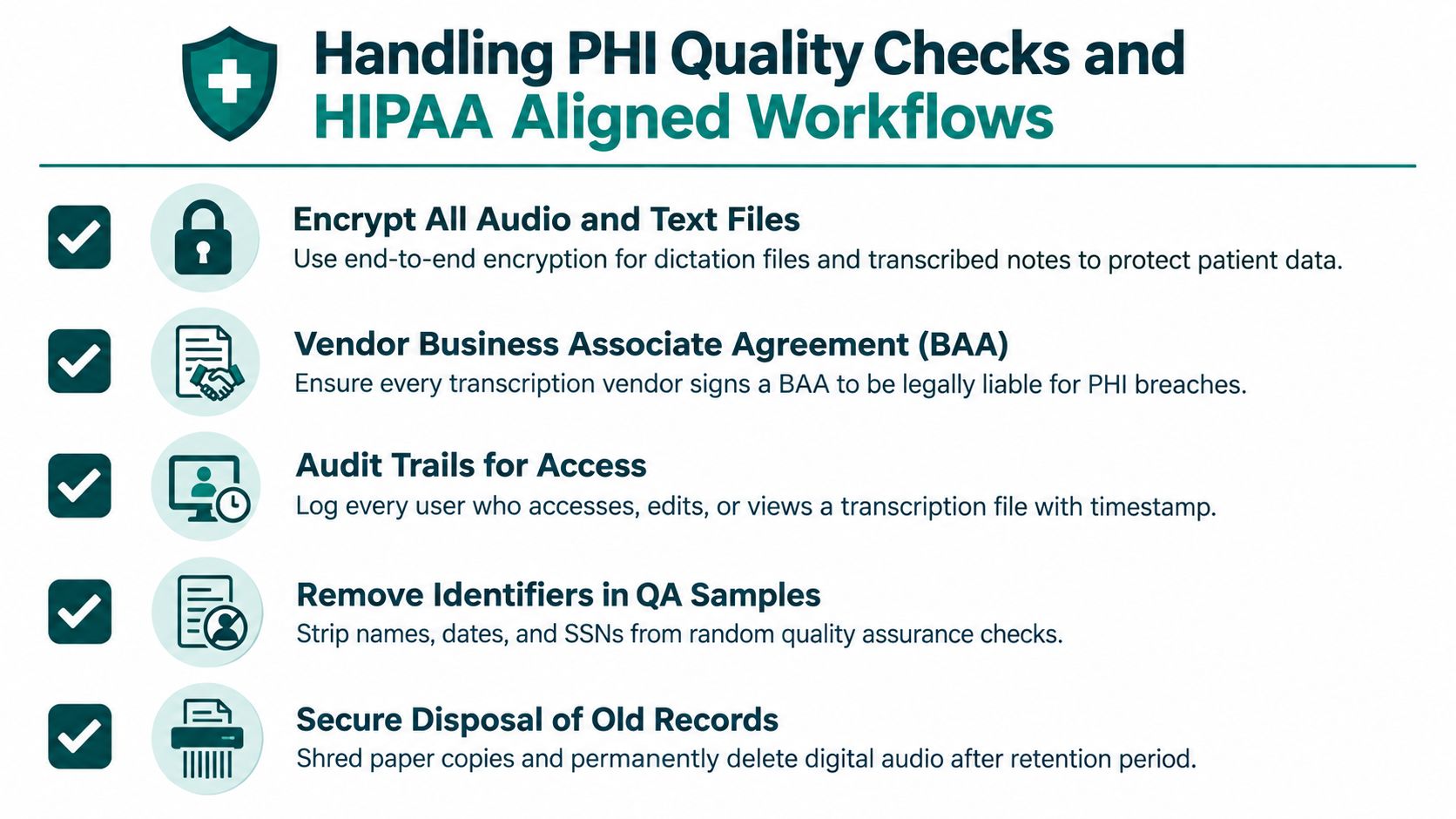
HIPAA sets the legal framework, but practices still have to turn that into ordinary operating steps. That usually includes secure access to dictation files, controlled EHR permissions, confidentiality agreements, and clear rules for where audio and drafts can be stored.
A practice evaluating phone-based dictation or call workflows may also find a technical overview such as this HIPAA compliant phone system guide useful for understanding how communication tools intersect with privacy expectations. The same principle applies to transcription: the platform matters, but so do user permissions and day-to-day behavior.
If you're building a remote support model, this broader guide to HIPAA-compliant virtual assistants for medical practices is a useful companion because the same access, confidentiality, and workflow issues come up across documentation and administrative roles.
A workable quality-check sequence
Privacy is only half the job. The other half is making sure the note is right before it reaches the chart.
A practical review sequence looks like this:
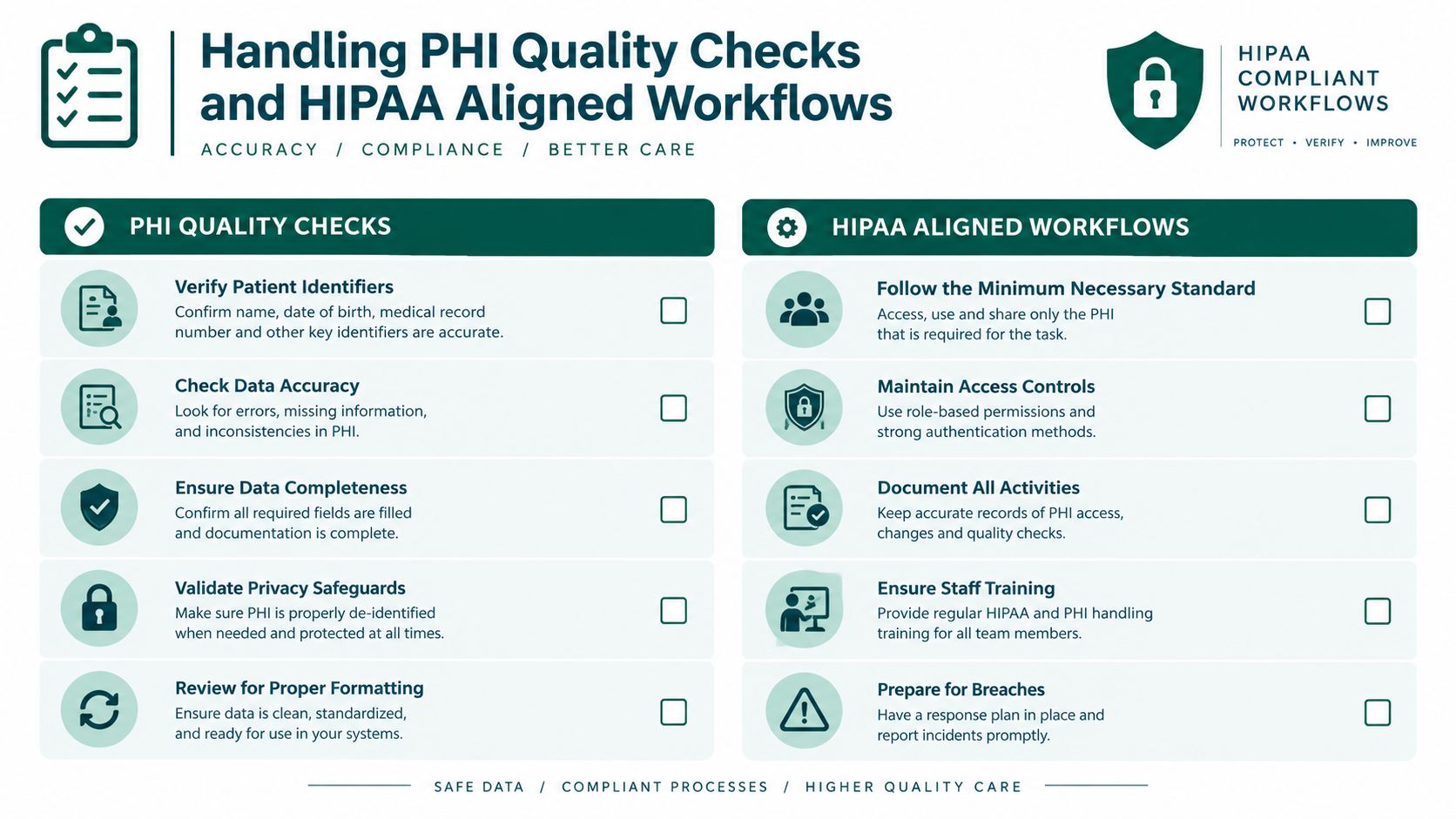
- Terminology verification: Check drug names, diagnoses, anatomy terms, and procedures against the dictated context.
- Inconsistency flagging: Pause when the report contains mismatched medications, incomplete statements, or unclear plan details.
- Template formatting: Align the report to the practice's note style, headings, and specialty conventions.
- Final review: Confirm readability, internal consistency, and correct placement before filing or provider signature.
Good transcription workflows don't treat proofreading as cosmetic. In healthcare, proofreading is part of risk control.
Manager checklist for evaluating the workflow
When you review an internal or outsourced transcription process, ask practical questions rather than broad ones.
- Access control: Who can open audio files, drafts, and final notes?
- Clarification path: How does the worker flag unclear dictation without delaying the queue indefinitely?
- Template discipline: Are note types standardized by specialty and provider preference?
- Software fluency: Can the worker use the EHR, document queue, and file naming conventions without constant help?
- Retention handling: Does the practice have a clear process for storage and disposal that matches its policies and obligations?
Requirements can vary by setting and contract structure, so practices should confirm specific obligations with qualified compliance or legal counsel. But as an operations matter, a defensible transcription process always combines secure handling with a visible review method.
Why the Role Is Shrinking and What That Means for Your Practice
A familiar practice scenario explains the shift. A physician dictates after clinic, the EHR produces a draft through speech recognition, and someone still has to clean up the note before it is safe to sign. The typing portion has gotten smaller. The review portion has not.
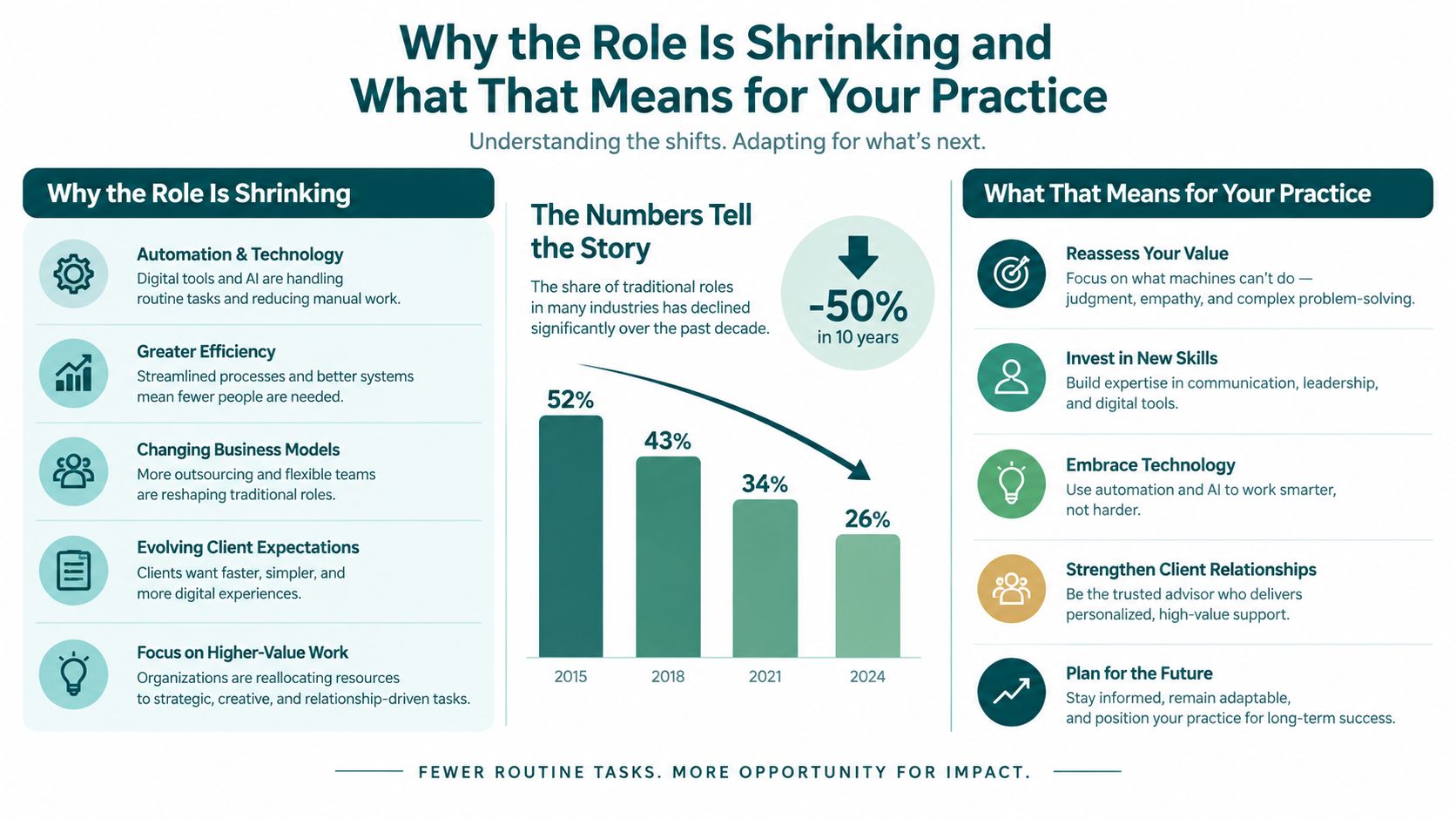
Medical transcription is no longer a broad growth occupation. It now sits in a narrower lane inside the documentation process. The U.S. Bureau of Labor Statistics projects employment of medical transcriptionists to decline 4% from 2025 to 2035, while still averaging about 6,200 openings per year because workers leave the occupation and need to be replaced. The same BLS outlook lists a median annual wage of $40,410 in May 2025 and notes that the occupation typically requires a postsecondary nondegree award (BLS occupational outlook for medical transcriptionists).
The long trend matters more than a single year
The decline becomes clearer when you compare older and newer employment counts. BLS occupational employment data recorded about 52,420 jobs in May 2023 and 41,550 jobs in May 2025 for medical transcriptionists (BLS occupational employment and wage statistics). Earlier BLS reporting, as noted earlier in the article, placed the occupation near 100,000 jobs in 1999. In plain terms, the field has contracted for years, not just during one hiring cycle.
Practice operations changed at the same time. EHR templates reduced the amount of free-form dictation. Speech recognition cut down on straight typing. Providers also split into different documentation habits. Some type directly into the chart, some dictate and edit, and some rely on live support during the visit.
That is why the old image of a transcriptionist, someone who mainly converts audio into text, no longer matches most clinics.
The work survives in a different form
The part of the role that is fading is routine text production. The part that remains is documentation quality control.
A good way to frame it is assembly line versus inspection line. Software now handles more of the assembly. Human reviewers still catch the defects that matter in healthcare, such as the wrong medication, an incomplete assessment, a specialty formatting problem, or a mismatch between the dictated plan and the final note.
In many practices, the remaining transcription work looks like this:
- Editing speech-generated drafts
- Standardizing note structure for the specialty and provider
- Checking for obvious inconsistencies before signature
- Routing reports into the correct EHR location or queue
This distinction matters for staffing. If your provider needs help documenting during the patient visit, a scribe usually fits better. If the provider dictates after the visit and the weak point is draft quality, a transcription-focused role can still solve a real problem.
What this means for practice managers
Do not treat "transcription" as a generic answer to documentation burden. Treat it as one tool in a shrinking but still useful category.
For a small specialty practice with predictable dictation patterns, a transcriptionist or transcription editor may still be a practical choice. For a busy primary care group trying to close notes the same day, the better answer is often scribing, direct EHR entry, or a hybrid setup where technology creates the first draft and a person reviews exceptions.
The management question is simpler than it sounds. Ask where the note breaks down. If the delay happens after dictation because drafts are messy, transcription support may help. If the delay happens during the encounter because the provider cannot document in real time, transcription will not fix the bottleneck.
That is the operational shift. Transcription has moved from a stand-alone production role to a narrower documentation-quality function. Practices that understand that difference usually make better staffing choices, set more realistic turnaround expectations, and avoid paying for the wrong kind of support.
The Takeaway
A medical transcriptionist takes dictated clinical information and turns it into an accurate, formatted, chart-ready record. The value isn't just in producing text. It's in listening carefully, correcting speech-recognition output, standardizing terminology, and catching problems before they become part of the permanent record.
For many practices, the decision is not whether transcription exists. It's whether transcription is the right solution for the specific documentation gap you have. If providers dictate after visits and need careful editing, transcription can still be useful. If providers need notes completed during the encounter, scribing is usually the better fit. If your challenge includes records flow, intake quality, or remote PHI handling, you may need a broader support model.
Start by looking at your actual workflow. Review where notes stall, who fixes errors, how quickly records must be finalized, and whether your privacy controls match the way audio and drafts move through the practice. That gives you a practical basis for deciding whether to staff for transcription, scribing, or a blended documentation process.
If you're evaluating remote documentation support, Medical Virtual Assistants helps U.S. practices hire pre-vetted healthcare staff for roles such as virtual medical scribes, records support, and other HIPAA-aligned administrative functions. It's a useful option when your need goes beyond basic transcription and into day-to-day chart workflow, provider support, and U.S.-hours coverage.