

A referring physician is the licensed doctor who initiates a request for a patient to see another provider or receive a service, and that same clinician is often the person Medicare requires on claims and authorizations. Referral volume rose from 4.83% of physician visits in 1999 to 9.29% in 2009, while current industry reporting says only about half of referral requests are completed, making referral management a workflow issue rather than a vocabulary exercise.
A typical referral starts during an already crowded clinic session. A primary care physician identifies a cardiac concern, sends the patient to a cardiologist, requests relevant testing, and expects the specialist's findings to return to the primary care record. If the referral packet is incomplete, the specialist can't triage it properly. If the wrong clinician is entered on the claim, authorization, or order, staff may spend days correcting an administrative error that began with one unclear provider field.
That's the practical meaning of referring physician. The role connects clinical judgment with scheduling, records transfer, prior authorization, medical necessity documentation, claim submission, and continuity of care. This guide explains how Medicare uses the term, how it differs from ordering and attending providers, what a complete referral packet contains, why referrals fail after they're issued, and how practice managers can build a closed-loop process with the help of appropriately scoped remote administrative staff.
What Is a Referring Physician
The plain-English definition
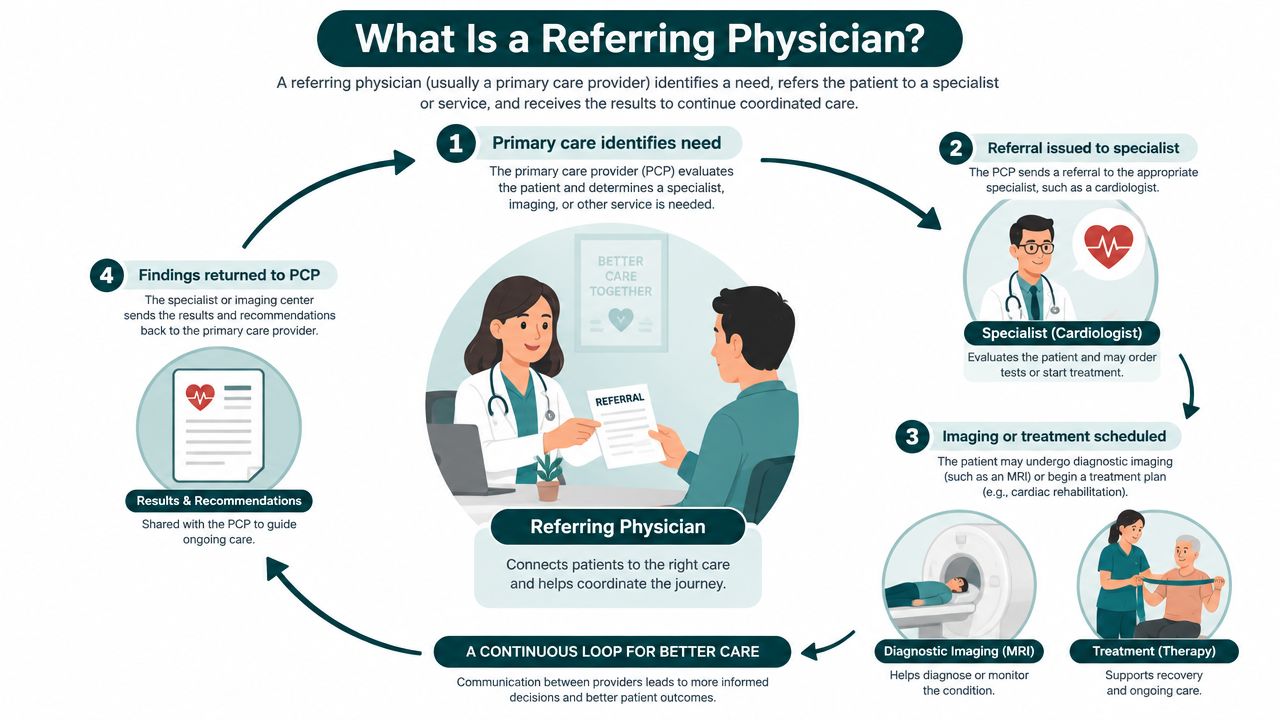
A referring physician is the doctor who initiates a patient's movement to another clinician, facility, diagnostic service, or treatment pathway. The request may be for a specialist consultation, imaging, a procedure, therapy, or another covered service. In everyday conversation, people often describe this physician as “the doctor who sends you to a specialist.”
That description is useful, but incomplete. In a medical practice, the referring physician's identity can become the anchor for billing, prior authorization, clinical documentation, and provider-to-provider communication. The referral is not finished when a staff member faxes an order or sends an electronic message. The receiving practice needs to know who initiated the request, why the patient is being sent, what service is needed, and where the resulting report should go.
Consider a primary care visit for a patient with persistent exertional symptoms. The primary care physician may refer the patient to cardiology, request that the cardiologist evaluate a specific concern, and identify relevant test results in the chart. The cardiologist then reviews the request, schedules the patient, performs the consultation, and sends findings back to the referring practice. The primary care physician may continue managing the patient throughout the process.
That last point distinguishes a referral from a complete transfer of care. A consultation generally implies cooperation between physicians, with the original physician continuing responsibility for the patient during and after the specialist's input. A referral can involve transferring some or all care to another physician with specialized expertise or access to a facility. The historical distinction became clearer during the 1950s, and a review by the Massachusetts Medical Society describes the development of consultation and referral terminology.
Why the identity matters after the referral is sent
The referring physician's name can appear in several connected workflows:
- Authorization: The payer or receiving office may need the clinician who initiated the service request.
- Claims: Medicare-related claims workflows distinguish the referring clinician from the attending, ordering, and rendering providers.
- Records: The specialist needs a clear destination for consultation findings and follow-up recommendations.
- Scheduling: Staff may need to confirm the referral source, specialty, urgency, and requested service before booking.
- Medical necessity: The clinical reason for the referral must support the requested service and be documented in the chart.
The role also isn't limited to a physician who personally hands a patient a referral form. Under the federal definition used in Stark law regulations, a referring physician can make a referral, direct another person or entity to make one, or control referrals made by another person or entity. That broader definition matters to practice owners because the term carries compliance significance beyond ordinary patient communication.
Practical rule: Treat the referring physician as a controlled data field, not a casual description. Confirm the clinician's identity at the point the referral is created, then preserve that information through authorization, scheduling, claims, and follow-up.
The referring physician may be a primary care doctor, but not always. Another physician involved in the patient's care may initiate the request. The same clinician may also be the ordering provider or attending provider, but practices shouldn't assume those roles are interchangeable. The correct answer depends on what the clinician did in that specific episode of care and what the payer or claim form requires.
The Medicare Definition and Compliance Rules
Medicare treats a referral as an operational and compliance event, not just a message passed between offices. It can be a physician's request for an item or service, including a request for consultation, or a physician-established plan of care that requires designated health services. The Medicare Part B guidance on referring providers and referrals explains why the referral can affect downstream billing and documentation.
The federal Stark law definition is broader than the common office meaning. A referring physician is someone who makes a referral, directs another person or entity to make one, or controls referrals made by another person or entity. The regulation also covers a consultation request and orders for tests or procedures connected with that consultation when Medicare Part B payment may be involved. The federal regulation defining referring physician provides the controlling legal reference for this definition.
How the definition developed
The distinction between referral and consultation became clearer in the 1950s, as medical organizations addressed uncertainty about whether the original physician continued to hold responsibility for the patient. The Stark law's referral definition was enacted at the federal level in 1989. CMS later explained that the original self-referral restriction covered only clinical laboratory services, while the ordering and referring requirement took effect on January 1, 1992.
Current Medicare rules still apply the term broadly. It may identify the physician who starts the request, directs someone else to start it, or controls referrals made by another person or organization. An administrative employee may submit the electronic or paper form, but that task does not automatically make the employee the referring physician.
What this means for claims and authorizations
A referring physician field should be treated as controlled claim data. Medicare data guidance uses the term for the clinician who sends a beneficiary to another provider for a service. If that clinician differs from the attending clinician, the referring provider may be required in the applicable claims workflow. The ResDAC explanation of referring, ordering, attending, and rendering provider variables helps staff assign the field based on the clinician's actual role.
Errors usually arise from workflow shortcuts. Staff may enter the specialist because that office submits the claim, select the attending physician even though another doctor initiated the service, or copy an old referral source into a new authorization. The patient can receive appropriate care while the practice still creates claim corrections, authorization delays, or compliance questions. Validate the field against the referral order and clinical note instead of relying on memory or a default EHR value.
Prior authorization requires the same control. For imaging, procedures, or specialty medications subject to payer review, the request should connect the service to the clinician who ordered or referred it. A documented prior authorization workflow for medical practices can separate clinical records, payer requirements, status tracking, and escalation responsibilities. Staff must still review each case because payer rules and state obligations vary.
Use one operating rule: document who requested what, for which patient, and for what clinical reason. Keep the referral order, supporting note, authorization record, and claim information consistent. Medicare and commercial payer requirements may differ, so billing leaders should escalate disputed or unusual cases to qualified compliance counsel.
Referring Physician vs Ordering vs Attending Provider
The terms referring physician, ordering physician, and attending provider describe different actions or relationships. They can refer to the same person in one encounter and three different people in another. The error occurs when staff treat the labels as permanent titles instead of asking what each clinician did in practice.
| Role | What the clinician does | Typical operational question |
|---|---|---|
| Referring physician | Initiates or directs the patient's request for another provider or service | Who sent the patient or service request into the next stage of care? |
| Ordering physician | Requests a specific test, treatment, item, or service | Who ordered this MRI, lab, procedure, or therapy? |
| Attending provider | Oversees or manages the patient's care in the relevant setting | Who is responsible for the patient's active care during this encounter? |
| Rendering provider | Performs the billed service | Who actually delivered the service being reported? |
When the roles overlap
A primary care physician may evaluate a patient, refer the patient to a neurologist, and order an MRI at the same visit. In that case, the PCP may be both the referring and ordering physician. The neurologist later becomes the attending or treating provider for the consultation and may order additional testing. The imaging facility or radiologist then has its own rendering and billing roles.
A different example involves a hospital patient. The attending physician may request a specialist consultation, making the attending and referring physician the same person for that request. The consulting specialist may order a test, making the specialist the ordering physician for the test while the attending remains the clinician directing the overall inpatient care.
This distinction matters because the provider field should follow the action, not the organizational hierarchy. A group practice's name, a facility name, or the physician who happens to be available for follow-up doesn't automatically replace the clinician who initiated the request.
A practical decision framework
Before entering a provider name, ask four questions:
- Who initiated the referral? Identify the doctor who requested another clinician's input or directed the patient to another service.
- Who ordered the specific service? Separate a broad referral from a particular MRI, laboratory test, procedure, or therapy order.
- Who managed the patient in the relevant setting? This helps identify the attending provider when the care episode involves a facility or active treatment relationship.
- Who performed the service? Confirm the rendering provider separately from the referral source.
The answer may be the same physician for multiple questions. That's acceptable when the documentation supports it. The problem is assigning one name to every field just because that clinician is the PCP, the practice owner, or the specialist receiving the patient.
The provider who receives a referral isn't automatically the provider who made it.
The distinction also helps practices outside traditional specialty medicine. A mental health clinician may refer a patient for neurological testing while another clinician orders a specific assessment. A physical therapy practice may receive a physician referral but rely on a separate order for the treatment plan. A dental office may coordinate with a physician for a medical necessity request without making that physician the attending provider for the dental service.
For teams working across specialties, even clinical terminology can require careful documentation. A practice that handles cognitive or neurological referrals may also benefit from keeping reference materials, such as this Australian psychology resource on the post-traumatic amnesia scale, separate from claim-role instructions. Educational clinical resources and billing role definitions serve different purposes, and staff shouldn't use one as a substitute for the other.
Referral Documentation Standards and Workflow
A referral works when the receiving clinician can understand the question and the administrative team can act without repeatedly contacting the referring office. Professional guidance emphasizes that the request should be specific, complete, and recorded in both the referring and consulting records. The American Academy of Family Physicians guidance on consultations, referrals, and transfers of care supports this continuity-of-care standard.
The Canadian guidance from the College of Physicians and Surgeons of Ontario on transitions in care provides a practical example of the information a referral should contain. Although U.S. practices must apply their own payer, state, and organizational requirements, the underlying operational principle is widely useful: the specialist should receive enough context to understand the requested consultation and determine the appropriate next step.
What belongs in the referral packet
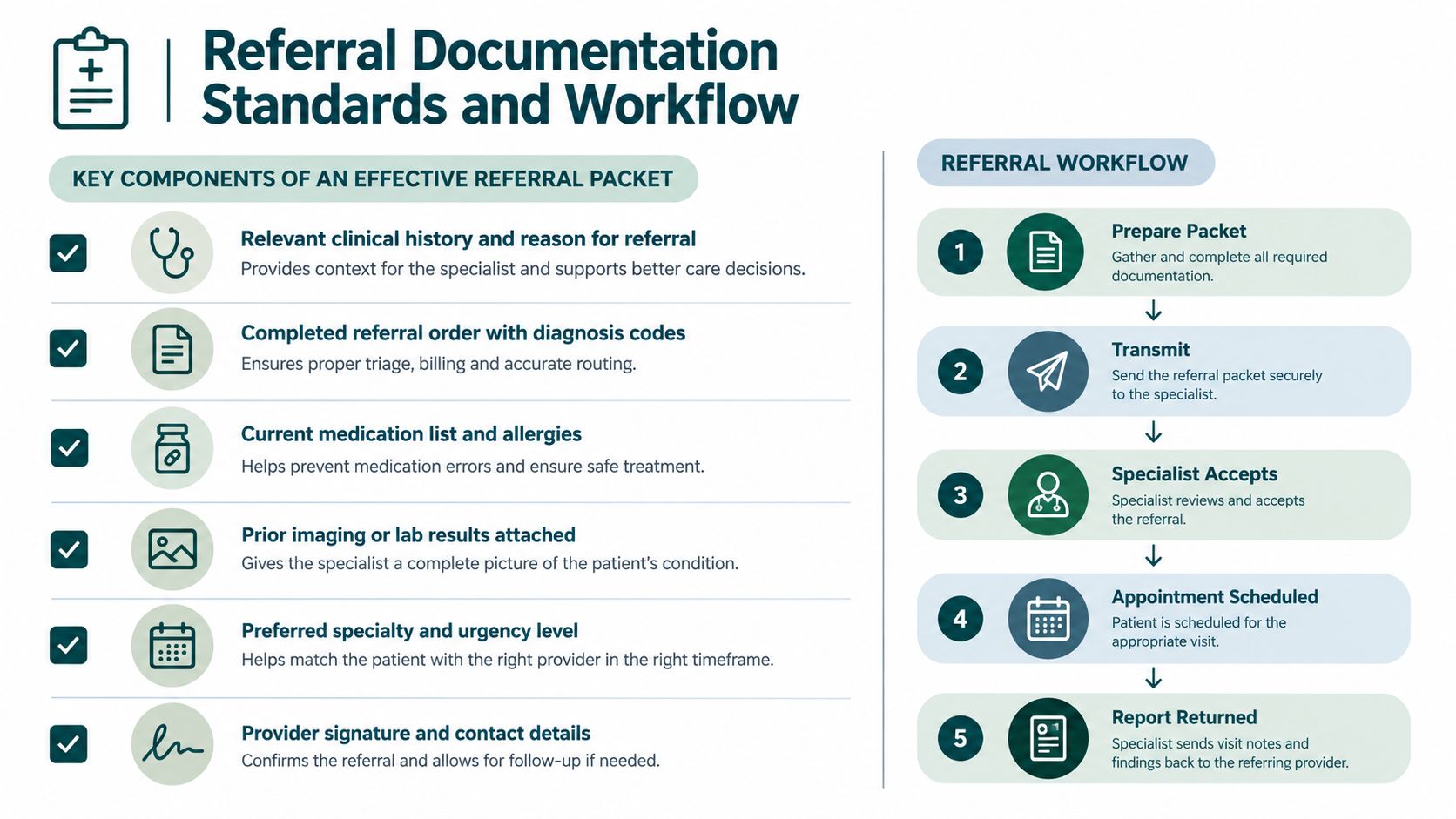
Use a structured checklist rather than relying on free-text notes or a staff member's memory:
- Patient identifiers: Confirm the patient's identifying information and preferred contact details.
- Referring provider details: Include the physician's name, identifiers required by the workflow, contact information, and signature where applicable.
- Clinical question: State what the specialist is being asked to evaluate, treat, or recommend.
- Relevant history: Summarize the symptoms, working diagnosis, significant history, medications, allergies, and prior procedures.
- Urgency: Record whether the request is routine, expedited, or time-sensitive according to the provider's documented judgment.
- Supporting records: Attach relevant imaging, laboratory results, prior consultation notes, and other records needed for triage.
- Requested destination: Identify the specialty, preferred provider or facility when appropriate, and the service being requested.
- Return pathway: State where the consultant's report should be sent and how the referring practice will review follow-up recommendations.
Documentation should also show what happened after transmission. The referral coordinator needs a status such as prepared, sent, received, accepted, scheduled, completed, report received, or follow-up pending. A referral that has been faxed but not confirmed is not a closed referral.
A workable handoff sequence
- Prepare: The physician completes or dictates the clinical request, and staff assemble the supporting records.
- Validate: A coordinator checks patient identity, payer details, provider roles, required signatures, and attachment completeness.
- Transmit: Staff send the packet through the approved channel and record the transmission date and destination.
- Confirm receipt: The receiving office confirms that the packet is readable and sufficient for triage.
- Schedule: Staff document the appointment or the reason scheduling remains pending.
- Monitor: The referring office follows up on uncompleted or rejected referrals according to its internal policy.
- Close the loop: Staff obtain the specialist report, route it to the responsible clinician, and record any follow-up action.
Medical dictation can help clinicians capture the clinical question and supporting context while details are fresh. Practices evaluating medical dictation software for healthcare professionals should still require human review, because transcription tools don't replace provider judgment, chart verification, or referral-role validation.
For practices with recurring authorization work, a prior authorization specialist role can be assigned to gather records, submit requests, check status, and escalate missing information. That role should remain administrative and operate from documented provider decisions. It shouldn't diagnose, alter medical necessity, or independently select a treatment.
The Rise in Referral Volume and Completion Gaps
A referral can create work across several organizations before the patient sees a specialist. Physician practices coordinate with specialty offices, facilities, diagnostic centers, and payer systems, so the referring physician's role becomes an operational trigger for documentation, authorization, scheduling, and follow-up.
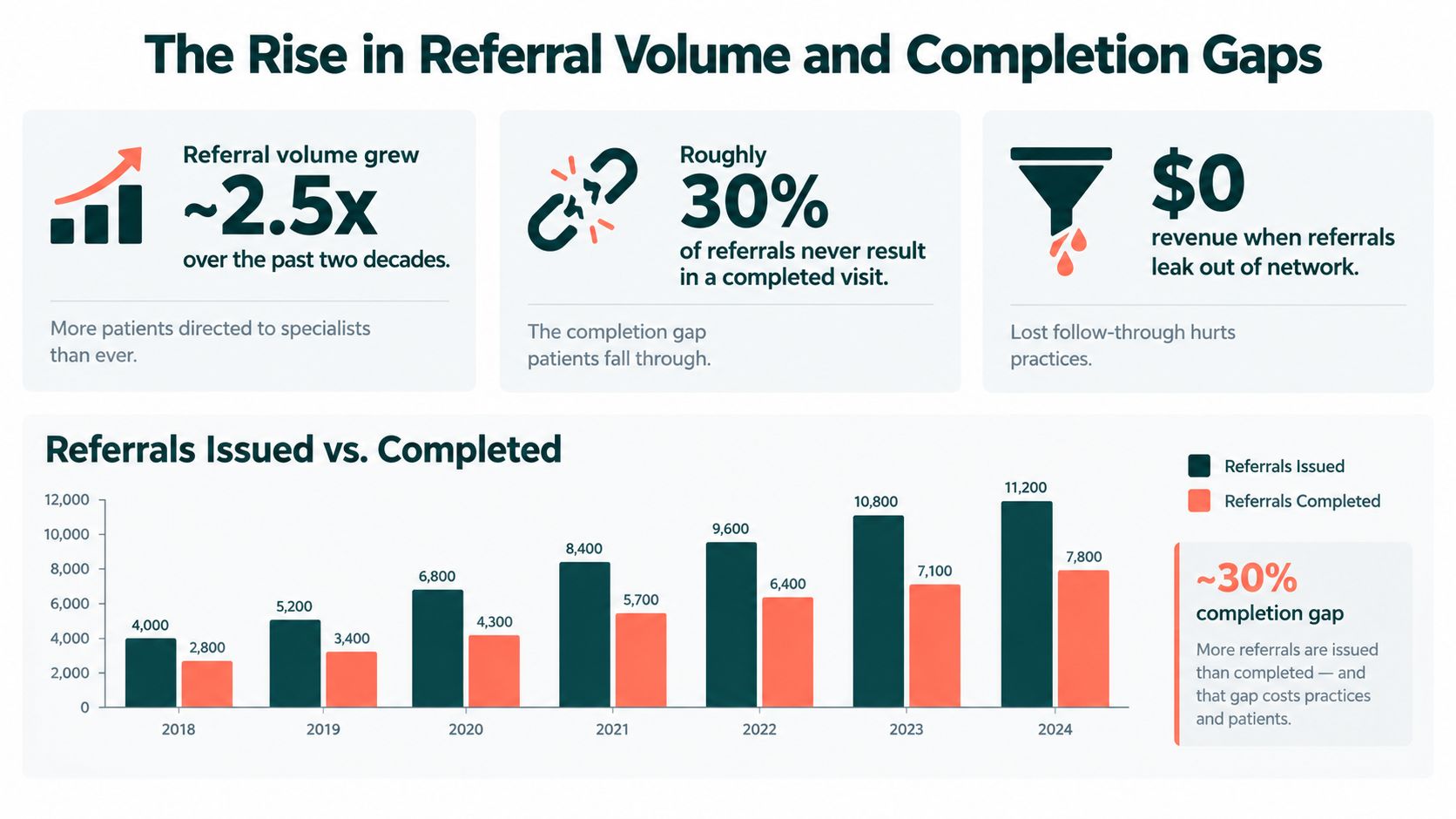
A peer-reviewed analysis of U.S. physician visits found that referrals increased from 4.83% in 1999 to 9.29% in 2009, a 92% increase over ten years. The PubMed Central's study of referral patterns in U.S. physician visits also distinguishes a referral from a consultation by whether the original physician continues caring for the patient.
The larger management problem appears after the request leaves the originating practice. Specialists receive more than 100 million referral requests annually, yet only about half are completed. That completion gap turns the referring physician's designation into more than a clinical label. It affects whether staff can identify responsibility, verify authorization, reconcile billing details, and confirm that the patient received the intended care.
Why issued referrals disappear
A referral can fail at several points:
- The specialist never receives a usable packet. Missing records or an unclear clinical question may prevent triage.
- The payer requires authorization. Scheduling may pause while staff gather documentation or await a decision.
- The patient can't reach the receiving office. The referral is marked sent, but no one confirms an appointment.
- The specialist is out of network. Staff may identify the mismatch only after the patient attempts to schedule.
- The report never returns. The consultation occurs, but the referring practice does not receive or route the findings.
- The EHR status remains stale. A referral stays open without showing whether the patient was seen or whether follow-up is required.
Digital tools have not removed these failure points. MGMA reported in 2025 that 76% of medical groups managed referrals in their EHR or referral software, while 21% still relied on manual tracking. Technology may be available while the actual process still depends on spreadsheets, inbox searches, scanned documents, and staff memory. Managers should compare the system's stated status with evidence of receipt, scheduling, completion, and report routing.
A referral status of “sent” describes an administrative action. It doesn't prove that care was completed.
What the completion gap means for managers
An incomplete referral can leave the patient without specialty input and the primary care team without information needed for a treatment decision. Staff may repeat calls, billing teams may face uncertainty, and the practice may struggle to reconcile the referral source, order, authorization, and completed service.
Manual follow-up by every staff member creates inconsistent work. A more reliable design assigns responsibility by stage, uses defined statuses, sets escalation rules, and records report receipt before closing the referral. The referring physician field should support that process by identifying who initiated the request and who remains accountable for the clinical follow-up.
Improving Referral Management in Your Practice
Start with a single referral definition that every department uses. Train staff to identify the physician who initiated the request, the provider who ordered the specific service, the clinician managing the relevant encounter, and the provider who rendered the service. Put those fields into the referral template instead of leaving them to free-text notes.
Then build a closed-loop queue. The queue should show the patient, specialty, requested service, referring physician, authorization status, receiving office, appointment status, report status, and next action. Assign ownership to a person or team, not to a generic department. A referral without an owner is likely to remain “in progress” until a patient calls.
A practical implementation sequence
First, audit the current path. Select representative referrals from creation through report receipt. Look for missing clinical questions, unclear urgency, duplicate entry, rejected authorizations, and reports that arrive without being routed to a clinician.
Second, standardize the packet. Use required fields for the reason for referral, relevant history, medications, allergies, supporting tests, urgency, provider identifiers, and return destination. Make the EHR prevent transmission when essential fields are blank, where the system supports that control.
Third, define service-level expectations internally. Decide when staff confirm receipt, when they contact a patient, when they escalate an authorization, and when they notify the physician that a referral remains unresolved. These are operational policies, not universal legal deadlines, so document them according to your specialty, payer mix, staffing model, and compliance advice.
Fourth, separate administrative work from clinical judgment. A remote coordinator can request records, verify demographics, contact offices, monitor queues, and route reports. A provider must make clinical decisions, interpret findings, change treatment, and determine urgency.
Where remote support fits
Remote healthcare staff can support referral coordination when the practice supplies clear access controls, written procedures, training, and supervision. A virtual medical receptionist may handle calls and scheduling. A patient coordinator may collect forms and records. An insurance verification specialist may confirm benefits before an appointment. A prior authorization specialist may submit and track payer requests. A medical administrative assistant may maintain the referral queue and route returned reports.
For practices considering a virtual medical receptionist or another remote role, evaluate the person against the actual workflow. Look for reliable documentation, comfort with the EHR and phone system, familiarity with insurance terminology, appropriate escalation habits, and the ability to work the practice's U.S. clinic hours. Remote staff shouldn't independently diagnose, interpret clinical results, make medical decisions, or perform licensed work.
Medical Virtual Assistants is one staffing option for U.S. practices that need pre-vetted LATAM healthcare talent for referral coordination and related administrative work. Its model includes U.S.-hours coverage, prior U.S. healthcare experience for shortlisted assistants, role-specific skills testing, HIPAA training, confidentiality agreements, and a Business Associate Agreement with each client. Practices should still define the role carefully and verify that the arrangement fits their own privacy, security, payer, and supervision requirements.
The Takeaway
The practical referring physician meaning is broader than “the doctor who sends a patient to a specialist.” It identifies the clinician who initiates or directs a request and may connect that request to claims, authorization, medical necessity, and continuity-of-care obligations. That clinician may or may not be the ordering, attending, or rendering provider.
To improve results, standardize provider-role fields, require complete referral packets, assign ownership after transmission, track every referral through appointment and report receipt, and keep administrative responsibilities separate from clinical decisions. A clear workflow protects the patient handoff and reduces avoidable billing rework.
Medical Virtual Assistants can help your practice staff referral coordination, scheduling, prior authorization, records, and other administrative workflows with pre-vetted LATAM healthcare professionals working U.S. clinic hours. Review the available roles and discuss the coverage your referral process needs with Medical Virtual Assistants.